Robohub.org
iCub philosophy, history and recent results: Lecture by Giorgio Metta
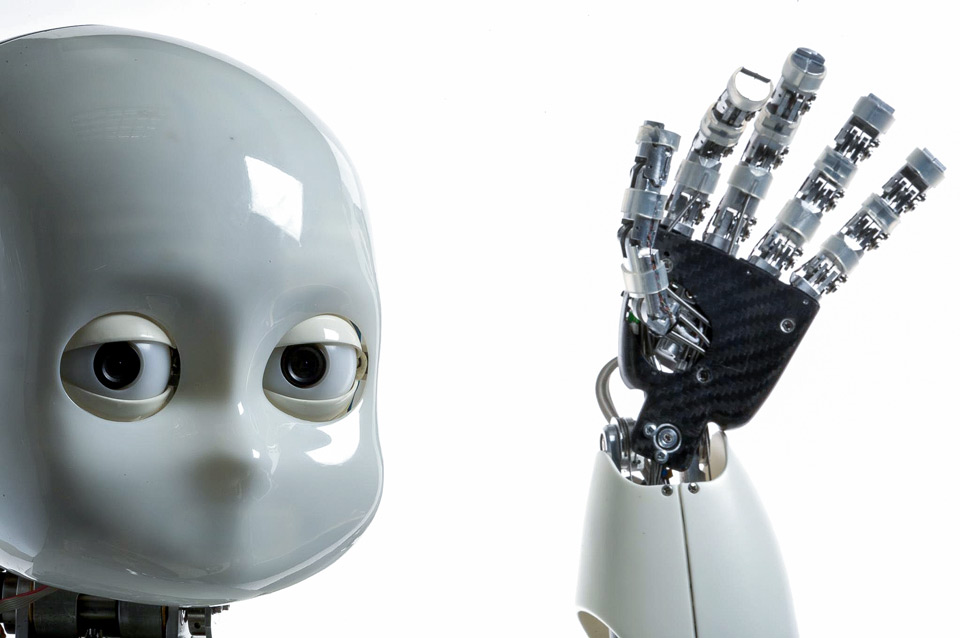
In this lecture, Giorgio Metta describes the history and philosophy behind the iCub project, and presents some recent results.
The iCub project was started 10 years ago within the field of Human Robotics, focused mostly on building models of cognitive behaviours. The goals of the project include understanding how the human brain resolves certain problems just to use this knowledge within robotics and build models that can allow robots to solve autonomously the same problems, hence become highly intelligent systems.
20 years ago neurophysiologists discovered special types of neurons called visuomotor neurons. This discovery triggered a shift in the way robots were programmed to learn and perceive as now, mirroring the function of these neurons, the goal was not only for the robot to perceive the surroundings but also to act upon the new information acquired, to carry out a task, solve a problem, imitate what a person would do when he or she perceives and processes external information.
To translate these goals into practice, first experiments where focused on registering human grasping actions via data gloves and trackers and then these registered actions, translated into images, were used to build a classifier which would aid the robot to predict better what action to carry out when perceiving certain information. Furthermore, neuro studies showing that it is not that important to recognise the object to be grasped it but it’s enough to recognise it’s shape, helped Metta and his team build models that prepared the robot to recognise the shape of an object just before executing an action like grasping it. This made possible for the robot to execute more complex behaviours such as recognise not only the objects to be grasped or pushed, but also to recognise tools which may help the robot to do something with the object in question. In one of the experiments lead by Metta, this was translated into an iCub grasping a tool to bring closer an object placed too far away from the robot, in order for the iCub to grasp it.
Watch Metta’s presentation to find out more about his amazing experiments using the iCub robot and what he’s latest research efforts are all about. (You can download the full .pptx presentation here.)
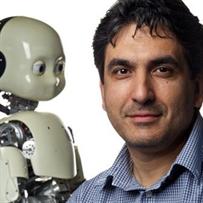 Giorgio Metta is the Director of the well-known iCub Facility. He is currently on leave of absence from the University of Genoa (Italy) where he used to teach courses on Anthropomorphic Robotics and Intelligent Systems for the Bioengineering curricula. He holds a MSc cum laude (1994), and PhD (2000) in Electronic Engineering from the University of Genoa.
From 2001 to 2002 he was postdoctoral associate at the MIT AI-Lab . He has been assistant Professor at the University of Genoa since 2005 and he works at the Italian Institute of Technology where the iCub Facility is to be found since 2006. He is Professor of Cognitive Robotics at the University of Plymouth (UK) since 2012.
Giorgio Metta’s research activities are in the fields of biologically motivated and humanoid robotics and, in particular, in developing humanoid robots that can adapt and learn from experience. His research efforts have stemmed from collaborations with leading European and international scientists from different disciplines like neuroscience, psychology, computer science and robotics.
Metta has authored approximately 250 publications and has been working as principal investigator and research scientist in about a dozen international as well as national funded projects.
Metta G. IJARS Video Series: iCub Philosophy, Some History & Recent Results [online video]. International Journal of Advanced Robotic Systems, 2014, 11:V5. DOI: 10.5772/60065
tags: EU, iCub, Italy, research
AUAI is supported by: