
Robohub.org
Robots in society, business and culture: October 2026
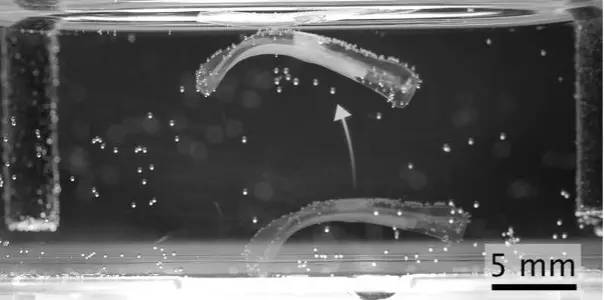 The biohybrid robot pushes off from the ground as soon as it is stimulated by an electrical impulse. Credit: Nature Communications (2026).
By Emmet Cole
In our monthly series, we showcase a selection of robotics stories from society, business, research and culture, as we track the field’s ongoing journey from specialized industrial machines to an increasingly visible social phenomenon.
People perceive robots approaching from behind as faster
A Toyohashi University of Technology team tested whether a robot’s approach direction changes how fast it seems to move. Across five experiments using a real mobile robot and virtual reality, 92% of participants showed the same bias: at the same physical speed, a robot approaching from behind seemed faster than one approaching from the front.
In the first experiment, participants learned two reference speeds—0.5 and 1.0 metres per second—then judged a robot approaching at speeds between those values. Follow-up experiments suggested the effect wasn’t explained by the robot’s appearance or motor noise. The researchers link it instead to visual factors involved in turning to look at something coming from behind.
The researchers say further work is needed to see how the bias affects comfort, perceived safety, and people’s actual avoidance behaviour.
Monocular drone racer
Engineers at Delft University of Technology have developed an AI system that enables a racing drone to navigate demanding courses at extreme speed using only a single camera, while outperforming human drone champions in the process. The team’s MonoRace autonomous drone system generalizes to a competition environment without any external motion tracking system, using only a monocular rolling-shutter camera and an inertial measurement unit.
Researchers at ETH Zurich designed lab-grown mouse muscle tissue and its soft hydrogel scaffold together, using computer simulations to find arrangements that turn muscle contractions into larger movements. The resulting bioactuators, each about 1.5 centimetres long, powered small prototypes that could jump, swim, walk and grasp. The team reports up to 11 times more range of motion than earlier systems using a comparable amount of muscle tissue.
The biohybrid robot pushes off from the ground as soon as it is stimulated by an electrical impulse. Credit: Nature Communications (2026).
Meanwhile, another team at ETH Zurich demonstrated a quadruped robot that can autonomously solve a giant Rubik’s Cube using its feet. One foot pins the cube while the other turns its layers; the robot also flips and repositions the cube while keeping its balance. In tests, it completed three autonomous solves of a 4.6-kilogram cube, each taking about 30 steps and eight to nine minutes.
The ability to coordinate perception, balance and repeated precise contact to manipulate a free-standing object could improve design of robots that need to handle objects without hands or in situations where their legs are their only available tools.
RobCo hits a billion
German industrial robot startup RobCo hit a USD1 billion valuation in October following the sale of USD40 million of shares. The company plans to launch Alfie, a two-armed, self-learning robot designed to handle industrial tasks in March 2027.
Meanwhile, GXO Logistics, Inc. and Agility Robotics, announced an expansion of their partnership to advance humanoid automation in logistics with deployments of Agility’s Digit humanoid robot to GXO sites in North Carolina and Tennessee. (We spoke with Damion Shelton recently as part of our commercialization series)
TUM RoboGym, an advanced training and research center for embodied artificial intelligence, opened in October. The result of a collaboration between the Munich Institute of Robotics and Machine Intelligence (TUM MIRMI) at the Technical University of Munich (TUM) and NEURA Robotics, TUM RoboGym will initially see around 100 humanoid and service robots learn specific skills and processes in 48 training cells.
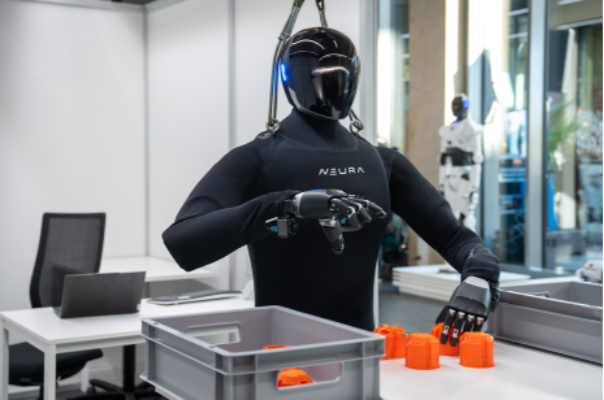 Credit: Andreas Heddergott / TUM
Elsewhere, Teradyne Robotics –the company behind Universal Robots and Mobile Industrial Robots- announced a partnership with physical AI company Sereact, to accelerate industrial AI solutions in retail, logistics and manufacturing. Sereact’s physical AI platform Cortex is trained in NVIDIA Isaac Sim using NVIDIA Cosmos open world models. It is then post-trained with reinforcement learning and benchmarked on Teradyne Robotics hardware before deployment.
Kwon Byungjun’s I Embrace You
At Seoul’s Buk-Seoul Museum of Art, the artist Kwon Byungjun uses wobbling humanoid robots and sound to explore how we respond to people who feel like strangers. The exhibition draws on the arrival of Yemeni refugees on Jeju Island in 2017 as imperfect robots struggle to move, yet keep reaching out, opening their arms to offer visitors a hug. Their performances combine movement and sounds from lullabies, nature and AI, asking how different beings might find ways to live alongside each other.
The exhibition runs until 16 May 2027.

AUAI is supported by: