Robohub.org
€ 7M EuRoC competition opens call to ignite EU manufacturing industry
 The call for Europe’s newest robotics competition opened yesterday when a consortium of leading robotics and research institutions from across the EU announced the launch of the European Robotics Challenge (EuRoC). The competition will consist of a series of three industry-relevant challenges created to help keep Europe’s manufacturing industry globally competitive and at the leading edge of innovation. € 7M in grants, funded through the European Commission, will be awarded throughout the duration of the four-year program.
[ youtube.com/watch?v=iJDjJ02lYjw ]
With the goal of involving whole supply chains and fostering collaboration among application experts, technology suppliers, system integrators, service providers and potential end users, the three separate challenges ultimately aim to spur innovation in areas that are important to the future of the EU manufacturing industry. Says EuRoC Project Coordinator Bruno Siciliano: “For the first time in public-funded research, teams of challengers and end-users will work hand in hand on common platforms and compete to achieve technology transfer where performance success is keenly benchmarked.”
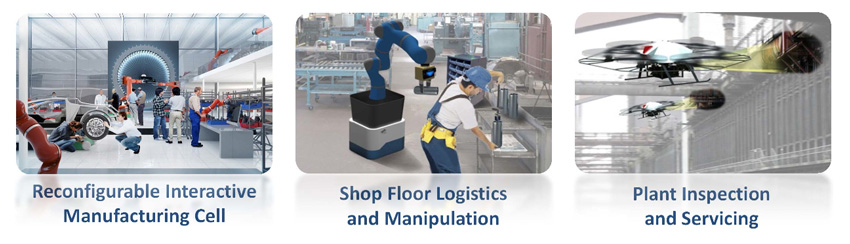
- Challenge 1: Reconfigurable Interactive Manufacturing Cell
- e.g. multi-role multi-arm cooperative robot systems, perception and cognitive skills, and safe and effective human-robot collaboration
- Challenge 2: Shop Floor Logistics and Manipulation
- e.g. navigation on dynamic shop floor, coping with uncertainties by means of 3D vision and compliant manipulation and grasping, and true mobile manipulation to improve cycle time
- Challenge 3: Plant Servicing and Inspection
- e.g. highly reliable vision-only navigation, dynamic control of MAVs in challenging industrial environments, and high-level task allocation by mission expert
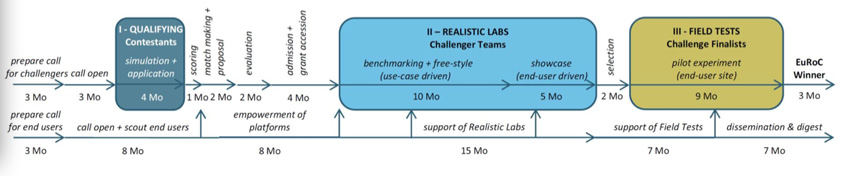
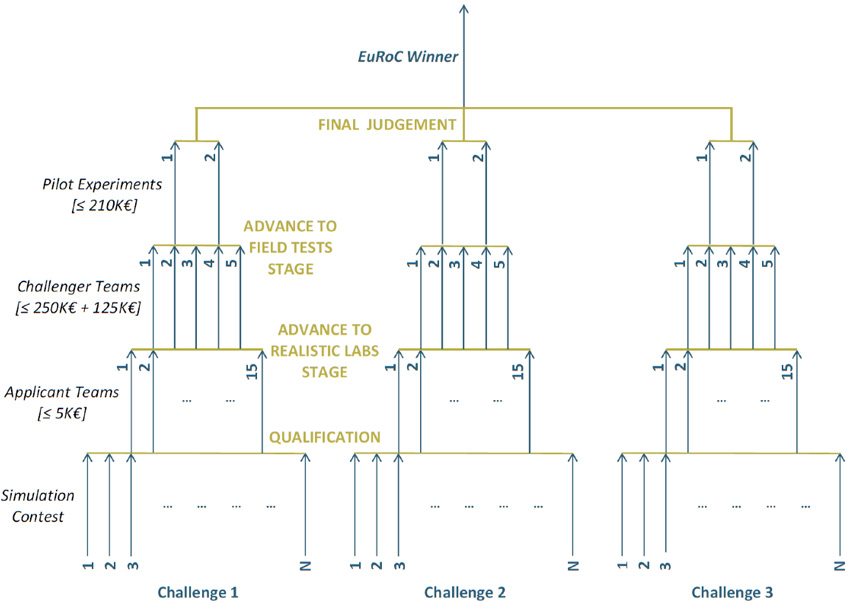
The three challenges will take place in successive stages that will increase in complexity from simulation to real work environments. In the first stage, up to 45 applicants will compete in a simulation challenge, allowing new players to compete with established robotics teams. The most promising applicants will be paired with industrial end-users at a match-making event, and 15 of these “challenger teams” (5 per challenge) will be admitted to the second stage of the competition. The second stage will focus on realistic lab testing, and qualifying teams will each receive up to € 375K to further develop their solutions. Only six teams (2 per challenge) will move to the final stage, where they will each receive an additional € 210K to compete at a public event where they will demonstrate their solutions in practical field tests. A single EuRoC winner will be chosen from this group.
Four distinct calls have been announced, each addressing a different target group:
- Call for Challengers (Deadline: 2014-06-30)
- Call for End-Users (Deadline: 2014-11-15)
- Call for Technology Developers (Deadline: 2014-11-15)
- Call for System-Integrators (Deadline: 2014-11-15)
More information about the challenges and how to apply can be found on the EuRoC website and at: info (at) robotics-challenges.eu.
tags: Bruno Siciliano, c-Events, Competition-Challenge, cx-Research-Innovation, Industrial Automation