Robohub.org
 

Google to release monthly driving reports

by
09 June 2015


share this:
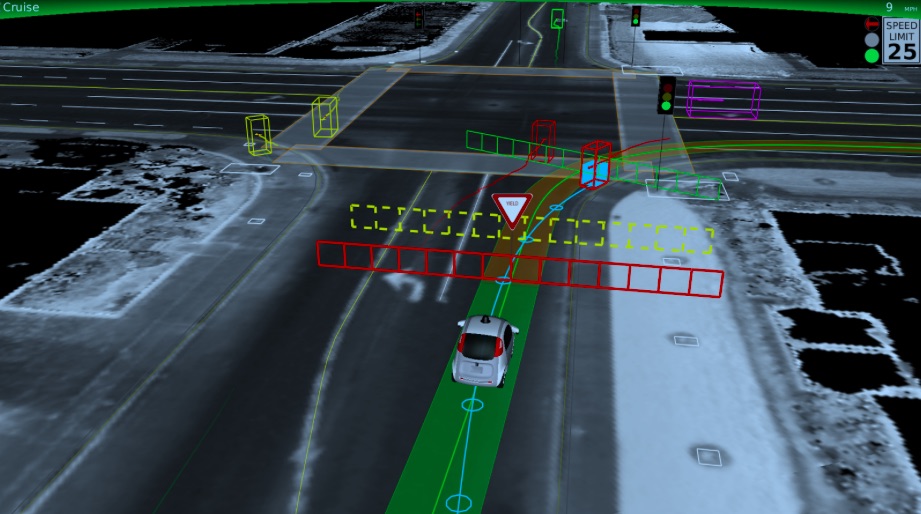
S​elf-driving car keeping track of multiple moving objects at once, in this instance two cyclists, depicted as red rectangles. Source: Google.

S​elf-driving car keeping track of multiple moving objects at once, in this instance two cyclists, depicted as red rectangles. Source: Google.

Google has started publicly disclosing details of accidents involving its self-driving cars.

In the past weeks reports of incidents involving the company’s autonomous vehicles looked to be multiplying. Under Californian law, details of car accidents remain confidential. But, in its May Monthly Report, Google claims that its vehicles were not responsible for any of the 12 accidents they’ve been involved in since testing began in 2009.

Google released the first of what it says will be monthly reports last week. It summarises accident data and highlights from testing, and includes a synopsis of all 12 accidents. Most involved the autonomous vehicles being either rear-ended, sideswiped, or hit after another vehicle failed to follow basic traffic safety laws, such as stopping at a stop sign, according to Google.

The report also gives illustrations and examples of how the driverless cars, which average 10,000 autonomous miles per week on public streets, are able to adapt to traffic situations.

The reports are available to download on a dedicated website: www.google.com/selfdrivingcar/reports


tags: , ,


Adriana Hamacher Associate Editor at Robohub and the UK's Knowledge Transfer Network and a contributor to Economist Insights

            AUAI is supported by:


Subscribe to Robohub newsletter on substack


Related posts :

A ‘5-in-1’ seed-sized surgical robot

Mini robot can move, cut tissue, release drugs, grip and store samples, and generate heat wirelessly

AI agents create virtual playgrounds to help robots get crucial training data

  07 Aug 2026
“SceneSmith” system uses collaborative AI agents to create realistic 3D environments of places like kitchens, hotels, and living rooms, where robots can simulate everyday chores.

Robots in society, business and culture: July 2026

A round up of robotics stories in a new monthly series from IEEE RAS.

Simulated zebrafish and a vision-equipped robotic fish reveal how the body shapes brain circuits

Researchers look to the fish brain to create a robotic zebrafish that can autonomously swim upstream.

Researchers develop modular nanorobot

  31 Jul 2026
A team at the University of Basel has developed a versatile nanorobot with propulsion and payload modules.

Surviving the paper deluge: a one-year study in learning from demonstration

With the explosion of robotics research, staying current in fields like Learning from Demonstration is a monumental challenge.

Soft robotic heart offers new way to study disease and test life-saving devices

Researchers have developed a soft robotic model of the human heart that can mimic disease and provide a realistic environment for testing the next generation of cardiac devices.

A mini robot to simplify dental treatment

  24 Jul 2026
Researchers have developed a miniature dental robot that could one day automatically prepare teeth for crowns.


AUAI is supported by:


Subscribe to Robohub newsletter on substack


©2026.05 - Association for the Understanding of Artificial Intelligence