
Robohub.org
The state of telepresence
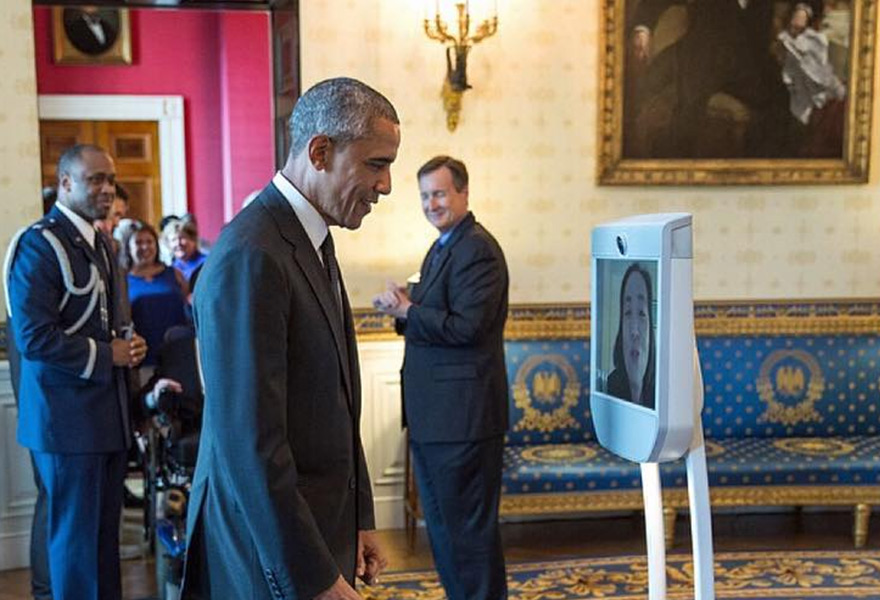
photo by Pete Souza, Chief Official White House Photographer via Instagram
Telepresence robots have been around since the early 2000s, with a research project called PEBBLES out of Ryerson University in Toronto. When I first started covering this area a little over three years ago, there were only a handful of products available. Since then, the market has exploded, with a slew of robots ranging from the table-top Kubi and the sleek Double to the highly advanced Ava 500. They’ve also been on the move, heading out of the office, attending conferences, and touring museums. In this series I’ll be updating you on telepresence as is stands today, the various market categories, and where the field is headed.
Roughly broken down by pricing levels, we’ll start with enterprise or business class telepresence, where you’ll find high end robots like iRobot’s Ava 500 or Suitable Technologies Beam Pro. These cost several thousand dollars to start and usually have a monthly fee.
Telemedicine robots deserve a category on their own; with requirements for HIPAA and FDA clearance, these aren’t cheap and are not something something the average person or business typically needs.
Then there are the home or personal robots, like the Double, Padbot, and Beam+. These typically have fewer options, but are certainly more affordable. Often, as in the case of the Double, you’ll need a tablet to act as the brain of the device.
Likewise is the toy category, which typically uses a smartphone as a brain. The Romo or Wheelphone are better suited to roam around on a table rather than down a hallway. And if you’re looking for even economy, Kubi and the TableTop TeleMe offer telepresence without mobility. They’ve taken away the wheels, but still offer an interactive experience that allows the user to pan and tilt their view around the room.
Then we have the unique and unusual robots that push the boundaries of telepresence, such as the Telenoid or Orihime, or that cater to niche markets, such as those specifically adapted for use by the physically disabled.
And finally, there are the service robots such as BUDDY, PAL, and OSHBot, which while not built specifically for telepresence, still offer this as a feature. For example, the OSHBot has a telepresence feature that allows a customer in need of help to contact an associate who may be in another store and remote him or her onto the OSHBot screen.
Over the course of the series, I’ll be tallying about 40 different kinds of telepresence robots, a few of which have already gone away or never made it out of the research lab. Keep an eye out over the coming weeks!
* Note: Before I delve too deeply, we have to deal with a very controversial topic: are telepresence robots really robots? I will be hijacking the definition of robot from Wikipedia, which states that a robot is an electromechanical device that can be autonomous or semi-autonomous. A device like the Double uses an algorithm that allows it to balance itself on two wheels while in operation, while iRobot’s AVA navigates autonomously. Many telepresence devices have some sort of obstacle avoidance, making them at least semi-autonomous. I am arguing that one or more sensors providing feedback, such as obstacle avoidance, is sufficient for referring to the device as a robot.
tags: household, telepresence

AUAI is supported by:









