
Robohub.org
Automating window washing
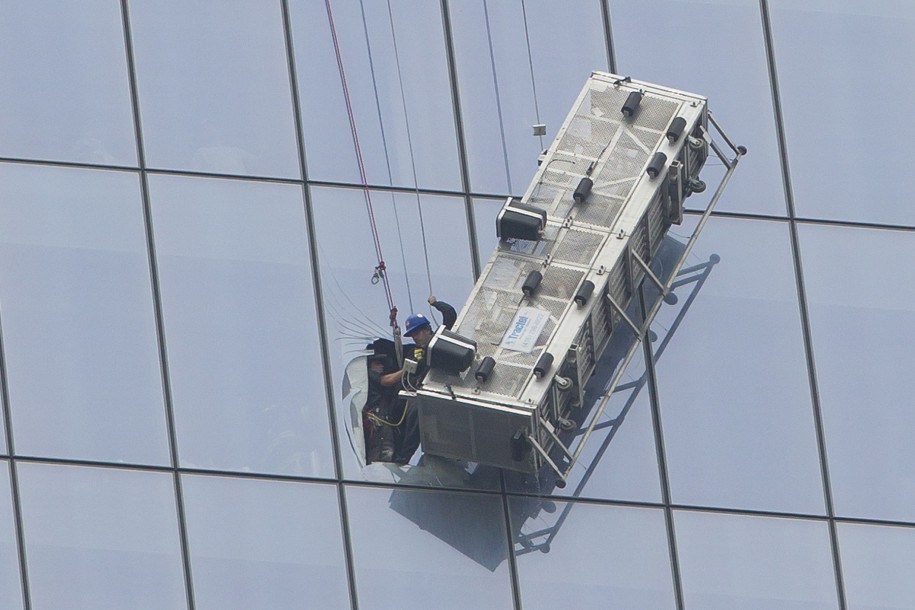
Three and half years ago, I stood on the corner of West Street and gasped as two window washers clung to life at the end of a rope a thousand feet above. By the time rescue crews reached the men on the 69th floor of 1 World Trade they were close to passing out from dangling upside down. Everyday risk-taking men and women hook their bodies to metal scaffolds and ascend to deadly heights for $25 an hour. Ramone Castro, a window washer of three decades, said it best, “It is a very dangerous job. It is not easy going up there. You can replace a machine but not a life.” Castro’s statement sounds like an urgent call to action for robots.
One of the promises of automation is replacing tasks that are too dangerous for humans. Switzerland-based Serbot believes that high-rise facade cleaning is one of those jobs ripe for disruption. In 2010, it was first reported that Serbot contracted with the city of Dubai to automatically clean its massive glass skyline. Utilizing their GEKKO machine, the Swiss company has demonstrated a performance of over 400 square meters an hour, 15 times faster than a professional washer. GEKKO leverages a unique suction technology that enables the massive Roomba-like device to be suspended from the roof and adhere to the curtain wall regardless of weather conditions or architectural features. Serbot offers both semi and full autonomous versions of its GEKKOs, which include options for retrofitting existing roof systems. It is unclear how many robots are actually deployed in the marketplace, however Serbot recently announced the cleaning of the architecturally challenging FESTO’s Automation Center in Germany (shown below).

According to the press release, “The entire building envelope is cleaned automatically: by a robot, called GEKKO Facade, which sucks on the glass facade. This eliminates important disadvantages of conventional cleaning: no disturbance of the user by cleaning personnel, no risky working in a gondola at high altitude, no additional protection during the cleaning phase, etc.” Serbot further states its autonomous system was able to work at amazing speeds cleaning the 8,600 square meter structure within a couple of days via its intelligent platform that plans a route across the entire glass facade.

Parallel to the global trend of urbanization, skyscraper construction is at an all time high. Demand for glass facade materials and maintenance services is close to surpassing $200 billion worldwide. As New York City is in the center of the construction boom, Israeli-startup, Skyline Robotics, recently joined Iconic Labs NYC (ICONYC). This week, I had the opportunity to ask Skyline founder and CEO Yaron Schwarcz about the move. Schwarcz proudly said, “So far we are deployed in Israel only and are working exclusively with one of the top 5 cleaning companies. Joining ICONYC was definitely a step forward, as a rule we only move forward, we believe that ICONIC can and will help us connect with the best investors and help us grow in the NY market.”
While Serbot requires building owners to purchase their proprietary suction cleaning system, Skyline’s machine, called Ozmo, integrates seamlessly with existing equipment. Schwarcz explains, “We use the existing scaffold of the building in contrast to GEKKO’s use of suction. The use of the arms is to copy the human arms which is the only way to fully maintain the entire building and all its complexity. The Ozmo system is not only a window cleaner, it’s a platform for all types of facade maintenance. Ozmo does not need any humans on the rig, never putting people in danger.” Schwarcz further shared with me the results of early case studies in Israel whereby Ozmo cleaned an entire vertical glass building in 80 hours with one supervisor remotely controlling the operation from the ground, adding with “no breaks.”
While Serbot and Skyline offer an optimistic view of the future, past efforts have been met with skepticism. In a 2014 New York Times article, written days after the two window washers almost fell to their deaths, the paper concluded, “washing windows is something that machines still cannot do as well.” The Times interviewed building exterior consultant, Craig S. Caulkins, who stated then, “Robots have problems.” Caulkins says the set back for automation has been the quality of work, citing numerous examples of dirty window corners. “If you are a fastidious owner wanting clean, clean windows so you can take advantage of that very expensive view that you bought, the last thing you want to see is that gray area around the rim of the window,” exclaimed Caulkins. Furthermore, New York City’s window washers are represented by a very active labor union, S.E.I.U. Local 32BJ. The fear of robots replacing their members could lead to city wide protests, and strikes. The S.E.I.U. 32BJ press office did not return calls for comment.
High rise window washing in New York is very much part of the folklore of the Big Apple. One of the best selling local children books, “Window Washer: At Work Above the Clouds,” profiles the former Twin Towers cleaner Roko Camaj. In 1995, Camaj predicted that “Ten years from now, all window washing will probably be done by a machine.” Unfortunately, Camaj never lived to see the innovations of GEKKO and Ozmo, as he perished in the Towers on September the 11th.

Automating high-risk professions will be explored further on June 13th @ 6pm in NYC with Democratic Presidential Candidate Andrew Yang and New York Assemblyman Clyde Vanel at the next RobotLab on “The Politics Of Automation” – Reserve Today!

AUAI is supported by:









