
Robohub.org
 

Chris Hadfield launches Canada’s new five dollar bill … from outer space

by
10 May 2013


share this:
$5 bill canada

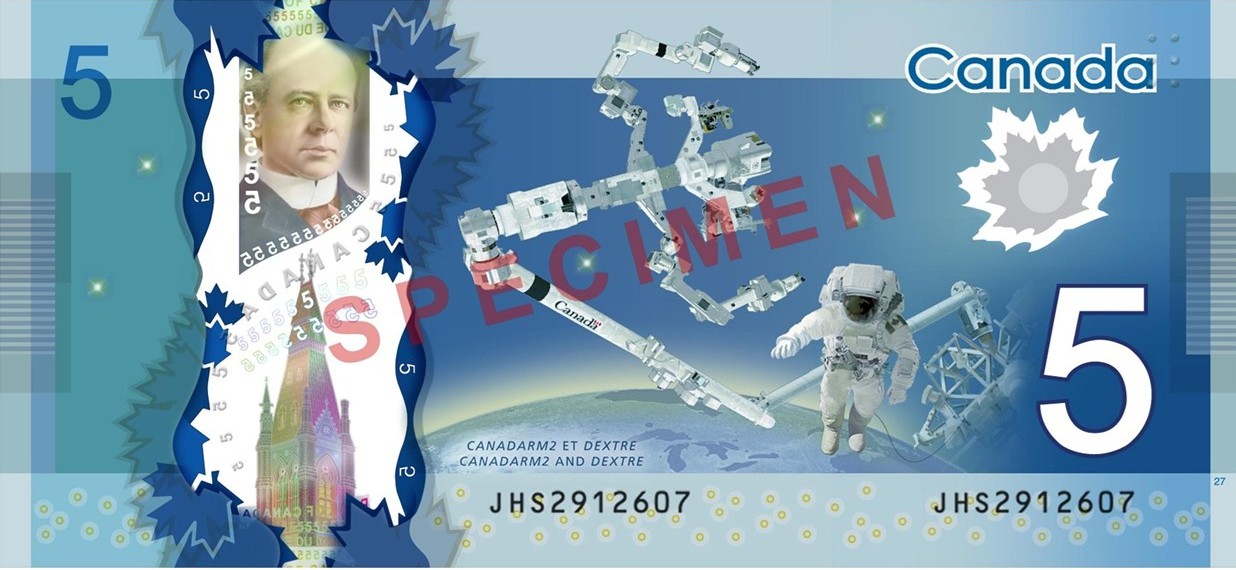
Earlier this month CSA Astronaut Chris Hadfield revealed the new Canadian $5 bank note in a live videostream from the International Space Station to the Bank of Canada’s Ottawa head office. Why all the extraterrestrial fanfare? The new polymer bill proudly sports Canadian space robotics achievements Canadarm2 and Dextre.

The 17.2 meter-long Canadarm2 was launched in April 2001 and is the robotic arm that assembled the International Space Station (ISS) while in space. Dextre was launched in March 2008 to help ISS crew by taking care of routine maintenance jobs outside the station, and its duties include moving cargo transport containers, replacing failed electrical parts, and unpacking visiting spacecraft. Dextre was also the first robot to refuel a mock satellite in space.

“It really marks Canada’s contribution to the space station program and especially our longterm area of expertise in robotics,” said Hadfield, who also stated that he was proud to see Canada’s achievements in space highlighted on the bill.

Hadfield, who regularly tweets and videoblogs from outerspace, has become something of an icon and mentor among young Canadians. On Monday, he conducted the last of his live video downlinks from the ISS by co-performing the song ISS (Is Somebody Singing) — a song he co-wrote with Ed Robertson of the Barenaked Ladies — in a live simulcast with thousands of school kids from across the country.

Hadfield returns to earth on Monday, May 13.


Hallie Siegel robotics editor-at-large

            AUAI is supported by:


Subscribe to Robohub newsletter on substack


Related posts :

Robot Talk Episode 156 – Rugged robots for dangerous missions, with Gavin Kenneally

  15 May 2026
In the latest episode of the Robot Talk podcast, Claire chatted to Gavin Kenneally from Ghost Robotics about robot dogs for defence, security, and public safety.

Developing active and flexible microrobots

  13 May 2026
This class of robots opens up possibilities for biomedical applications.

How to teach the same skill to different robots

  11 May 2026
A new framework to teach a skill to robots with different mechanical designs, allowing them to carry out the same task without rewriting code for each.

Robot Talk Episode 155 – Making aerial robots smarter, with Melissa Greeff

  08 May 2026
In the latest episode of the Robot Talk podcast, Claire chatted to Melissa Greeff from Queen's University about autonomous navigation and learning for drones.

New understanding of insect flight points way to stable flapping-wing robots

  07 May 2026
The way bugs and birds flap their wings may look effortless, but the dynamics that keep them aloft are dizzyingly complex and difficult to quantify.

Robotically assembled building blocks could make construction more efficient and sustainable

  05 May 2026
Research suggests constructing a simple building from interlocking subunits should be mechanically feasible and have a much smaller carbon footprint.

Robot Talk Episode 154 – Visual navigation in insects and robots, with Andrew Philippides

  01 May 2026
In the latest episode of the Robot Talk podcast, Claire chatted to Andrew Philippides from the University of Sussex about what we can learn from ants and bees to improve robot navigation.

Ultralightweight sonar plus AI lets tiny drones navigate like bats

  29 Apr 2026
Researchers develop ultrasound-based perception system inspired by bat echolocation.


AUAI is supported by:


Subscribe to Robohub newsletter on substack


©2026.02 - Association for the Understanding of Artificial Intelligence









