
Robohub.org
The 5 craziest spherical robots
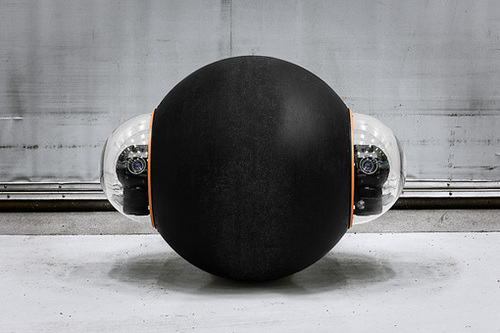
“Spherical robots are currently in use for research, fun and even surveillance purposes. Without legs they are inherently stable and capable of traveling great distances in short periods of time. Here are five of the craziest rounded robots rolling their way across Earth.”
John Payne‘s insight:
Spherical designs also necessarily tend to be light, and to distribute what weight they do have over a relatively large area, meaning that they have low-pressure footprints. This makes them good candidates for what I call "locally supported" devices in a recent blog post http://cultibotics.blogspot.com/2013/05/design-options-and-factors-which.html .
See on gigaom.com

John Payne
AUAI is supported by:








Related posts :
Robotics and automation? Informal reflections on familiar terms
IEEE Robotics and Automation Society (RAS)
30 Sep 2026
IEEE experts reflect on what is meant by the term "robotics and automation".
Small, medium or large, a robotic fish maintains its swimming ability
EPFL
28 Sep 2026
Researchers at EPFL and New York University have developed a robotic fish that can be made in various sizes for studying shallow creeks to open water.
Robot Talk Episode 163 – Robots helping people, with Aaron Edsinger
Robot Talk
25 Sep 2026
In the first episode of Robot Talk season 7, Claire chatted to Aaron Edsinger from Hello Robot about their Stretch robots that can help people with mobility issues live more independently.
An open source approach to physical AI from Intrinsic
Lucy Smith
25 Sep 2026
Find out more about the capabilities of Intrinsic Core.
What’s coming up at #IROS2026?
Lucy Smith
24 Sep 2026
Find out what the International Conference on Intelligent Robots and Systems has in store.
Robotics roadmaps from around the world spotlight of the month: China
IEEE Robotics and Automation Society (RAS)
23 Sep 2026
China is targeting the next industrial revolution by doubling down on embodied AI and humanoid robotics, building directly on its vast manufacturing infrastructure.
Mars rovers give scientists a ground-level view of the red planet – peek inside their NASA control room
The Conversation
21 Sep 2026
NASA created Curiosity to search for evidence of ancient habitable environments.
Reimagining robotics for sustainability
EPFL
18 Sep 2026
"Our ambition is not to simply make robots more sustainable; they must actively contribute to solving sustainability challenges."

