
Robohub.org
RAC ‘Emerging Trends in Retail Robotics’ report released
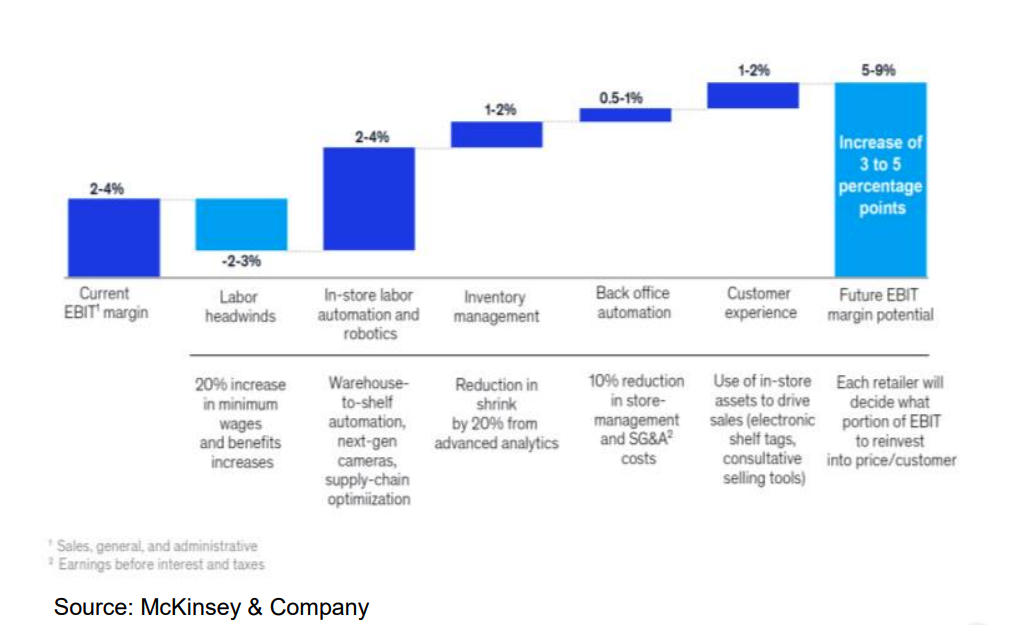
Robots are increasingly being deployed in retail environments. The reasons for this include: to relieve staff from the performance of repetitive and mundane tasks; to reallocate staff to more value-added, customer-facing activities; to realize operational improvements; and, to utilize real-time in-store generated data. Due to the impact of the 2020 Coronavirus outbreak, we can now add a new reason to use robots in retail: to assist with customer and employee safety.
In this Research Article, the Retail Analytics Council at NWU presents information on the benefits associated with deploying robots in stores. Estimates of the size of the global retail robot market are advanced. The impact on demand for robots in the grocery industry, in light of the Coronavirus outbreak, is discussed as well. This is followed by a review of U.S. retail robot deployments and the advancing of some emerging applications.
In summary, we find that the trend toward deploying robots in retail environments is accelerating. The reasons for this include their functional utility, advances in AI, and the ability to address both labor challenges and customer and employee safety concerns. The introduction of new uses of real-time, in-store generated data is another advantage. Further, the movement toward multimodal robots that are efficient at performing various functions adds to the value equation. We also find that changing consumer behavior to increase online purchases, especially in grocery, is a major impetus fueling this movement. Finally, establishing industry standards, which is ongoing, will fuel adoption.
Previous impediments to adoption, which are not detailed here, are also at play. These, for the most part, include issues of cost and training. The costs of robots will decrease, and the ROI will greatly increase, as complex computing moves off the payload via 5G and sensor costs continue to decrease. Increased vendor competition will also be a factor. The cost and complexity associated with environmental training are also being addressed via the introduction of synthetic data.
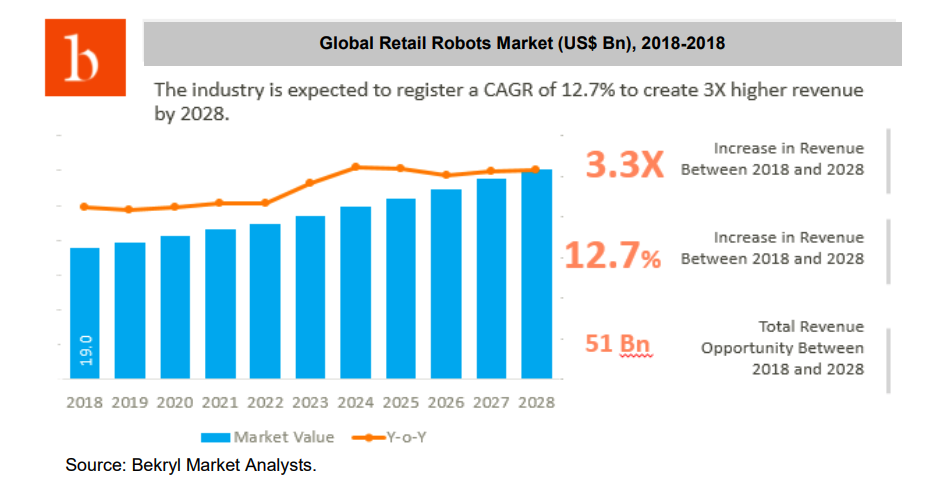
As the industry is still in its infancy, there are minimal reliable studies regarding market size. Estimates range from $4.8 billion to $19 billion in the 2015 to 2018 time frame, to as much as $52 billion by 2025. In April 2018, Bekryl Market Analysts published its Global Retail Robots Market Size Analysis, 2018-2028. Bekryl estimates the global retail robot market at $19 billion in 2018. They further estimate that the market will grow at a CAGR of 12.7 percent over the next ten years.
Now consider a different perspective. Verified Market Research valued the global retail robotics market at $4.78 billion in 2018, but expects a much more rapid rate of growth of 31.89 percent from 2019- 2026, reaching $41.67 billion by 2026.12 In 2016, yet another point of view was advanced by consulting firm Roland Berger, which stated “[t]he segment of robots designed for retail stores is emerging in a global robotics market that is already significant ($19 billion in 2015) and growing steadily ($52 billion in 2025).”
As the current Coronavirus pandemic constrains consumers’ ability to shop in stores, there is ample evidence that a shift to online purchasing is occurring in select categories, particularly grocery. To realize operating efficiencies while meeting this increased demand, grocery retailers, which represent the largest segment currently invested in robotics technology, are expected to accelerate their rate of investment.
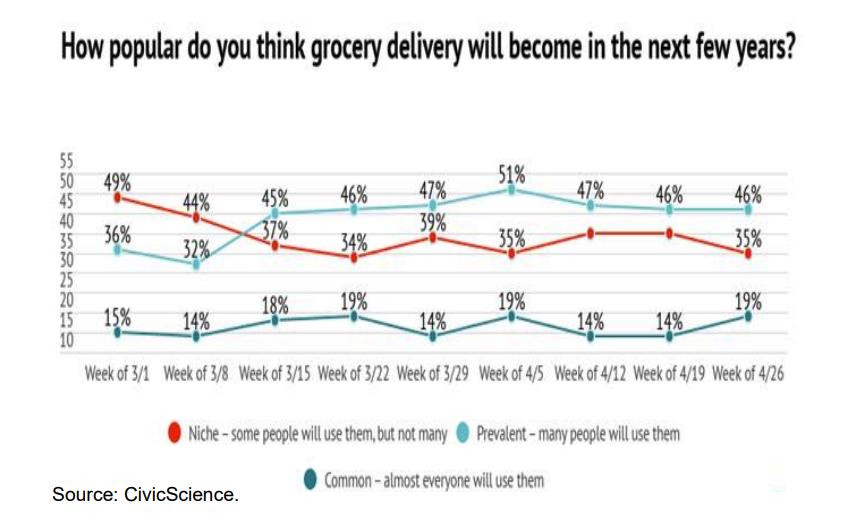
The pressing question is whether this current movement to online grocery purchases during the pandemic represents a more permanent shift in consumer behavior. Consumers seem to think so. For example, in an April 2020 survey, 43 percent of adults said they were somewhat or very likely to
continue ordering groceries online once the pandemic ends (see Chart 11). McKinsey & Company’s COVID-19 U.S. Digital Sentiment Survey found that fully “75 percent of people using digital channels for the first time indicate that they will continue to use them when things return to normal.”
In conclusion, we see the pace of retail robot adoption accelerating, especially in the grocery segment. Technology advancements surrounding deployments in stores, backroom/warehouses, and delivery applications will continue to improve. Deployment costs will fall, as will the time to deploy, which will increase ROI, as will multi-functional payloads that perform a variety of tasks. Emerging innovations will add interesting new use cases. Increasing uses of real-time data generated, and the application/integration thereof, will also create additional value. Finally, ongoing efforts to establish industry standards will aid in industry adoption.
Silicon Valley Robotics is on the Robotics and AI Advisory Board of the Retail Analytics Council at NWU, where you can download the full report “Emerging Trends in Retail Robotics”.

AUAI is supported by:









