
Robohub.org
Winners of the DIH Champions Challenge 2020 revealed at the #EDIH2021 conference
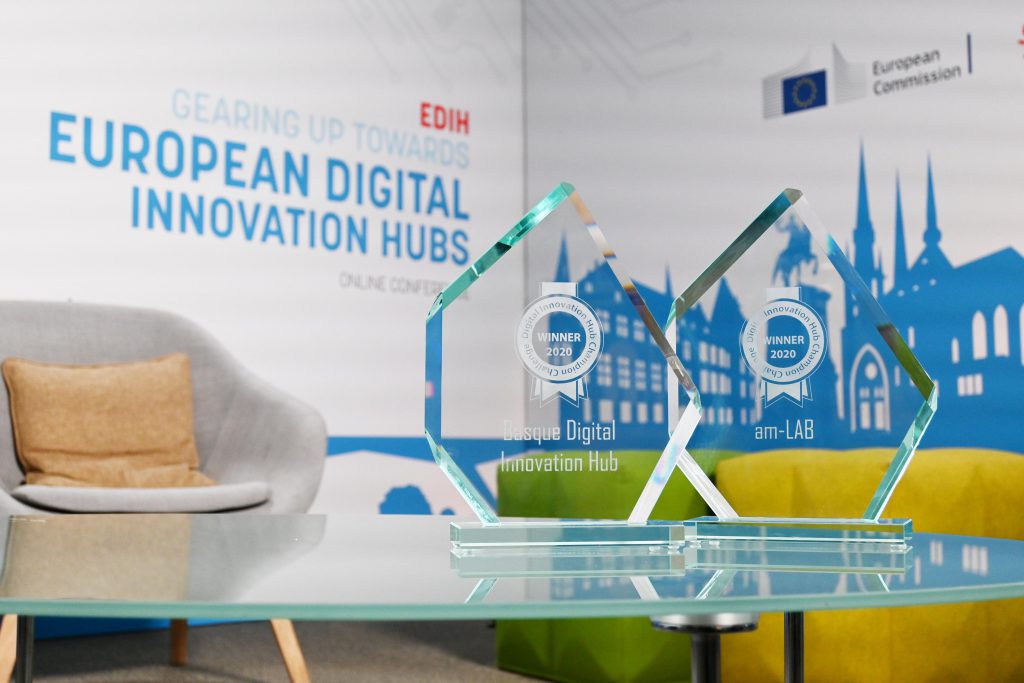
Photo by Luxinnovation
On the 27th of January, DIHNET revealed the winners of the 2020 DIH Champions Challenge at the virtual EDIH Conference 2021 “Gearing up towards European Digital Innovation Hubs”. The awards ceremony gathered more than 1176 participants including Digital Innovation Hubs, designated EDIHs, regions and Member States, representatives of EEN, Clusters, SME associations, among other stakeholders.
DIHNET.EU was pioneer in launching the annual DIH Champions Challenge for identifying mature Digital Innovation Hubs in Europe. Begoña Sanchez, Innovation Systems and Policies manager at Tecnalia, and member of the DIHNET consortium, explains that the main purpose of this initiative is “to provide the DIHs community with a process for identifying good practices, showcase and support success stories of Mature DIHs that can inspire and guide other DIHs in their development.”
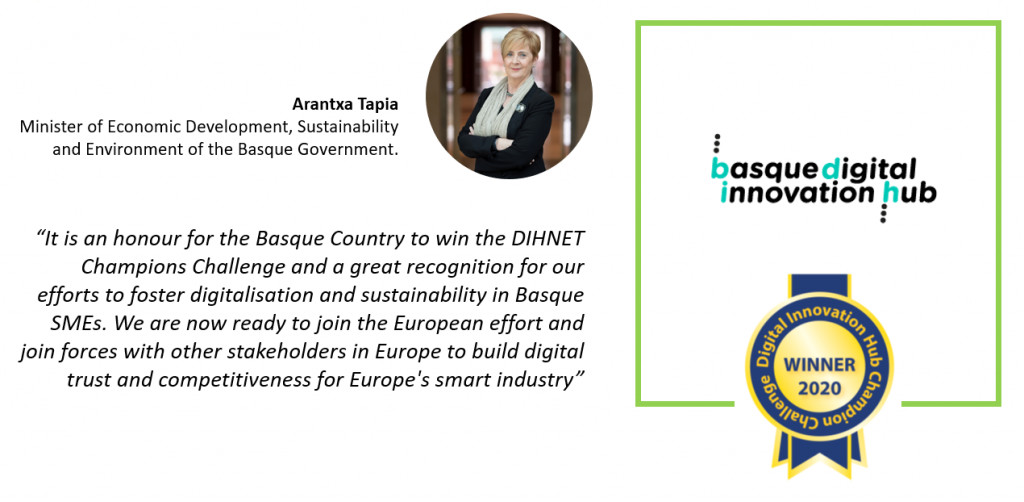
In this second edition, four DIHs were shortlisted as finalists: the am-LAB, the Basque Digital Innovation Hub (BDIH), the FZI Research Center for Information Technology and the ITI Data Hub (The Data Cycle Hub). The DIHNET consortium revised the proposals with the contribution of two external evaluators: Jan Kobliha, Ministerial Counsellor at the Ministry of Industry and Trade of the Czech Republic, and Thorsten Huelsmann, manager of the Digital Hub Logistics Dortmund, winner of the 2019 DIH Champions Challenge. “The different applications from the DIHs have once again demonstrated that the different approaches and structures of DIHs in Europe are diverse and heterogeneous as the European regions and members states are. Each application has shown an individual service and format portfolio, governance structure and operations model which fits to the requirements of the customers in the innovation or digital transformation value chain” explains Thorsten. Jan Kobliha, external evaluator in both contests, adds that “this year the proposals were more mature and the results of the top ones were comparable to each other, which is a huge difference to last year, where we had one absolute champion. In Europe there is a huge increase of DIH projects, some of them aspiring to become a EDIH and they have gained more experience”.
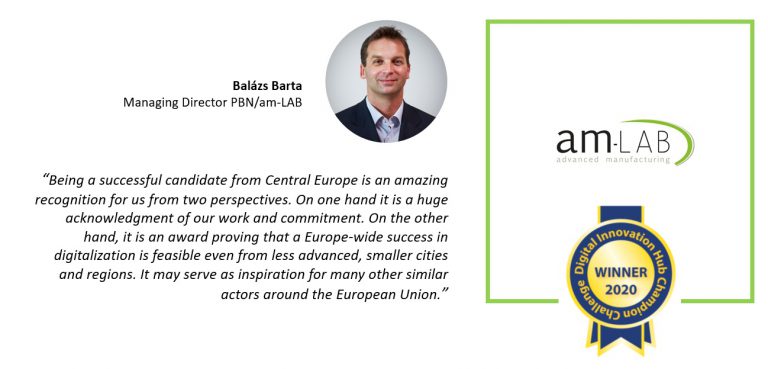
The 2020 DIH Champions Challenge winners are two Digital Innovation Hubs that have demonstrated a leading level of maturity: the am-LAB (Hungary) and the Basque Digital Innovation Hub (Spain).
From DIHNET we want to congratulate both winners – am-LAB and the Basque DIH – for this great achievement, and also to the two finalists ITI Data Hub and the FZI Research Center for Information Technology. We hope other Digital Innovation Hubs see them as a source of inspiration for the future.
Meet the finalists
am-LAB
Located in the West Pannon region of Hungary, the am-LAB is the daughter company of Pannon Business Network Association – PBN. This DIH promotes and assists digitisation of SMEs in Western Hungary and works as an anchor of the regional digitisation initiatives in SME manufacturing. The local innovation technology transfer network has strong organically developed relations. Members of the hub are the local university – ELTE Multidisciplinary Science Network, local manufacturing companies and a cluster of mechatronic manufacturing SMEs. The regional government is also supporting and closely following the progress of the DIH. http://www.amlab.hu/
Basque Digital Innovation Hub (BDIH)
The Basque Digital Innovation Hub (BDIH) is a non-for-profit initiative that provides European industrial fabric -especially Basque SMEs- an easy and cost-efficient access to innovative and excellent scientific-technological capabilities required to meet the challenges of the Industry 4.0 in the Advanced Manufacturing environment. This DIH located in Spain consists of a digitally-linked network of R+D infrastructures, pilot plants and specialised know-how in 6 different areas: Additive Manufacturing, Flexible and Collaborative Robotics, Cybersecurity, Big Data Analytics, Smart and Connected Machines and New Materials.
http://www.spri.eus/en/basque-industry/basque-digital-innovation-hub/
FZI Research Center for Information Technology
The FZI Research Center for Information Technology at the Karlsruhe Institute of Technology, Germany, is a non-profit institution for applied research in information technology and technology transfer. Its task is to provide businesses and public institutions with the latest research findings in information technology. It also qualifies young researchers for their career in academics or business as well as self-employment. http://www.fzi.de/en/home/
ITI Data Hub (The Data Cycle Hub)
The Data Cycle Hub has a non-for-profit aim and is coordinated and led by ITI, also a non-for-profit Research Centre and a reference on Big Data and Artificial Intelligence in the Valencia region, Spain. The objective of this DIH is to bridge the gap between research and industry, specifically SMEs, providing innovative solutions and services that require advanced data analytics, automatic learning and artificial intelligence. The Data Cycle Hub addresses primarily Big Data and Artificial Intelligence, but also other key digital enabling technologies like Cyber Physical Systems, IoT, Cloud and High-Performance Computing Platforms or statistics optimisation. https://thedatacyclehub.com/en/
To know more about these Digital Innovation Hubs visit their respective websites and the JRC DIH catalogue: https://s3platform.jrc.ec.europa.eu/digital-innovation-hubs-tool
Note from the Managing Editor: This post has been merged from this article and this article.
tags: Competition-Challenge

AUAI is supported by:









