
Robohub.org
Robots can be companions, caregivers, collaborators — and social influencers
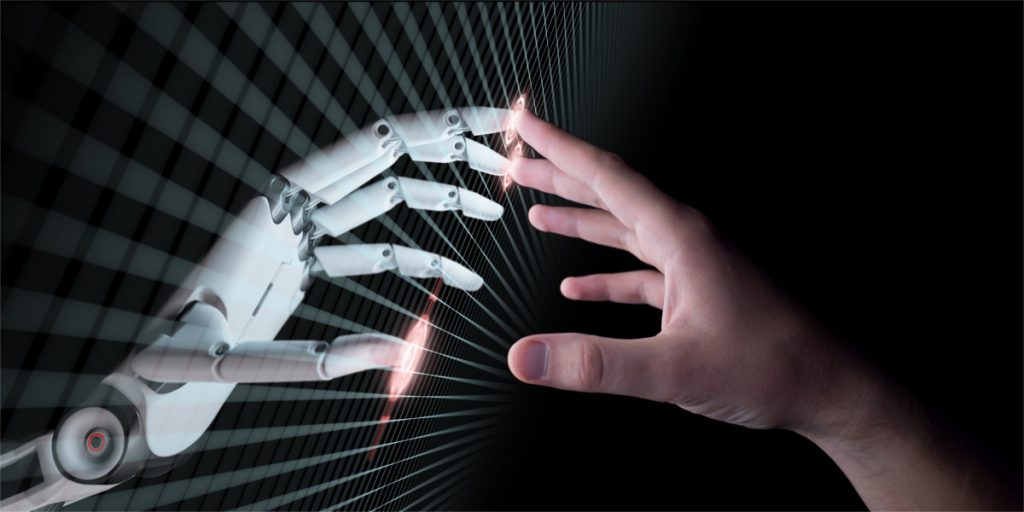
Robot and artificial intelligence are poised to increase their influences within our every day lives. (Shutterstock)
By Shane Saunderson
In the mid-1990s, there was research going on at Stanford University that would change the way we think about computers. The Media Equation experiments were simple: participants were asked to interact with a computer that acted socially for a few minutes after which, they were asked to give feedback about the interaction.
Participants would provide this feedback either on the same computer (No. 1) they had just been working on or on another computer (No. 2) across the room. The study found that participants responding on computer No. 2 were far more critical of computer No. 1 than those responding on the same machine they’d worked on.
People responding on the first computer seemed to not want to hurt the computer’s feelings to its face, but had no problem talking about it behind its back. This phenomenon became known as the computers as social actors (CASA) paradigm because it showed that people are hardwired to respond socially to technology that presents itself as even vaguely social.
The CASA phenomenon continues to be explored, particularly as our technologies have become more social. As a researcher, lecturer and all-around lover of robotics, I observe this phenomenon in my work every time someone thanks a robot, assigns it a gender or tries to justify its behaviour using human, or anthropomorphic, rationales.
What I’ve witnessed during my research is that while few are under any delusions that robots are people, we tend to defer to them just like we would another person.
Social tendencies
While this may sound like the beginnings of a Black Mirror episode, this tendency is precisely what allows us to enjoy social interactions with robots and place them in caregiver, collaborator or companion roles.
The positive aspects of treating a robot like a person is precisely why roboticists design them as such — we like interacting with people. As these technologies become more human-like, they become more capable of influencing us. However, if we continue to follow the current path of robot and AI deployment, these technologies could emerge as far more dystopian than utopian.
The Sophia robot, manufactured by Hanson Robotics, has been on 60 Minutes, received honorary citizenship from Saudi Arabia, holds a title from the United Nations and has gone on a date with actor Will Smith. While Sophia undoubtedly highlights many technological advancements, few surpass Hanson’s achievements in marketing. If Sophia truly were a person, we would acknowledge its role as an influencer.
However, worse than robots or AI being sociopathic agents — goal-oriented without morality or human judgment — these technologies become tools of mass influence for whichever organization or individual controls them.
If you thought the Cambridge Analytica scandal was bad, imagine what Facebook’s algorithms of influence could do if they had an accompanying, human-like face. Or a thousand faces. Or a million. The true value of a persuasive technology is not in its cold, calculated efficiency, but its scale.
Seeing through intent
Recent scandals and exposures in the tech world have left many of us feeling helpless against these corporate giants. Fortunately, many of these issues can be solved through transparency.
There are fundamental questions that are important for social technologies to answer because we would expect the same answers when interacting with another person, albeit often implicitly. Who owns or sets the mandate of this technology? What are its objectives? What approaches can it use? What data can it access?
Since robots could have the potential to soon leverage superhuman capabilities, enacting the will of an unseen owner, and without showing verbal or non-verbal cues that shed light on their intent, we must demand that these types of questions be answered explicitly.
As a roboticist, I get asked the question, “When will robots take over the world?” so often that I’ve developed a stock answer: “As soon as I tell them to.” However, my joke is underpinned by an important lesson: don’t scapegoat machines for decisions made by humans.
I consider myself a robot sympathizer because I think robots get unfairly blamed for many human decisions and errors. It is important that we periodically remind ourselves that a robot is not your friend, your enemy or anything in between. A robot is a tool, wielded by a person (however far removed), and increasingly used to influence us.

Shane receives funding from the Natural Sciences and Engineering Research Council of Canada (NSERC). He is affiliated with the Human Futures Institute, a Toronto-based think tank.
This article appeared in The Conversation.
tags: c-Politics-Law-Society

AUAI is supported by:









