
Robohub.org
Connecting robots and people – #ICRA2022 Day 3 interview with Kate Ladenheim (+ video digest)
If you are quite enthusiastic about robotics like me, then by now you will probably have finished the third season of Netflix acclaimed series Love, Death and Robots. I believe that animation, like many other artistic expressions, is an effective way to communicate the ideas and concepts that revolve around contemporary robotics. If we envision a future in which robots and society coexist, we must ensure that the way we communicate about robotics engages positively with the non-specialized public. Art is an interesting way to achieve it. I think that, in the broader sense, art could help us to create robots that engage better with people.
How can we ensure that the positive intention of a robot maker is accurately portrayed in the robot appearance and/or behavior? We are certainly good at developing new features and functionalities for our robots. However, how often do we design robots that can connect with people? Creating artistic expressions with our robots could help us think out of the box: what do we intend to communicate with our robots? To whom are we speaking? Are we effectively passing our intention? Probably, in order to address these questions better, we must leave the technician aside for a moment and connect with our inner robot.
ICRA has a wonderful space to develop these ideas. In 2022, the conference partnered with the RAD Lab and many Philadelphia-based art galleries to create a central space for art in its program. The workshop Automatic Expressions and the robotic art installations presented between Monday 23 and Wednesday 25 explored interactive, expressive and meditative aspects of robotics.
In yesterday´s post, I asked robot makers about the art of creating robots. Today, I ask an artist about creating art in robotics. I met Kate Ladenheim, a presenter at ICRA 2022´s Robotics and Art exhibition “Expressive and Meditative Machines for Imaging New Futures With Technology”. Kate participates with the art piece Monumental Death: an interactive installation that asks participants to perform the motions of death in order to give rise to an inflatable monument. In so doing, it challenges tropes of heroism as represented by monuments and performances of death in popular media. Check more about Kate´s work in her social media (Twitter, Instagram).
I asked Kate about robotics, art, and public engagement. Below some excerpts of her answers.
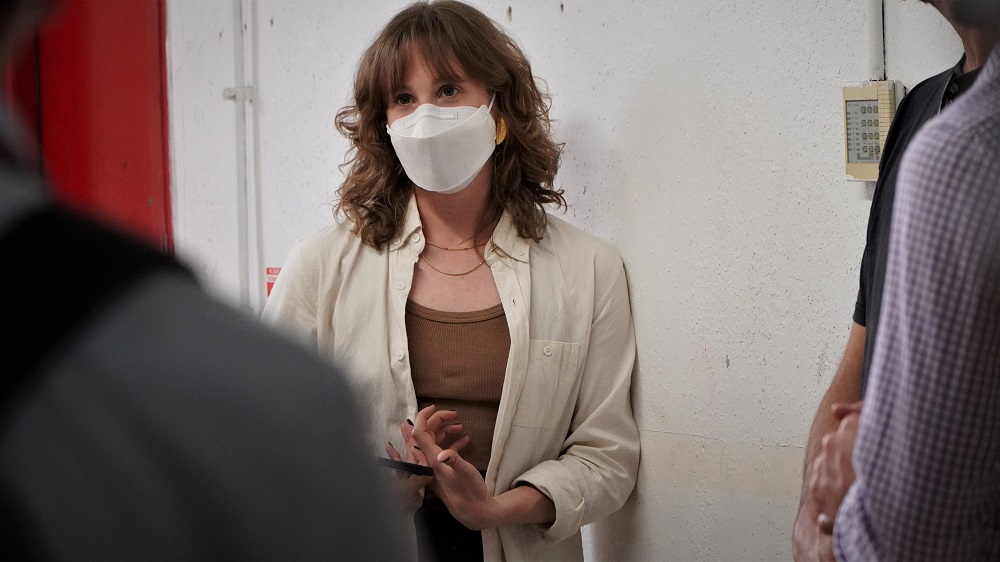
Kate Ladenheim
Q1. What comes to your mind if I say that making robots is an art?
I think that roboticists and artists both engage in really intensive creative processes in order to make their work come to life. I think the real thing that separates art from many other intensive creative processes is the intentions of the artist. If a roboticist is trying to make a product that scales and that goes to market, then it is not necessarily an art. However, if a roboticist is trying to make something with a high level of intellectual and conceptual rigor, with an output that is not necessarily commercial in nature but is one that is meant to enrich the lives of people around it, then I think it crosses the realm from a project into a project that is artistic.
Q2. Is it possible to use art to communicate robotics and to engage with the non-specialized public?
I think it is an exciting path for artists and engineers to work together. I also think that artists and engineers actually run into the same problems with accessibility. Sometimes artists present things that are very heady and feel sometimes intimidating or inaccessible to the general public. Engineers also engage in processes that are maybe hard for the general public to grasp at face value. I think it is up to both artists and engineers to endeavor to make meaning, functionality, and creative processes more tangible and experiential to an audience. Simply making a robot artistic, or making a robot dance, won’t automatically help the general public understand how it works and be more comfortable around it. I do not think it is that simple. Maybe if the robot is made to dance, and it was made to dance in a way that was alienating or intriguing or humorous or otherwise expressive, people would have that same range of feelings about that robot and what it’s meant to do.
Q3. What does it mean for you and for company to be in ICRA 2022?
I am honored and excited to be here. This is a really different audience than the one I normally present my work to. It is really exciting to get different kinds of inputs and perspectives of what I made. It is a great time to share ideas and for ideas to be reflected back to me in enriching ways.
More robots in today’s video digest of #ICRA2022.
tags: c-Events, icra2022

AUAI is supported by:









