
Robohub.org
Asimov’s First Law: Exploring the implications | FUTURESTATES.tv via The Verge
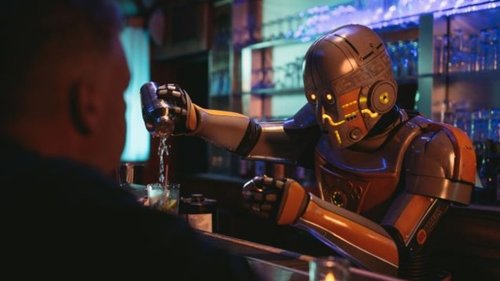
“Isaac Asimov’s first law of robotics states, “A robot may not injure a human being or, through inaction, allow a human being to come to harm.” However, injury mostly corresponds to physical harm, not mental or emotional harm. Sleep Dealer director Alex Rivera plays with human emotions in his latest short film A Robot Walks Into a Bar.”
John Payne‘s insight:
FUTURESTATES isn’t your typical website; I wouldn’t be surprised if it doesn’t work at all in older browsers. Once it appears, click on the "Continue" button, then on the menu icon (three stacked horizontal bars), then on the video title, then on the triangular images that zooms into the foreground.
See on www.theverge.com

John Payne
AUAI is supported by:








Related posts :
Robot Talk Episode 163 – Robots helping people, with Aaron Edsinger
Robot Talk
25 Sep 2026
In the first episode of Robot Talk season 7, Claire chatted to Aaron Edsinger from Hello Robot about their Stretch robots that can help people with mobility issues live more independently.
An open source approach to physical AI from Intrinsic
Lucy Smith
25 Sep 2026
Find out more about the capabilities of Intrinsic Core.
What’s coming up at #IROS2026?
Lucy Smith
24 Sep 2026
Find out what the International Conference on Intelligent Robots and Systems has in store.
Robotics roadmaps from around the world spotlight of the month: China
IEEE Robotics and Automation Society (RAS)
23 Sep 2026
China is targeting the next industrial revolution by doubling down on embodied AI and humanoid robotics, building directly on its vast manufacturing infrastructure.
Mars rovers give scientists a ground-level view of the red planet – peek inside their NASA control room
The Conversation
21 Sep 2026
NASA created Curiosity to search for evidence of ancient habitable environments.
Reimagining robotics for sustainability
EPFL
18 Sep 2026
"Our ambition is not to simply make robots more sustainable; they must actively contribute to solving sustainability challenges."
Watch the ICRA keynote and plenary talks
Lucy Smith
16 Sep 2026
If you missed the conference you can catch up on IEEE TV.
Robots in society, business and culture: August 2026
IEEE Robotics and Automation Society (RAS)
14 Sep 2026
A round up of robotics stories from IEEE RAS.

