
Robohub.org
NASA 3D prints rocket injector, initial tests successful | NASA News
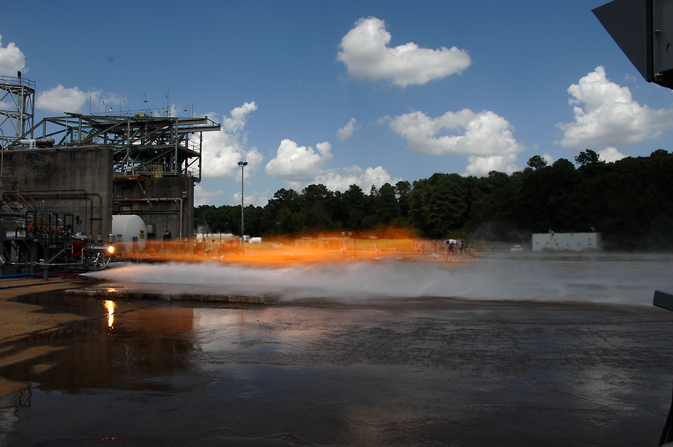
According to a press release issued today:
NASA has successfully tested the most complex rocket engine parts ever designed by the agency and printed with additive manufacturing, or 3-D printing, on a test stand at NASA’s Marshall Space Flight Center in Huntsville, Alabama. NASA engineers pushed the limits of technology by designing a rocket engine injector –a highly complex part that sends propellant into the engine — with design features that took advantage of 3-D printing. To make the parts, the design was entered into the 3-D printer’s computer. The printer then built each part by layering metal powder and fusing it together with a laser, a process known as selective laser melting. The additive manufacturing process allowed rocket designers to create an injector with 40 individual spray elements, all printed as a single component rather than manufactured individually. The part was similar in size to injectors that power small rocket engines and similar in design to injectors for large engines, such as the RS-25 engine that will power NASA’s Space Launch System (SLS) rocket, the heavy-lift, exploration class rocket under development to take humans beyond Earth orbit and to Mars.
3-D Printed Rocket Injector Roars to Life: The most complex 3-D printed rocket injector ever built by NASA roars to life on the test stand at NASA’s Marshall Space Flight Center in Huntsville, Alabama.“We wanted to go a step beyond just testing an injector and demonstrate how 3-D printing could revolutionize rocket designs for increased system performance,” said Chris Singer, director of Marshall’s Engineering Directorate. “The parts performed exceptionally well during the tests.”
Using traditional manufacturing methods, 163 individual parts would be made and then assembled. But with 3-D printing technology, only two parts were required, saving time and money and allowing engineers to build parts that enhance rocket engine performance and are less prone to failure.
Two rocket injectors were tested for five seconds each, producing 20,000 pounds of thrust. Designers created complex geometric flow patterns that allowed oxygen and hydrogen to swirl together before combusting at 1,400 pounds per square inch and temperatures up to 6,000 degrees Fahrenheit. NASA engineers used this opportunity to work with two separate companies — Solid Concepts in Valencia, California, and Directed Manufacturing in Austin, Texas. Each company printed one injector.
“One of our goals is to collaborate with a variety of companies and establish standards for this new manufacturing process,” explained Marshall propulsion engineer Jason Turpin. “We are working with industry to learn how to take advantage of additive manufacturing in every stage of space hardware construction from design to operations in space. We are applying everything we learn about making rocket engine components to the Space Launch System and other space hardware.”
Additive manufacturing not only helped engineers build and test a rocket injector with a unique design, but it also enabled them to test faster and smarter. Using Marshall’s in-house capability to design and produce small 3-D printed parts quickly, the propulsion and materials laboratories can work together to apply quick modifications to the test stand or the rocket component.
“Having an in-house additive manufacturing capability allows us to look at test data, modify parts or the test stand based on the data, implement changes quickly and get back to testing,” said Nicholas Case, a propulsion engineer leading the testing. “This speeds up the whole design, development and testing process and allows us to try innovative designs with less risk and cost to projects.”
Marshall engineers have tested increasingly complex injectors, rocket nozzles and other components with the goal of reducing the manufacturing complexity and the time and cost of building and assembling future engines. Additive manufacturing is a key technology for enhancing rocket designs and enabling missions into deep space.
tags: 3D printing, cx-Research-Innovation, NASA, Space

AUAI is supported by:









