
Robohub.org
Day One at euRathlon 2015: Video recap
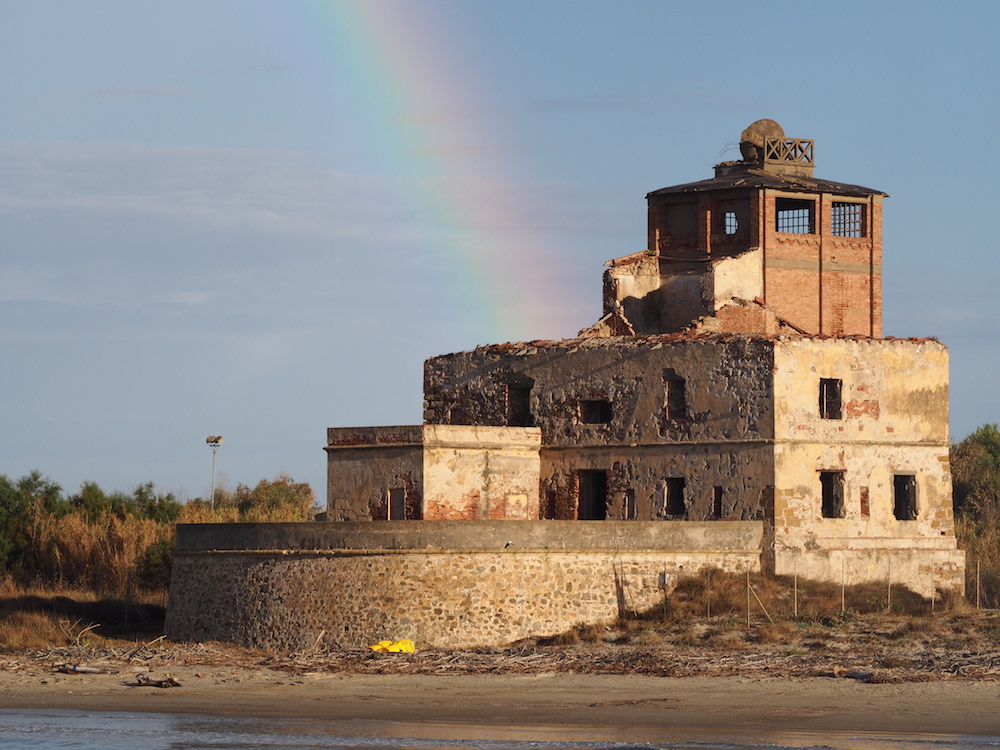
Torre del Sale building, Piombino, Italy. Image: eurathlon
Inspired by the 2011 Fukushima accident, euRathlon is a civilian outdoor robotics competition focused on realistic cooperative disaster response scenarios. euRathlon 2015 takes place in the area surrounding the building of Torre del Sale, on the site of the Enel-owned power plant, and 16 teams from ten different countries have travelled to Piombino, Italy, to tackle this unique challenge. In the first day of trials, aerial, ground and marine robots had to deal with the very real conditions of a demanding coastal environment. Watch the Day One recap video.
The Opening
The mayor of the city of Piombino, Massimo Giuliani, gave a warm welcome to all the attendees, followed by the Enel engineer Antongiulio Bertoncini, Dr Anne Bajart (the project’s European Commission officer), Professor Alan Winfield (euRathlon project Coordinator) and Dr Gabriele Ferri (Head of the euRathlon 2015 robotics competition).
The Trials
The euRathlon 2015 scenarios are arranged in increasing order of complexity, with the trials first, followed by the sub-challenges and finally the Grand Challenge.
Trials are single-domain scenarios designed to encourage the participation of teams that may not have the time, resources and/or experience to directly address the euRathlon Grand Challenge. But, at the same time, they serve as a warm up for the multi-domain (land, sea and air) teams. There are a total of six trials divided into two land trials (L1, L2), two sea trials (S1, S2) and two air trials (A1, A2).
Land Trial (L1): Reconnaissance in Urban Structure
For the first of the two land trials the competitors’ robots were required to approach, inspect and map a ruined building. The land robots had to navigate across a beach filled with obstacles such as wood debris, vegetation and sand dunes. Once inside the building, robots had to look for mock damage and the entrance to the machine room.
A schematic map of the building was given to the teams at the beginning of the trial. The map didn’t include detailed dimensions of entrances, corridors and rooms. As part of the staging, entrances are randomly blocked as a result of a hypothetical earthquake and tsunami.
The seven teams participating in this land trial were B.R.A.I.N. Robots, Cobham, Bebot, ICARUS, ENSTA Bretagne Team 1, ENSTA Bretagne Team 2 and SARRUS.
The beach natural environment turned out to be a real challenge for the robots and only two teams successfully entered the building.
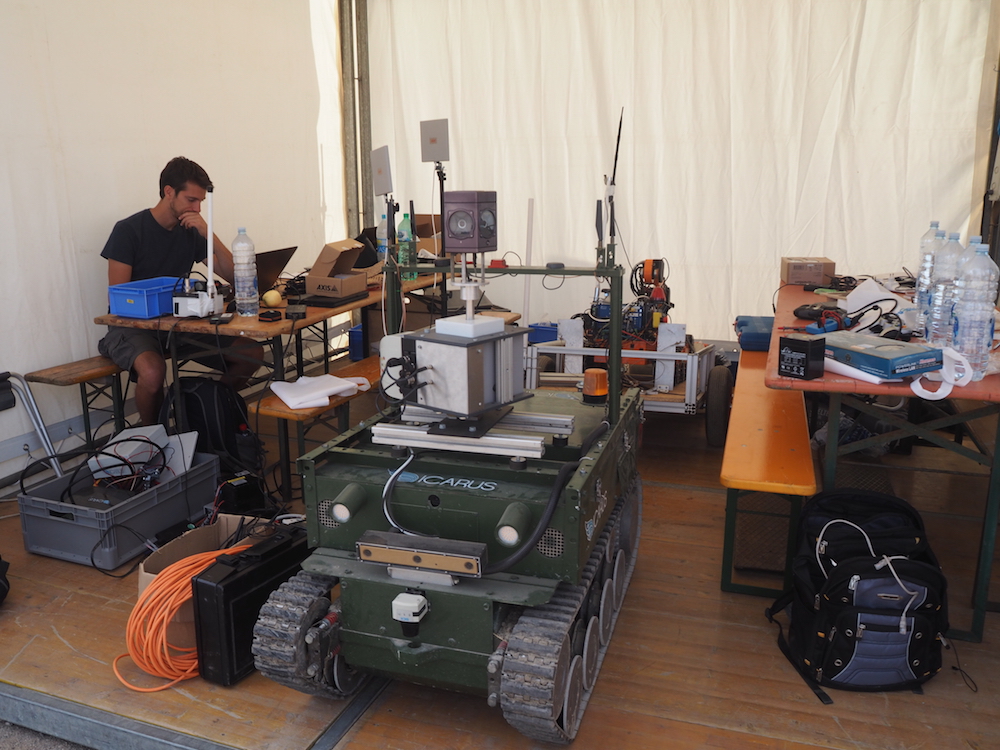
Team ICARUS (ICARUS EU-FP7) preparing for the land trial. Image: euRathlon
Sea Trial (S1): Navigation and Environmental Survey
The sea trial took place in the Enel-owned plant harbour, where robots were tasked with surveying an area of 15×15 metres in the basin of the dock.
The AUVs (Autonomous Unmanned Vehicles) had to navigate from the launch point to a validation gate, pass through it and search for damage on the seabed, marked by submerged orange buoys.
The 11 teams participating in the sea trial competed in parallel, in two different areas. The teams were OUBOT, AUV Team TomKyle, ENSTA Bretagne Team 2, AVORA, UNIFI, ENSTA Bretagne Team 1, AUGA, Team Nessie, ICARUS, Robdos Team and Universitat de Girona.
Teams had to contend with poor water visibility worsened by the rough sea conditions of the previous days. Although acquiring live video and images of the buoys with the on-board camera was a challenge, most of the teams succeed in the navigation task.
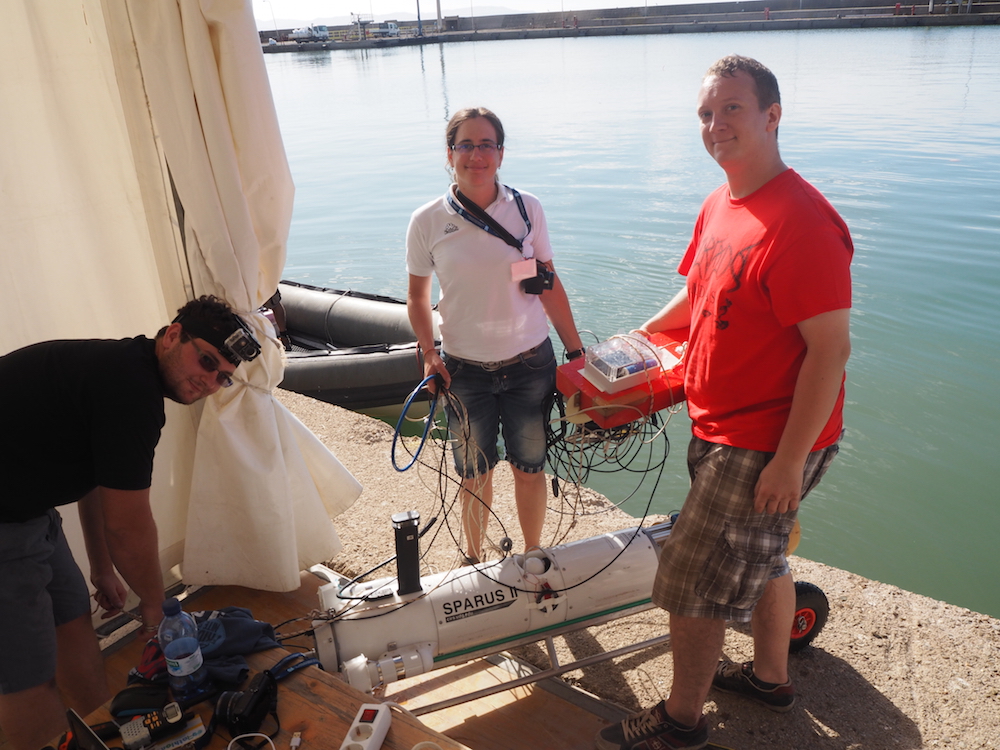
Team OUBOT (Obuda University) after their participation in the sea trial.
Air Trial (A1): Aerial Detection and Mapping
In this first air trial, teams were called on to conduct an aerial inspection to find a safe path from the starting point, for a land robot, to an unblocked entrance of the building.
Specific take-off and landing areas were designated for the UAVs (Unmanned Aerial Vehicles).
The robots had to map the area surrounding the building and look for objects of potential interest (OPIs) representing blocked and unblocked entrances.
The six teams that participated in this trial were UNIFI, ICARUS, ENSTA Bretagne Team 1, ENSTA Bretagne Team 2 and ISEP/INESC TEC.
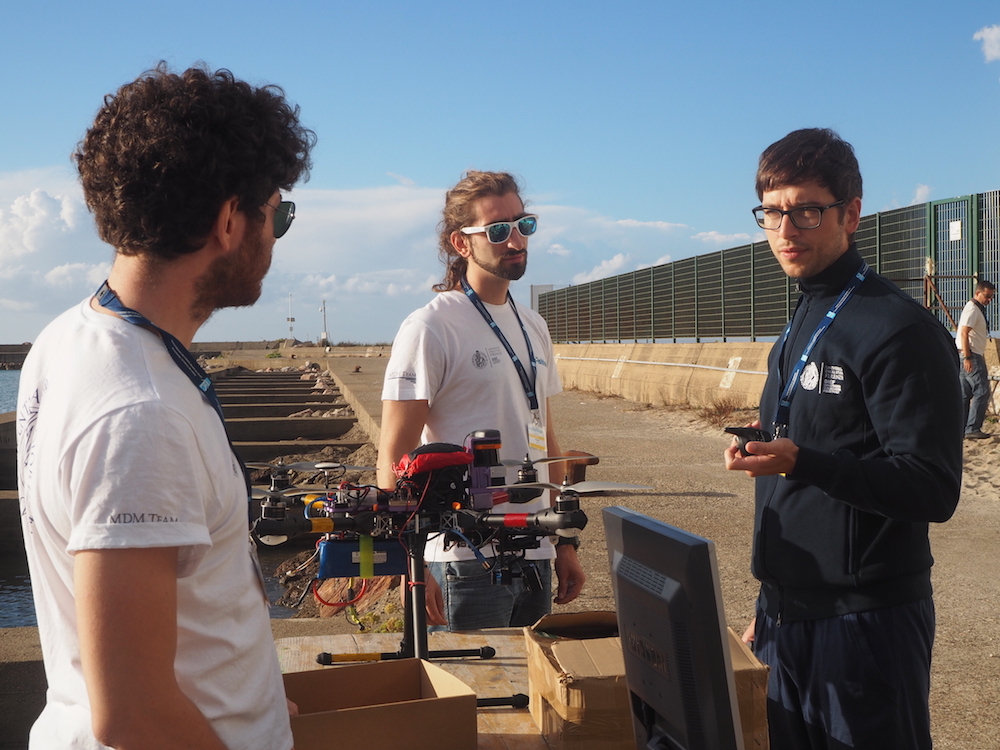
Team UNIFI ( University of Florence) getting ready for the aerial trial. Image: euRathlon
The teams faced variable wind conditions during the day, but that did not stop their robots from taking-off and flying around the building. Most of the teams succeed in surveying the area and finding a safe path for the land robot.
Watch this space for Day Two: the second set of land, and sea trials!
tags: euRathlon, euRathlon 2015, events, exploration & mining, field robotics, mapping & surveillance, military, research
AUAI is supported by:









