
Robohub.org
The Drone Center’s Weekly Roundup: 12/29/15
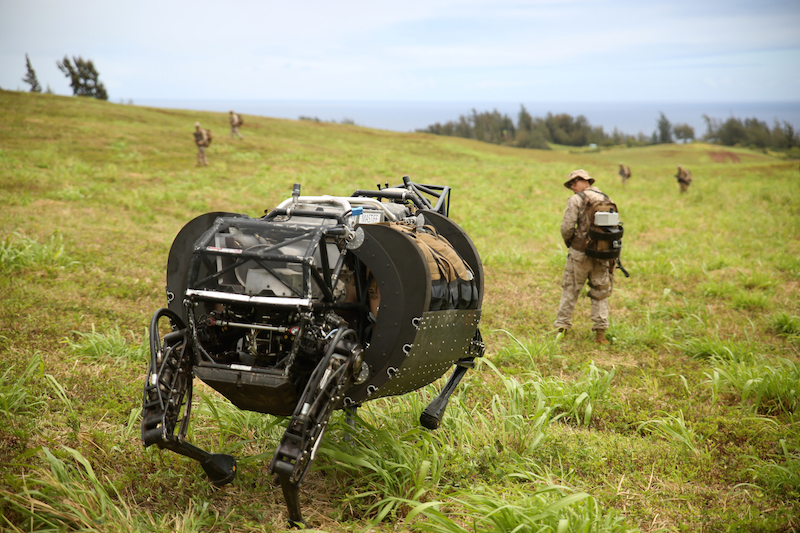
The Legged Squad Support System during testing with the Marine Corps Warfighting Lab. The LS3 project was cancelled by the Marine Corps last week. Via: Wikipedia.
In the News
Drones have been banned from World Cup ski events after a large multirotor drone that was being used to film a race nearly hit one of the skiers. Austrian skier Marcel Hirscher was participating in a slalom race when a television camera-equipped drone crashed behind him and shattered on the slope. (New York Times)
The Federal Aviation Administration reported that in the first two days since its drone registration system was opened, 45,000 drone users signed up. The FAA is requiring all drone users to register their aircraft or face stiff civil or criminal penalties. Existing drone users must register by February 2016. (Mashable)
The U.S. Marine Corps canceled the Legged Squad Support System program due to noise issues and other concerns. The LS3, also known as the robotic mule, was a highly publicized autonomous mechanical pack animal, capable of carrying up to 400 lb. of supplies and gear. (Military.com)
Commentary, Analysis, and Art
At the New York Times, Quentin Hardy takes a look at a growing hub for drone development and flight training in North Dakota.
At the Bulletin of the Atomic Scientists, Heather Roff argues that the debate over lethal autonomous weapons is complicated by a lack of clarity over what constitutes a “killer robot.”
At the Washington Post, Michael S. Rosenwald writes that some new drone users these holidays have been quick to crash their holiday gifts.
Meanwhile, at Wired, Scott Gilbertson offers suggestions on “how to avoid immediately destroying your new drone.”
At Forbes, Alex Konrad writes that drones and autonomous cars could be at the center of some of the major regulatory battles that the tech industry faces in 2016.
At the Scientific American, Annie Sneed writes that the flood of new drone users is challenging notions of privacy and individual ownership of airspace.
At the Telegraph, Camilla Turner takes a look at home insurers that are implementing new measures to protect against potential hazards posed by drones.
At the Washington Post, Craig Whitlock takes a look at recreational drones that are interfering with military operations.
The East Bay Regional Park District in California issued a reminder to local residents that drones are banned from the area’s parks and open spaces. (Contra Costa Times)
At Motherboard, Jason Koebler writes that the FAA’s drone registration process is “surprisingly painless.”
Meanwhile, at Newsweek, Seung Lee considers whether or not the FAA has the authority to require that drones be registered.
At the Independent, David Connett writes that underwater drones could pose a threat to Britain’s nuclear deterrent.
Know Your Drone
NATO’s new Alliance Ground Surveillance drone, which is based on the U.S. Air Force’s Global Hawk high-altitude surveillance and reconnaissance unmanned aircraft, made its maiden flight. (Defense News)
Researchers at Cambridge University have developed an advanced computer vision system for self-driving cars and robots. (Gizmag)
Russian defense company Rostec claims that it has developed a flamethrower-equipped multirotor drone. (Popular Mechanics)
Kratos Defense & Security Solutions, a U.S. defense contractor, has completed a round of tests in which two of its Unmanned Tactical Aerial Platform jet-powered drones autonomously conducted several maneuvers, including a weapons release. (Unmanned Systems Technology)
Vietnam’s government announced that it has a developed a high-altitude long-endurance drone with a range of up to 2,500 miles. (IHS Jane’s 360)
Draganfly Innovations, a U.S. drone maker, has integrated an ADS-B transponder, which is used to track aircraft and prevent mid-air collisions, on a small multirotor drone. (Unmanned Systems Technology)
Twitter has submitted a patent for a drone that can be controlled by tweets. (Popular Science)
Drones at Work
Russian ground and air drones were allegedly involved in engagements with Syrian rebels near Latakia. (Fort Russ)
Icelandic scientists are using drones to help predict volcano eruptions. (Sky News)
Chinese commercial drone maker DJI has opened a futuristic flagship retail space in Shenzhen. (PetaPixel)
For updates, news, and commentary, follow us on Twitter. The Weekly Drone Roundup is a newsletter from the Center for the Study of the Drone. It covers news, commentary, analysis and technology from the drone world. You can subscribe to the Roundup here.
tags: UAVs & drones

AUAI is supported by:









