
Robohub.org
Amputee Feels Texture with a Bionic Fingertip
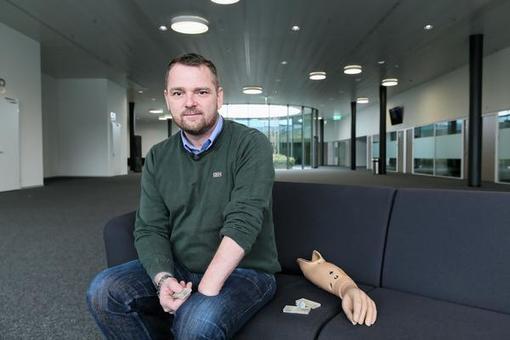
An amputee feels rough or smooth textures in real-time — in his phantom hand — using an artificial fingertip connected to nerves in the arm. The advancement will accelerate the development of touch enabled prosthetics.
An amputee was able to feel smoothness and roughness in real-time with an artificial fingertip that was surgically connected to nerves in his upper arm. Moreover, the nerves of non-amputees can also be stimulated to feel roughness, without the need of surgery, meaning that prosthetic touch for amputees can now be developed and safely tested on intact individuals.
The technology to deliver this sophisticated tactile information was developed by Silvestro Micera and his team at EPFL (Ecole polytechnique fédérale de Lausanne) and SSSA (Scuola Superiore Sant’Anna) together with Calogero Oddo and his team at SSSA. The results, published in eLife, provide new and accelerated avenues for developing bionic prostheses, enhanced with sensory feedback.
“The stimulation felt almost like what I would feel with my hand,” says amputee Dennis Aabo Sørensen about the artificial fingertip connected to his stump. He continues, “I still feel my missing hand, it is always clenched in a fist. I felt the texture sensations at the tip of the index finger of my phantom hand.”
Sørensen is the first person in the world to recognize texture using a bionic fingertip connected to electrodes that were surgically implanted above his stump.
Nerves in Sørensen’s arm were wired to an artificial fingertip equipped with sensors. A machine controlled the movement of the fingertip over different pieces of plastic engraved with different patterns, smooth or rough. As the fingertip moved across the textured plastic, the sensors generated an electrical signal. This signal was translated into a series of electrical spikes, imitating the language of the nervous system, then delivered to the nerves. Sørensen could distinguish between rough and smooth surfaces 96% of the time.
The research demonstrates that the needles relay the information about texture in much the same way as the implanted electrodes, giving scientists new protocols to accelerate for improving touch resolution in prosthetics.
“This study merges fundamental sciences and applied engineering: it provides additional evidence that research in neuroprosthetics can contribute to the neuroscience debate, specifically about the neuronal mechanisms of the human sense of touch,” says Calogero Oddo of the BioRobotics Institute of SSSA. “It will also be translated to other applications such as artificial touch in robotics for surgery, rescue, and manufacturing.”
Kassie Perlongo’s insight:
Sørensen is the first person in the world to recognize texture using a bionic fingertip connected to electrodes that were surgically implanted above his stump.

AUAI is supported by:









