
Robohub.org
Professor Emeritus Whitman Richards dies at 84
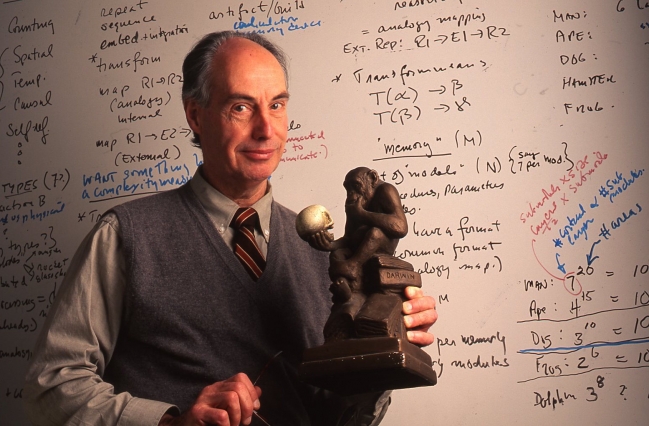
Whitman Richards. Photo: Webb Chappell/MIT Media Lab
Whitman Richards ’53, PhD ’65, professor emeritus of cognitive sciences and of media arts and sciences and principal investigator in the Computer Science and Artificial Intelligence Laboratory, died on Sept. 16 after a long battle with myelofibrosis. One of the first four PhD graduates of the Department of Brain and Cognitive Sciences (BCS), his more than 60 years at MIT were marked by a dedication to the experimental and theoretical study of vision, perception, and cognition.
Richards began his affiliation with MIT as an undergraduate, matriculating in 1950. His decision to return to MIT for graduate work was greatly inspired by a meeting with BCS founder and then department head Professor Hans-Lukas Teuber.
“In the 1960’s, with the advent of accessible computer technology, the development of information theory, and the single electrode, there was renewed excitement about prospects for modeling and understanding mind and brain,” Richards said in a 2004 interview. “Teuber’s charisma and broad vision for a new psychology was a powerful draw [to the department]. …There was a unique opportunity for a non-traditional grounding in a discipline otherwise mired in tradition.”
Richards’ early research pursued traditional psychophysical experimental methods to study the mechanisms of color perception and stereovision. In the 1970s, his research direction and methodology shifted dramatically after meeting noted physiologist David Marr, who he eventually recruited to MIT. Instead of relying on the traditional experimental methods that had characterized his early career, Richards, Marr, and colleagues began to look for the deep, underlying mathematical principles that allowed a human or artificial visual system to look at the world and make accurate inferences about what the system saw or perceived.
“The breadth of his research was really quite remarkable,” says Josh Tenenbaum, MIT professor of computational cognitive science and former Richards graduate student. “As his career developed, he transitioned from studying the parts of vision that are very close to neural mechanisms, to computational representations of perception, to Bayesian statistical models of perception and cognition. He became almost a computational social scientist — he was incredibly flexible in his thinking.”
Richards’ passionate advocacy for the computational approach to studying visual perception helped to create and nurture the department’s early computational research initiatives.
“Whit’s connection with David Marr back in the late ’70s is really the genesis of modern computational social science today,” says MIT Professor Alex Pentland, the Toshiba Professor of Media Arts and Science and a former Richards graduate student.
Alongside his impressive research legacy, which includes the publication of eight books and over 200 articles, Richards was also regarded by his students and colleagues as a superlative mentor. Many of his former students have found success in a variety of different fields, including psychology, cognitive science, computer science, media, computer graphics, and the defense industry.
“Whitman was an incredibly dedicated advisor. His strategy was to have very few students and make a huge personal investment in each of them,” says John Rubin, a former graduate student of Richards and current executive producer with Tangled Bank Studios at the Howard Hughes Medical Institute. “He was really great at keeping enthusiasm high in his lab, which took all kinds of forms, but included croquet parties at his home, which were terrifically fun. He was always available and, in fact, it was hard for me to keep up with the amount of time he wanted to devote to our joint work! He was indefatigable and devoted.”
Richards is survived by his wife of 54 years, Waltraud Weller Richards, and three daughters: Diana Richards Doyle and husband Mark S. Doyle of Green Cove Springs, Florida; Sylvia Richards-Gerngross and husband Tillman Gerngross of Hanover, New Hampshire; and Eleanor “Nora” Richards Bender and husband Thomas A. Bender of Dedham, Massachusetts. He is also survived by his two siblings: Lincoln K. Richards and wife Gerda of Wellesley, Massachusetts, and Sylvia Richards Messner of Cave Creek, Arizona; and by two grandchildren, Morgan Kelly Doyle and Serafina Richards-Gerngross. Memorial services will be private.
tags: CSAIL, MIT

AUAI is supported by:









