
Robohub.org
RobotsLab launches BOX at TCEA 2013
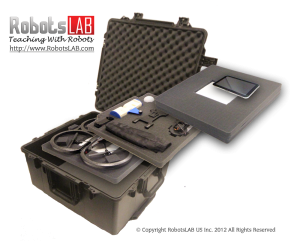
We all know that robots are the gateway to STEM education, so what’s not to love about getting 4 robots in a box, complete with lessons preloaded on a tablet. As both the US and UK undergo core curricula changes to better reflect the changing workforce and education needs, the market potential for robotics in education grows. As well as workng in the consumer and cloud robotics space, Elad Inbar is the CEO of RobotsLab, a new educational robotics company, who launched their “BOX” of robots today at the TCEA education convention in Austin TX.
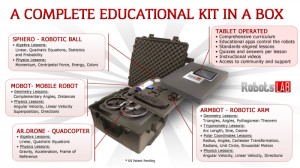
The BOX contains 4 robots; AR.Drone, Sphero, Armbot and Mobot; that demonstrate core concepts in algebra, physics, geometry, trigonometry and calculus. The BOX also contains accessories and a tablet preloaded with 50 lessons, all thoroughly tested by an expert teacher panel in classrooms prior to the launch.
“You can open the box, turn-on the preloaded tablet and within minutes explain quadratic equations with a Quadcopter” explains Prof. Peter Stone, UT Austin. “You don’t need to be experienced with robotics or have a degree in computer science, just an enthusiasm for your subject area.”
I have seen quite a few robot startups entering trying to enter the education sector recently, but few have the strategies or resources to tackle the incumbents, like Lego. One problem for the sector is the lack of market data specific to robotics. Robotics statistics agencies like IFR don’t seem to offer useful figures specific to this vertical and market leaders in the education space don’t share their data. New and emerging companies face an uphill battle gaining initial investors as they move from the research and prototype stage (usually supported by universities) into the commercialization stage. At the same time, they have to learn how to crack the tough customer nut that is the education system. Still if robotics can sell into defence and health, then education is achievable. And presumably, once you’ve broken into the market, you gain a lot of traction as an incumbent.
I interviewed Elad Inbar about robot startups entering the education sector:
[Elad Inbar] “The IFR (International Federation of Robotics) does not provide data about this market in this level of granularity and most of the companies don’t really share data about their sales, it is hard to figure out the actual value. Based on my experience in the educational robotics market in the past 4 years and our understanding of the market, I can say that the market (hardware sales – including robotic kits from DIY, VEX and LEGO, over to all kinds of robotic arms and similar robots and all the way to advanced robots for research such as NAO, Q.bo and DARwIn) is roughly $50-60 million\year. If you include services such as training, courses, development, after hour classes, etc. then the number will go up to roughly $150-200\year.
To me, the market has not yet reached even 10% of its potential, as educational robotics are mainly focused on computer science, robotics, artificial intelligence and such. There are many other niches in the education that can definitely benefit from robotics – such as our product that teaches Algebra, Geometry and science.”
[Andra Keay] What are your next plans?
[Elad Inbar] “We want to bring this unique experience to every school, we crafted state-of-the-art lessons that teachers and students love, and created an aggressive pricing and warranty, ensuring that every school will be able to get this revolutionary teaching-aid tool.”
[Andra Keay] And what differentiates you from other products in the area?”
“[Elad Inbar] All the educational robotics lessons are focused around computer science, robotics (building or programming), artificial intelligence and similar advanced topics. However, if students don’t understand the basics of math, they won’t be able to handle any advanced topic. No other product is using robotics to teach Algebra, Geometry, Trigonometry and Calculus that are the foundation for SLAM (Simultaneous localization and mapping) as an example.
We believe that the BOX and its lessons (apps) can make the difference for so many students who are struggling with the basics of STEM.”
tags: Business Deal, Elad Inbar, review, RobotAppStore, Service Professional Other, Social aspect, startup

AUAI is supported by:









