
Robohub.org
Waymo deploys with no human safety driver oversight
Credit:Waymo
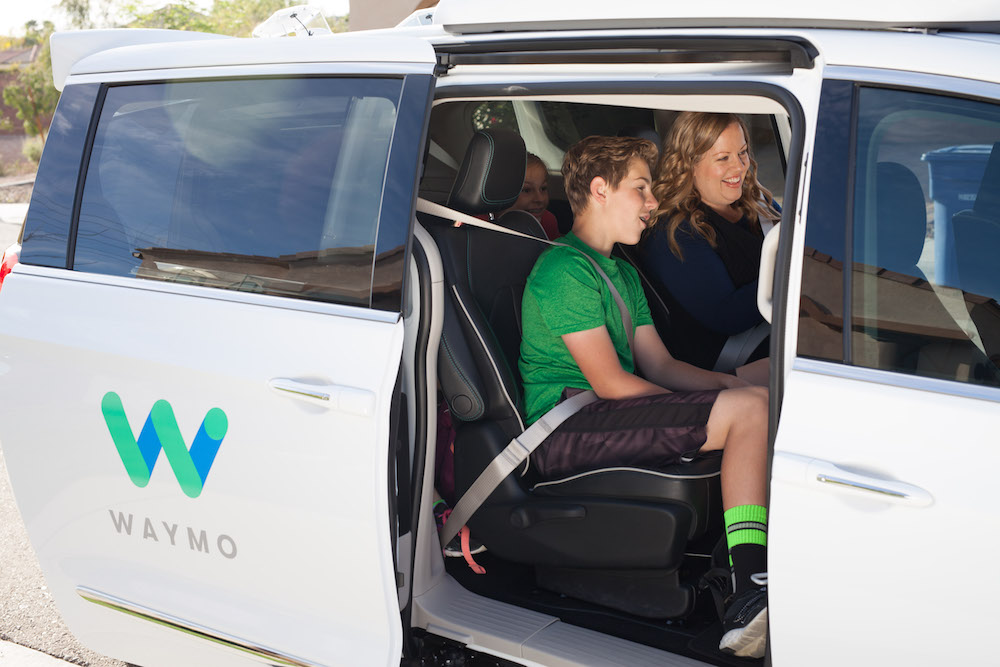
In a major milestone for robocars, Waymo has announced they will deploy in Phoenix with no human safety drivers behind the wheel. Until now, almost all robocars out there have only gone out on public streets with a trained human driver behind the wheel, ready to take over at any sign of trouble. Waymo and a few others have done short demonstrations with no safety driver, but now an actual pilot, providing service to beta-testing members of the public, will operate without human supervision.
https://youtube.com/watch?v=aaOB-ErYq6Y%3Frel%3D0
This is a big deal, and indicates Waymo’s internal testing is showing a very strong safety record. The last time they published numbers, they had gone 83,000 miles between “required interventions.” While in safety driver training, we are told to intervene at any sign of a problem, these interventions are tested in simulation to find out what would have happened if there had been no intervention. If the car would have done the right thing, it’s not a required intervention.
Waymo must have built their number up a great deal from there. People have an accident that is reported to insurance about ever 250,000 miles, and to police every 500,000 miles. Injury accidents happen every 1.2M miles, and fatalities every 80M miles. In Waymo’s testing, where they got hit a lot by other drivers, they discovered that there are “dings” about every 100,000 miles that don’t get reported to police or insurance.
People have argued about how good you have to be to put a robocar on the road. You need to be better than all those numbers. I will guess that Waymo has gotten the “ding” number up above 500,000 miles — which is close to a full human lifetime of driving. Since they have only driven 3.5M miles they can’t make real-world estimates of the frequency of injuries and certainly not of fatalities, but they can make predictions. And their numbers have convinced them, and the Alphabet management, that it’s time to deploy.
Congratulations to all the team.
They did this not just with real world testing, but building a sophisticated simulator to test zillions of different situations, and a real world test track where they could test 20,000 different scenarios. And for this pilot they are putting it out on the calm and easy streets of Phoenix, probably one of the easiest places to drive in the world. Together, that gives the confidence to put “civilians” in the cars with no human to catch an error. Nothing will be perfect, but this vehicle should outperform a human driver. The open question will be how the courts treat that when the first problem actually does happen. Their test record suggests that may be a while; let us hope it is.
Where do we go from here?
This pilot should give pause to those who have said that robocars are a decade or more away, but it also doesn’t mean they are full here today. Phoenix was chosen because it’s a much easier target than some places. Nice, wide streets in a regular grid. Flat terrain. Long blocks. Easy weather with no snow and little rain. Lower numbers of pedestrians and cyclists. Driving there does not let you drive the next day in Boston.
But neither does it mean it takes you decades to go from Phoenix to Boston, or even to Delhi. As Waymo proves things out in this pilot, first they will prove the safety and other technical issues. Then they will start proving out business models. Once they do that, prepare for a land rush as they leap to other cities to stake the first claim and the first-mover advantage (if there is one, of course.) And expect others to do the same, but later than Waymo, because as this demonstrates, Waymo is seriously far ahead of the other players. It took Waymo 8 years to get to this, with lots of money and probably the best team out there. But it’s always faster to do something the 2nd time. Soon another pilot from another company will arise, and when it proves itself, the land rush will really begin.

AUAI is supported by:









