
Robohub.org
China overtakes USA in robot density, according to World Robotics 2022 Report
China’s massive investment in industrial robotics has put the country in the top ranking of robot density, surpassing the United States for the first time. The number of operational industrial robots relative to the number of workers hit 322 units per 10,000 employees in the manufacturing industry. Today, China ranks in fifth place. The world´s top 5 most automated countries in manufacturing 2021 are: South Korea, Singapore, Japan, Germany and China.
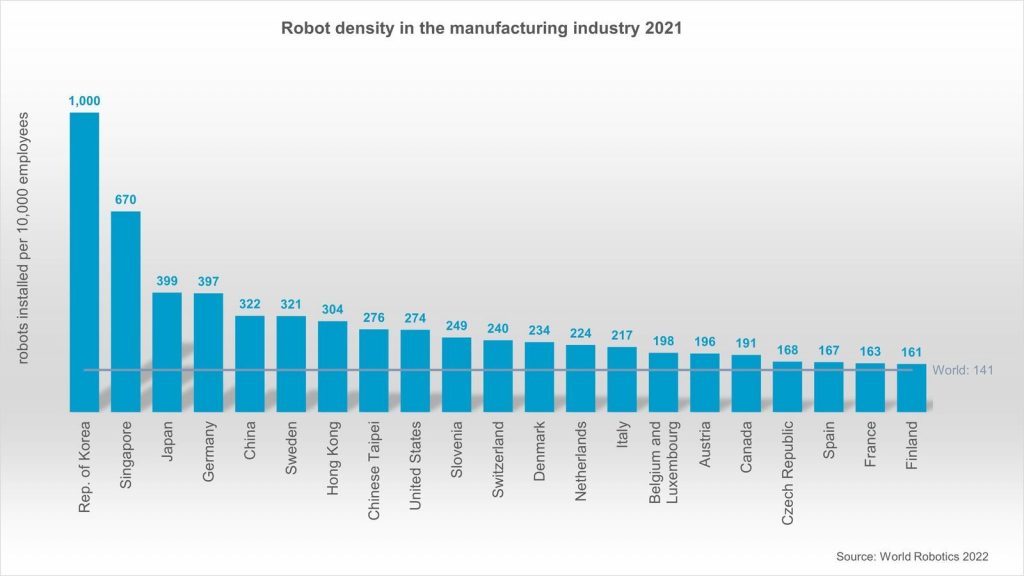
World average of robot density more than doubles compared to six years ago (2015: 69 units)
“Robot density is a key indicator of automation adoption in the manufacturing industry around the world,” says Marina Bill, President of the International Federation of Robotics. “The new average of global robot density in the manufacturing industry surged to 141 robots per 10,000 employees – more than double the number six years ago. China’s rapid growth shows the power of its investment so far, but it still has much opportunity to automate.”
Robot density by region
Driven by the high volume of robot installations in recent years, Asia’s average robot density surged by 18% compound annual growth rate (CAGR) since 2016 to 156 units per 10,000 employees in 2021. The European robot density had been growing by 8% (CAGR) in the same period of time reaching 129 units. In the Americas it was 117 robots – plus 8% (CAGR).
Top countries
The Republic of Korea hit an all-time high of 1,000 industrial robots per 10,000 employees in 2021. This is more than three times the number reached in China and makes the country number one worldwide. With its globally recognized electronics industry and a distinct automotive sector, the Korean economy profits from two large customer industries for industrial robots.
Singapore takes second place with a rate of 670 robots per 10,000 employees in 2021. Singapore’s robot density had been growing by 24% on average each year since 2016.
There is a remarkable gap to Japan (399 robots per 10,000 employees) which ranks third. Japan’s robot density had grown by 6% on average each year since 2016. Germany in fourth place (397 units) is the largest robot market in Europe.
China is by far the fastest growing robot market in the world. The country has the highest number of annual installations, and since 2016 it has each year had the largest operational stock of robots.
United States
Robot density in the United States rose from 255 units in 2020 to 274 units in 2021. The country ranks ninth in the world, down from seventh – now head-to-head with Chinese Taipei (276 units) and behind Hong Kong (304 units) and Sweden (321 units).
Orders for World Robotics 2022 Service Robots and Industrial Robots reports can be placed online. Further downloads on the content are available here.
Videos
FACTS video about ROBOT DENSITY
Video of recorded World Robotics press conference
tags: reports

AUAI is supported by:









