
Robohub.org
 

Chris Hadfield launches Canada’s new five dollar bill … from outer space

by
10 May 2013


share this:
$5 bill canada

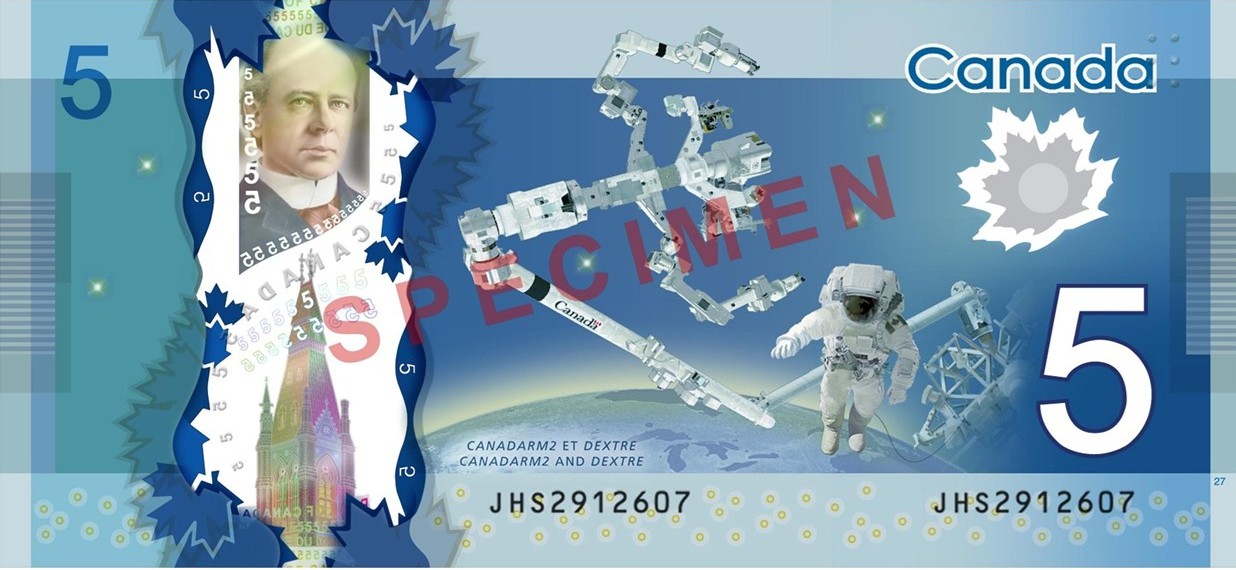
Earlier this month CSA Astronaut Chris Hadfield revealed the new Canadian $5 bank note in a live videostream from the International Space Station to the Bank of Canada’s Ottawa head office. Why all the extraterrestrial fanfare? The new polymer bill proudly sports Canadian space robotics achievements Canadarm2 and Dextre.

The 17.2 meter-long Canadarm2 was launched in April 2001 and is the robotic arm that assembled the International Space Station (ISS) while in space. Dextre was launched in March 2008 to help ISS crew by taking care of routine maintenance jobs outside the station, and its duties include moving cargo transport containers, replacing failed electrical parts, and unpacking visiting spacecraft. Dextre was also the first robot to refuel a mock satellite in space.

“It really marks Canada’s contribution to the space station program and especially our longterm area of expertise in robotics,” said Hadfield, who also stated that he was proud to see Canada’s achievements in space highlighted on the bill.

Hadfield, who regularly tweets and videoblogs from outerspace, has become something of an icon and mentor among young Canadians. On Monday, he conducted the last of his live video downlinks from the ISS by co-performing the song ISS (Is Somebody Singing) — a song he co-wrote with Ed Robertson of the Barenaked Ladies — in a live simulcast with thousands of school kids from across the country.

Hadfield returns to earth on Monday, May 13.


Hallie Siegel robotics editor-at-large

            AUAI is supported by:


Subscribe to Robohub newsletter on substack


Related posts :

AI agents create virtual playgrounds to help robots get crucial training data

  07 Aug 2026
“SceneSmith” system uses collaborative AI agents to create realistic 3D environments of places like kitchens, hotels, and living rooms, where robots can simulate everyday chores.

Robots in society, business and culture: July 2026

A round up of robotics stories in a new monthly series from IEEE RAS.

Simulated zebrafish and a vision-equipped robotic fish reveal how the body shapes brain circuits

Researchers look to the fish brain to create a robotic zebrafish that can autonomously swim upstream.

Researchers develop modular nanorobot

  31 Jul 2026
A team at the University of Basel has developed a versatile nanorobot with propulsion and payload modules.

Surviving the paper deluge: a one-year study in learning from demonstration

With the explosion of robotics research, staying current in fields like Learning from Demonstration is a monumental challenge.

Soft robotic heart offers new way to study disease and test life-saving devices

Researchers have developed a soft robotic model of the human heart that can mimic disease and provide a realistic environment for testing the next generation of cardiac devices.

A mini robot to simplify dental treatment

  24 Jul 2026
Researchers have developed a miniature dental robot that could one day automatically prepare teeth for crowns.

Pressure-free growing robots for soft medical robotics

A Q&A with the best paper award winner at RoboSoft.


AUAI is supported by:


Subscribe to Robohub newsletter on substack


©2026.05 - Association for the Understanding of Artificial Intelligence









