
Robohub.org
Conversation on racism and robotics
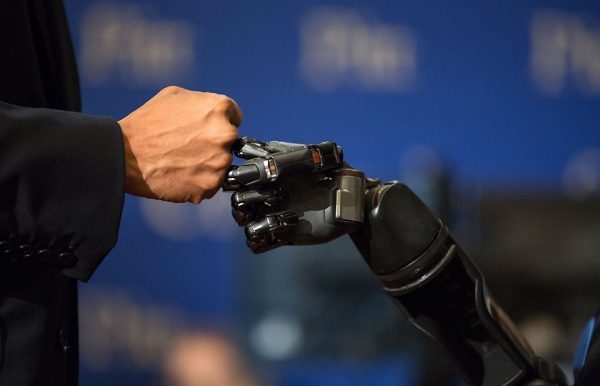
Talking about racism and its impact on robotics and roboticists was the first conversation in our new monthly online discussion series “Society, Robots and Us” on last Tuesday of the month at 6pm PDT. It was a generous, honest and painful discussion that I hope has left a lasting impact on everyone who listened. There is systemic racism in America, and this does have an impact on robotics and roboticists in many many ways. UPDATE: Black in Robotics has launched on twitter and online https://blackinrobotics.org
The US Senator Elizabeth Warren in conversation today with Alicia Garza from Black Futures Lab said, “America was founded on principles of liberty and freedom, but it was built on the backs of enslaved people. This is a truth we must not ignore. Racism and white supremacy have shaped every crucial aspect of our economy, and our political system for generations now.”
The speakers in ‘Society, Robots and Us’ were Chad Jenkins, Monroe Kennedy III, Jasmine Lawrence, Tom Williams, Ken Goldberg and Maynard Holliday explored the impact of racism in their experiences in robotics, along with explicit information about changes that we all can make. And we discussed learnings for allies and supporters and what a difference support could make. Please listen to the full discussion but Chad Jenkin’s notes capture some of the critical insights.
“I have been in computing for nearly 30 years and a roboticist for over 20 years. Thus, I have been able to experience firsthand many of the systemic problems that face our field. Let me build on some of the recommendations from the blackincomputing.org open letter and call to action. “
In particular, I believe we can bring equal opportunity to STEM quickly by upholding Title VI of the Civil Rights Act of 1964 and Title IX of the Educational Amendments of 1972 for institutions receiving federal funding, and public funding more generally. We now incentivize systemic disparate impacts in STEM.
Like law enforcement, university faculty are asked to do too much. Given our bandwidth limits, we have to make hard choices about what gets our attention and effort.
This creates a dilemma in every faculty member about whether to bolster their own personal advancement (by gaining social acceptance in the establishments of the field that control access to funding, hiring, and publishing through peer review) or further create and extend opportunity to others (taking a professional sacrifice to provide mentorship and empathy to future generations towards broadening participation in the STEM workforce).
It is clear STEM incentivizes the former given systemic exclusion of underrepresented minorities, with disastrous results thus far.
I believe we are a vastly better society with the upholding of Title VII of the Civil Rights Act of 1964 yesterday by the Supreme Court to prohibit employment discrimination against LGBTQ+ citizens. Discrimination is wrong. My hope is that we can apply this same standard and attention for Title VI of this statue to outcomes in STEM. This is not an issue of altruism, it reflects our true values at a nation and affects the quality of our work and its impact on the world.
There are placeholder measures that can be enacted to incentivize equal opportunity. For example, universities could decline sabbatical and leave requests from faculty seeking to collaborate with companies that have failed to provide equal opportunity, such as OpenAI and Google DeepMind.
To achieve systemic fairness in robotics, however, we must go beyond token gestures to address the causal factors of inequity rooted in the core economic incentives of our universities. It is universities that are the central ladder to opportunity through the development of future leaders, innovators, and contributors to our society.
We have the tools at hand today to create equal opportunity in STEM. The question is whether we have the will.
Equal opportunity cannot be true for anyone unless equal opportunity is true for everyone.
Odeste Chadwicke Jenkins, Associate Professor University of Michigan Robotics Institute
Our next episode of “Society, Robots and Us” on June 30 is going to discuss the role and the roll out of killer robots, but we’ll be coming back to talk more about racism, diversity and inclusion in robotics because we’ve only just scratched the surface. Sept 29 episode will be about Open Source Robotics.
tags: herotagrc

AUAI is supported by:









