
Robohub.org
Engineering fantasy into reality
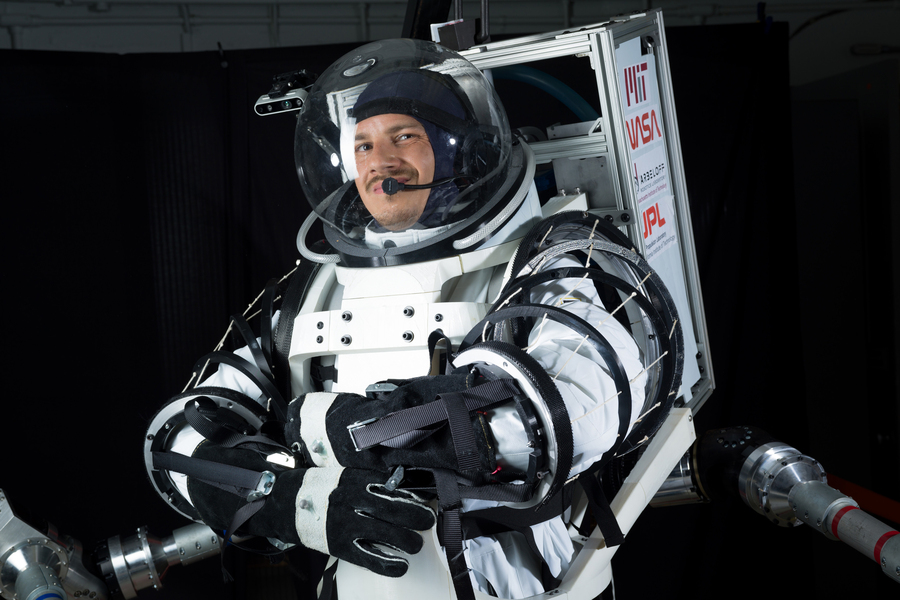 “One of the dreams I had as a kid was about the first day of school, and being able to build and be creative, and it was the happiest day of my life. And at MIT, I felt like that dream became reality,” says Ballesteros. Credit: Ryan A Lannom, Jet Propulsion Laboratory.
By Jennifer Chu
Growing up in the suburban town of Spring, Texas, just outside of Houston, Erik Ballesteros couldn’t help but be drawn in by the possibilities for humans in space.
It was the early 2000s, and NASA’s space shuttle program was the main transport for astronauts to the International Space Station (ISS). Ballesteros’ hometown was less than an hour from Johnson Space Center (JSC), where NASA’s mission control center and astronaut training facility are based. And as often as they could, he and his family would drive to JSC to check out the center’s public exhibits and presentations on human space exploration.
For Ballesteros, the highlight of these visits was always the tram tour, which brings visitors to JSC’s Astronaut Training Facility. There, the public can watch astronauts test out spaceflight prototypes and practice various operations in preparation for living and working on the International Space Station.
“It was a really inspiring place to be, and sometimes we would meet astronauts when they were doing signings,” he recalls. “I’d always see the gates where the astronauts would go back into the training facility, and I would think: One day I’ll be on the other side of that gate.”
Today, Ballesteros is a PhD student in mechanical engineering at MIT, and has already made good on his childhood goal. Before coming to MIT, he interned on multiple projects at JSC, working in the training facility to help test new spacesuit materials, portable life support systems, and a propulsion system for a prototype Mars rocket. He also helped train astronauts to operate the ISS’ emergency response systems.
Those early experiences steered him to MIT, where he hopes to make a more direct impact on human spaceflight. He and his advisor, Harry Asada, are building a system that will quite literally provide helping hands to future astronauts. The system, dubbed SuperLimbs, consists of a pair of wearable robotic arms that extend out from a backpack, similar to the fictional Inspector Gadget, or Doctor Octopus (“Doc Ock,” to comic book fans). Ballesteros and Asada are designing the robotic arms to be strong enough to lift an astronaut back up if they fall. The arms could also crab-walk around a spacecraft’s exterior as an astronaut inspects or makes repairs.
Ballesteros is collaborating with engineers at the NASA Jet Propulsion Laboratory to refine the design, which he plans to introduce to astronauts at JSC in the next year or two, for practical testing and user feedback. He says his time at MIT has helped him make connections across academia and in industry that have fueled his life and work.
“Success isn’t built by the actions of one, but rather it’s built on the shoulders of many,” Ballesteros says. “Connections — ones that you not just have, but maintain — are so vital to being able to open new doors and keep great ones open.”
Getting a jumpstart
Ballesteros didn’t always seek out those connections. As a kid, he counted down the minutes until the end of school, when he could go home to play video games and watch movies, “Star Wars” being a favorite. He also loved to create and had a talent for cosplay, tailoring intricate, life-like costumes inspired by cartoon and movie characters.
In high school, he took an introductory class in engineering that challenged students to build robots from kits, that they would then pit against each other, BattleBots-style. Ballesteros built a robotic ball that moved by shifting an internal weight, similar to Star Wars’ fictional, sphere-shaped BB-8.
“It was a good introduction, and I remember thinking, this engineering thing could be fun,” he says.
After graduating high school, Ballesteros attended the University of Texas at Austin, where he pursued a bachelor’s degree in aerospace engineering. What would typically be a four-year degree stretched into an eight-year period during which Ballesteros combined college with multiple work experiences, taking on internships at NASA and elsewhere.
In 2013, he interned at Lockheed Martin, where he contributed to various aspects of jet engine development. That experience unlocked a number of other aerospace opportunities. After a stint at NASA’s Kennedy Space Center, he went on to Johnson Space Center, where, as part of a co-op program called Pathways, he returned every spring or summer over the next five years, to intern in various departments across the center.
While the time at JSC gave him a huge amount of practical engineering experience, Ballesteros still wasn’t sure if it was the right fit. Along with his childhood fascination with astronauts and space, he had always loved cinema and the special effects that forged them. In 2018, he took a year off from the NASA Pathways program to intern at Disney, where he spent the spring semester working as a safety engineer, performing safety checks on Disney rides and attractions.
During this time, he got to know a few people in Imagineering — the research and development group that creates, designs, and builds rides, theme parks, and attractions. That summer, the group took him on as an intern, and he worked on the animatronics for upcoming rides, which involved translating certain scenes in a Disney movie into practical, safe, and functional scenes in an attraction.
“In animation, a lot of things they do are fantastical, and it was our job to find a way to make them real,” says Ballesteros, who loved every moment of the experience and hoped to be hired as an Imagineer after the internship came to an end. But he had one year left in his undergraduate degree and had to move on.
After graduating from UT Austin in December 2019, Ballesteros accepted a position at NASA’s Jet Propulsion Laboratory in Pasadena, California. He started at JPL in February of 2020, working on some last adjustments to the Mars Perseverance rover. After a few months during which JPL shifted to remote work during the Covid pandemic, Ballesteros was assigned to a project to develop a self-diagnosing spacecraft monitoring system. While working with that team, he met an engineer who was a former lecturer at MIT. As a practical suggestion, she nudged Ballesteros to consider pursuing a master’s degree, to add more value to his CV.
“She opened up the idea of going to grad school, which I hadn’t ever considered,” he says.
Full circle
In 2021, Ballesteros arrived at MIT to begin a master’s program in mechanical engineering. In interviewing with potential advisors, he immediately hit it off with Harry Asada, the Ford Professor of Enginering and director of the d’Arbeloff Laboratory for Information Systems and Technology. Years ago, Asada had pitched JPL an idea for wearable robotic arms to aid astronauts, which they quickly turned down. But Asada held onto the idea, and proposed that Ballesteros take it on as a feasibility study for his master’s thesis.
The project would require bringing a seemingly sci-fi idea into practical, functional form, for use by astronauts in future space missions. For Ballesteros, it was the perfect challenge. SuperLimbs became the focus of his master’s degree, which he earned in 2023. His initial plan was to return to industry, degree in hand. But he chose to stay at MIT to pursue a PhD, so that he could continue his work with SuperLimbs in an environment where he felt free to explore and try new things.
“MIT is like nerd Hogwarts,” he says. “One of the dreams I had as a kid was about the first day of school, and being able to build and be creative, and it was the happiest day of my life. And at MIT, I felt like that dream became reality.”
Ballesteros and Asada are now further developing SuperLimbs. The team recently re-pitched the idea to engineers at JPL, who reconsidered, and have since struck up a partnership to help test and refine the robot. In the next year or two, Ballesteros hopes to bring a fully functional, wearable design to Johnson Space Center, where astronauts can test it out in space-simulated settings.
In addition to his formal graduate work, Ballesteros has found a way to have a bit of Imagineer-like fun. He is a member of the MIT Robotics Team, which designs, builds, and runs robots in various competitions and challenges. Within this club, Ballesteros has formed a sub-club of sorts, called the Droid Builders, that aim to build animatronic droids from popular movies and franchises.
“I thought I could use what I learned from Imagineering and teach undergrads how to build robots from the ground up,” he says. “Now we’re building a full-scale WALL-E that could be fully autonomous. It’s cool to see everything come full circle.”

AUAI is supported by:









