
Robohub.org
euRathlon 2013 land robotics competition – Day Three recap
The sun was shining again on the third day of euRathlon 2013 outdoor robotics competition in Berchtesgaden, Germany. Wednesday was the day for the “Search and rescue in a smoke-filled underground structure” scenario, and the last day of the euRathlon 2013 workshop, where attendees enjoyed presentations by specialists in various areas of robotics. The keynote presentation was given by Shinji Kawatsuma, senior primary engineer of the Japan Atomic Energy Agency, who talked about the lessons learned from using robots in the emergency response disaster of Fukushima Daiichi NPP. Following the presentations was a UAV pilot demonstration carried out by the Center for Advanced Aerospace Technologies (CATEC). Watch the Day Three recap video …
Workshop Day Two
In addition to the keynote, Day Two of the workshop featured more presentations by specialists in the area of robotics:
- Anne Bajart, of the and euRathlon European Commission project officer , “Unmanned vehicles and Horizon 2020”
- Shinji KAWATSUMA, Senior primary engineer of the Japan Atomic Energy Agency (JAEA)
“Robotic lessons learned in emergency response to Fukushima Daiichi NPP” - Dr.-Ing. Peer Rechenbach, Senior Expert of Disaster Management, Civil
Protection, Leadership Organization and CBRN-Measurement.
“Information needs for decision makers in case of major emergencies – Experiences” - Martin Hutchings, of the National Bomb Squad Commanders Advisory Board (NSBCAB) “Robots used by police and bomb squads”
- Dr.-Ing Konstantin Kondak, of the DRL (National aeronautics and space research centre of the Federal Republic of Germany)
“Robotics Technologies for Flying Robots – New applications and challenges” - Antidio Viguria Jiménez, of CATEC (Center for Advanced Aerospace Technologies) “UAV platform available for teams participating in euRathlon 2015”
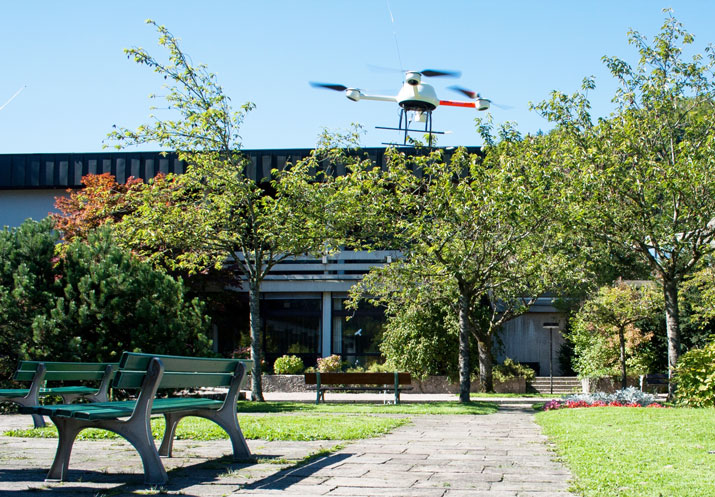
Following the presentations, a safety pilot from CATEC, one of the partners of euRathlon consortium, did a UAV pilot demonstration in the garden of the Kongresshaus, and attendees were invited to test their pilot skills.
The 3rd Scenario: Search and rescue in a smoke-filled underground structure
The scenario “Search and rescue in a smoke-filled underground structure” took place in a tunnel located next to Salinenplazt in Berchtesgaden. The tunnel entrance was covered with large curtains to keep the inside of the underground structure in darkness and filled with dense smoke.
This scenario required competing robots to enter the tunnel, inspect the area, and search for Objects of Potential Interest (OPI) — ERICard number plates. Debris and objects were scattered across the floor and stacked next to the walls to make navigation more difficult for the robots. The robots were required to build a geometric representation of the tunnel and reference all the OPI detected there. Once the OPIs were referenced and all the data and images reported to the control station, the robot had to leave the tunnel and return to the starting point.
The teams had 30 minutes to find as many OPI as they could and transmit the acquired data to the control station.
Spectators could follow the competition outside the perimeter of the underground scenario. Live camera video and computer screenshots were displayed on a big screen.
The competing robots managed well despite the extremely poor visibility and the debris-covered terrain; however locating all the OPIs in 30 minutes was a difficult challenge.
Of the ten teams participating in this scenario, eight qualified for the final. These eight teams were: ELP, Telerob, Ensta-Bretagne, IMM-IAIR,Robotics Inventions, SCentrRo, Space Applications and E15.
See all the euRathlon 2013 coverage.
tags: euRathlon, euRathlon 2013, events, research
AUAI is supported by:









