
Robohub.org
euRathlon 2013 land robotics competition – Day Two recap
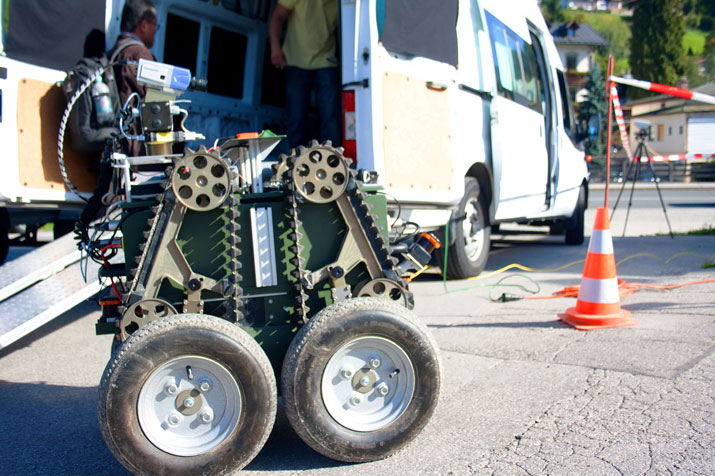
The second day of euRathlon competition started with the opening session of the euRathlon 2013 workshop, which was run in parallel with the scenario “Reconnaissance and surveillance in urban structures” (USAR). The competition continued until the end of the evening, followed by a fire drill performed by the local fire brigades featured in the same building as the USAR scenario. The fire drill took place simultaneously with an interactive display session of workshop posters in the Salinenplatz marquee. A typical and festive Bavarian dinner was served to teams, workshop delegates and fire fighters at the end of the second day. Watch the Day Two recap video …
Workshop – Day One
The first day of the euRathlon 2013 workshop was held in the Congress Centre “Kur-und Kongresshaus” of Berchtesgdaen, and featured presentations by specialists in the area of robotics for field search-and-rescue:
- Dr.-Ing. Michael Gustmann, “Real-world field robotics: Nuclear emergency response robotics in Germany”
- Thommaso Flamma, “ICARUS Unmanned Search and Rescue”
- Adam Jacoff, “Standard Test Methods for Response Robots: Supporting Objective Evaluations, Procurements, and Operator Training”
- George Kern, “Synthetic Aperture Processing for Deep GNSS/INS Integration”
- Andrzej Typiak , “Development of high mobility platforms for search and rescue missions”
- Prof. Sergey Tsarichenko “Robots of the all-Russian Scientific Research Institute for Fire Protection”
- Dirk Schmidt “BlueBot phone app robot control system”
The 2nd scenario: Reconnaissance and surveillance in urban structures (USAR)
The Reconnaissance and Surveillance in Urban Structures (USAR) scenario was held in the basement of an old building next to Berchtesgaden train station.
The scenario required competitors’ robots enter to the building and go down the stairs to the basement. Once there, the robots had to inspect the building and search for Objects of Potential Interest (OPI), which, for this scenario were ERICard number plates. While the robots were performing the search task, they had to simultaneously build a geometric representation of the structure and its environment and reference all the OPI detected in it. All data and images had to be reported to the control station, and live camera video and computer screen shoots were displayed on a big screen outside the building where spectators followed the competition.
The teams had 60 minutes to find as many OPI as they could and transmit the acquired data to the control station.
Going down the stairs was the most difficult task for the six teams that participated in the USAR scenario. Most of the robots used an elevator lift to go to the basement (despite a score penalization for doing so); of those teams that decided to take the stairs, many wound up upside-down on the staircase landing.
The robots were able to find OPIs in very low light conditions, to transmit data and to successfully build a 2-D and 3-D geometric representations of the urban structure.
The six teams that qualified for Friday’s finals were: ELP, Telerob, Space Applications, Robotics Inventions, IMM-IAIR and Fraunhofer FKIE.
Exhibition area
Various companies and organisations have their products and projects on display in the exhibition area this week. On Day Two, exhibition area visitors witnessed how teams had the chance to test their robots in an off-competition testing circuit designed by people from the National Institute of Standards and Technology (NIST), USA.
Workshop posters display and social event
In the evening, the exhibition area held an interactive display session of workshop posters and a typical Bavarian dinner, and team members, workshop delegates and fire fighters exchanged ideas and talked about their projects and jobs while having a drink.
See all the euRathlon 2013 coverage.
tags: euRathlon, euRathlon 2013, events, research
AUAI is supported by:









