Robohub.org
Forget Singularity, let’s talk Multiplicity: Ken Goldberg on AI at the WEF
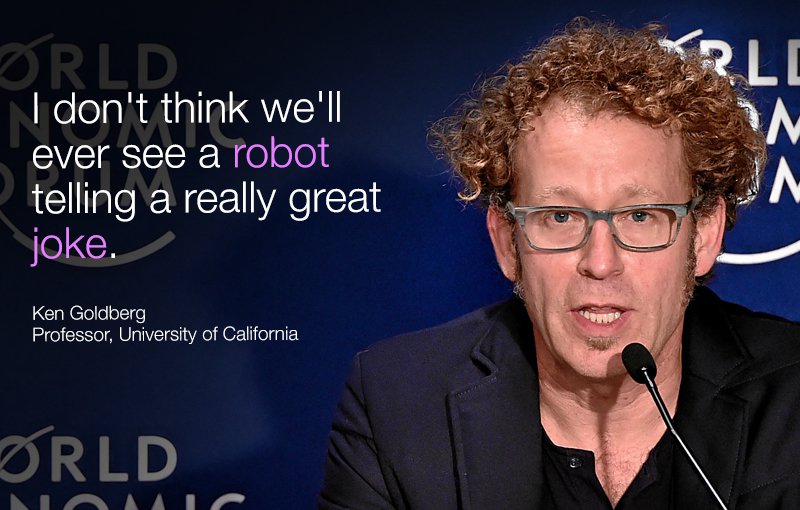
Each January, the World Economic Forum‘s (WEF) annual meeting takes place in Davos, Switzerland. This event is one of the preeminent economic conferences in the world, and this year, there was a major focus on technology; specifically, robotics, artificial intelligence, and Big Data. To discuss these areas, many leading experts were invited to speak at the conference, including Rodney Brooks, Red Whittaker, and Ken Goldberg—who we were lucky enough to speak with about the event. Goldberg is a Professor of Engineering and Art at UC Berkeley, as well as the Editor-in-Chief of the IEEE Transactions on Automation Science and Engineering. Check out his WEF talk below.
What are some of your current research projects?
My students and I are excited about several new projects, in particular our new Center for Automation and Learning for Medical Robotics (Cal-MR), Cloud Robotics and Automation, upcoming Special Issues for the IEEE Transactions on Automation Science and Engineering, and the African Robotics Network (AFRON), details can be found at http://goldberg.berkeley.edu.
What is the common theme in these projects?
The Cloud, Statistical Machine Learning, and importance of humans in the loop.
What did you speak about at the WEF? What kind of reaction did you receive?
UC Berkeley was invited to attend with a group of six faculty. It was the first time a public university was invited. We participated in a number of panels including an Oxford-style debate on “Will Machines Make Better Decisions Than Humans?” There was no pressure, just Chancellor Nicholas Dirks and Jack Ma, founder of Alibaba, in the front row ;)
In 2013, the WEF focused on business leadership; in 2014, there was an emphasis on technology with a few robotics related discussions; now in 2015, several robotics experts were invited to speak. Why do you believe economists are becoming more interested in technology now?
Several leaders including Stephen Hawking to Elon Musk to Bill Gates have recently expressed concerns that robots and AI may soon threaten humans. Google, Amazon, Facebook, and Apple are investing in robots. Drones for Good (for monitoring the environment) are here, and computer-assisted driving (but not totally automated driving) is starting to appear. Political and Business leaders view robots as an important frontier.
On the Economist podcast Money Talks, the mood at the WEF was described to be schizophrenic: technology people were almost utopian about the future (see Bill Gate’s letter), while economists despair (massive competition, fast CEO turnover, the collapse of middle-class spending power, etc). What was your impression of the mood at the WEF?
There was a broad range of perspectives and moods. A very big topic was the “Singularity,” popularized by Verner Vinge and Ray Kurzweil: a point where computers will surpass humans.
Most roboticists think the Singularity is nonsense. It is sensational and scares the hell out people, but although there have been major advances in machine learning and large-scale learning and model fitting from Big Data sets, there’s no sign that computers are getting any better at creativity, design, or any form of innovation. And robots are still suffering from Moravec’s Paradox: what’s hard for humans, like precision spot welding, is easy for robots, and what’s easy for humans, like clearing the dinner table, is hard for robots.
In our debate, I proposed that it’s time to move beyond the Singularity to a new idea that we might call Multiplicity, a model where groups of humans work effectively with groups of machines to answer important questions. The Multiplicity is inclusive, emphasizes diversity, and is actually practical as it applies to things like Google’s Search Engine, Wikipedia, and the Google Car. The Multiplicity builds on emerging results in Collective Intelligence (for humans) and Ensemble Learning Theory (for machines).
After the panel I spoke with Peter Diamandis (co-founder of the Singularity Institute) who said he agrees in principle with this idea, as did Rod Brooks, and Sandy Pentland of MIT, and Justine Cassell, Illah Nourbakhsh, and Tony Stentz from CMU.
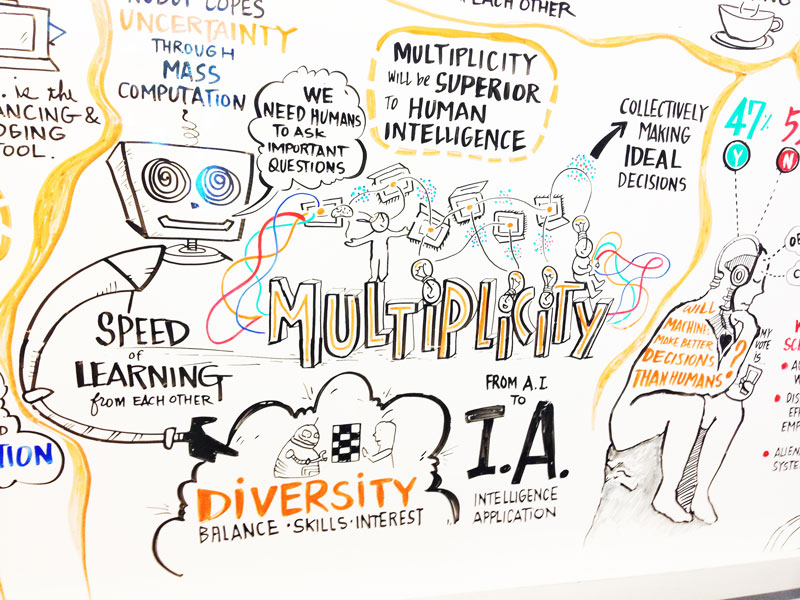
Source: Ken Goldberg.
What surprised you most at the WEF?
The high security. Someone said there were 5000 police and soldiers assigned to protect 2500 participants. I was lucky to meet leaders from a range of backgrounds, from Africa, Russia, India, Brazil, the Prince of Denmark, Shimon Peres, the Director of the National Science Foundation, and Peter Gabriel.
Did you think that any topics were missing from the conference program?
It was my first time and I was surprised to see so many faculty and artists. There are new tracks on science, technology, and culture, in addition to the expected ones on interest rates and export policy.
What upcoming areas do you expect to see discussed at the WEF or similar conferences in the next 2 years? 5 years?
I’m very excited about the Multiplicity and Cloud Robotics enhancing robot-human capabilities, and about robots inspiring future generations of students interests in science, technology, engineering, and math. I also met leaders from Africa who want to work with our African Robotics Network to develop an Ultra-Affordable Robot for Education. Someone designed a robot car from a surplus game controller that can be built for $9. Our dream is to to produce a few thousand in Africa and export them to the rest of the world to inspire the next generation of inventors.
Debate: Will Machines Make Better Decisions Than Humans?
Ken Goldberg’s 5-minute perspective
World Economic Forum, Davos, January 2015
If you liked this article, you may also be interested in:
- Robotics, AI in the spotlight at #WEF15 World Economic Forum
-
Artificial intelligence is a tool, not a threat, by Rodney Brooks
- What would be the energy cost of artificially evolving human-equivalent AI?, by Aland Winfield
- Why robots will not be smarter than humans by 2029, by Alan Winfield
See all the latest robotics news on Robohub, or sign up for our weekly newsletter.
tags: AI-cognition, events, politics, World Economic Forum

AUAI is supported by: