Robohub.org
Healthcare robotics for therapy, with Ayanna Howard
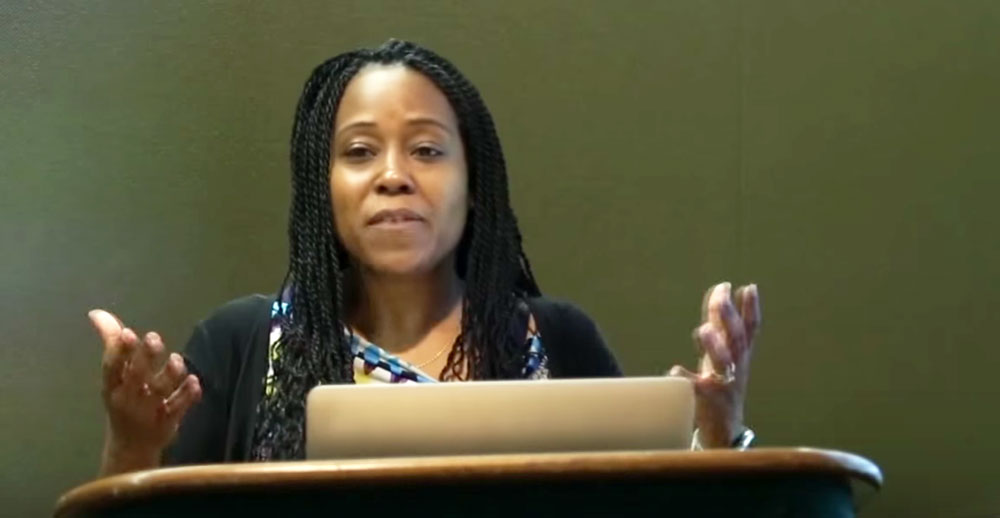
In this short video lecture, Ayanna M. Howard, Motorola Foundation Professor and Associate Director of Research at the Institute for Robotics and Intelligent Machines (Georgia Institute of Technology), introduces us to the world of healthcare robotics for therapy purposes.
Howard focuses on how to provide highly functional robotics that can be used safely both at home and at the hospital to assist a variety of individuals in terms of age, disabilities, and specific treatments. She also highlights the benefits, characteristics and current developments of robotic systems employed in assisting individuals to improve their movement coordination or function, for example in children with CP who not only need therapy assistance but also a play component to motivate and engage.
To find out more about the challenges of robots in therapy, play therapy implementation and robot monitoring/manipulation of the environment, check out this latest lecture.

Source: Georgia Institute
of Technology
Ayanna Howard received her B.S. in Electrical Engineering from Brown University, her M.S.E.E. from the University of Southern California, and her Ph.D. in Electrical Engineering from the University of Southern California, Los Angeles in 1999. Her area of research is centered around the concept of humanized intelligence, the process of embedding human cognitive capability into the control path of autonomous systems. This work, which addresses issues of autonomous control as well as aspects of interaction with humans and the surrounding environment, has resulted in over 100 peer-reviewed publications in a number of projects from scientific rover navigation in glacier environments to assistive robots for the home. To date, her unique accomplishments have been documented in over 12 featured articles – including being named as one of the world’s top young innovators of 2003 by the prestigious MIT Technology Review journal and in TIME magazine’s “Rise of the Machines” article in 2004.
From 1993-2005, Howard was at NASA’s Jet Propulsion Laboratory, California Institute of Technology, where she led research efforts on various robotic projects utilizing vision, fuzzy logic, and neural network methodologies. In 2005, she joined the School of Electrical and Computer Engineering at Georgia Tech, where she is a member of the systems and controls technical interest group and the founder of the Human-Automation Systems (HumAnS) Laboratory. Howard is also a member of the Center for Robotics and Intelligent Machines at Georgia Tech and currently serves as the robotics Ph.D. program coordinator.
Howard A.M. IJARS Video Series: Healthcare Robotics for Therapy [online video]. International Journal of Advanced Robotic Systems, 2015, 12:V8. DOI: 10.5772/61754
tags: Georgia Tech, healthcare, research
AUAI is supported by: