
Robohub.org
Interview with IJARS, with Howie Choset and Seth Hutchinson
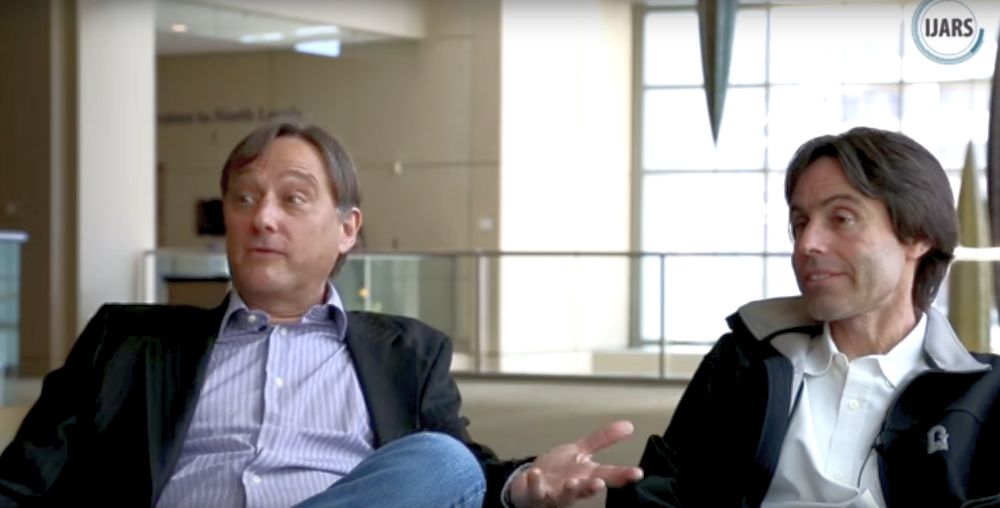
The IJARS team sat down at ICRA with two influential academics in robotics: Professor Howie Choset (Carnegie Mellon University) and Professor Seth Hutchinson (University of Illinois at Urbana-Champaign) to discuss some of the latest developments in robotics, what students of robotics should be focusing on, and what research they most hope to be remembered for.
A bit tongue-in-cheek, but if you ever wondered what engineering minds like to do in their free time there is a humorous Seth & Howie tradition not to be missed! Seth also shares his insight on what makes a science publication truly relevant.
We invite you to watch our interview with the Fantastic Robotics Duo. Enjoy!

Credits: ECE Illinois and Carnegie Mellon
Seth Hutchinson is a faculty member at the University of Illinois in Urbana-Champaign, where he is a professor in the Department of Electrical and Computer Engineering, the Coordinated Science Laboratory, and the Beckman Institute for Advanced Science and Technology. He received his Bachelors, Masters, and Ph.D. degrees in Electrical Engineering from Purdue University. He has published more than 200 papers on the topics of his research interests: vision-based control of robotic manipulators, robot motion planning, and computer vision.
Howie Choset is a Professor of Robotics at Carnegie Mellon University. Motivated by applications in confined spaces, Choset has created a comprehensive program in snake robots, which has led to basic research in mechanism design, path planning, motion planning, and estimation. Choset directs the Undergraduate Robotics Minor at Carnegie Mellon and teaches an overview course on Robotics which uses series of custom developed Lego Labs to complement the course work. In 2002 the MIT Technology Review elected Choset as one of its top 100 innovators in the world under 35. Choset also co-founded a company called Medrobotics (formerly Cardiorobotics) which makes a small surgical snake robot for minimally invasive surgery.
Choset H, Hutchinson S. IJARS Video Series: Howie Choset and Seth Hutchinson interview with the International Journal of Advanced Robotic Systems [online video]. International Journal of Advanced Robotic Systems, 2015, 12:V10. DOI: 10.5772/62191
tags: IJARS
AUAI is supported by:









