
Robohub.org
Light-activated gel could impact wearables, soft robotics, and more
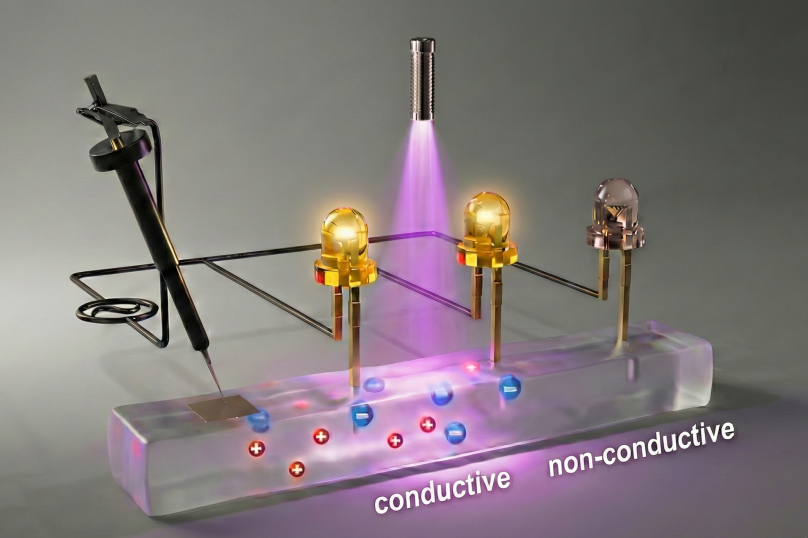 MIT engineers and colleagues have developed a soft, flexible gel that dramatically changes its conductivity upon the application of light. This figure shows a soft, stretchable circuit created with a rectangular bar of the gel. A copper electrode is attached to the left. A stylus and associated metal network connects the electrode to three “stations” on the bar. Light has been shone on the first two stations, creating conductivity that turns on each station’s lightbulb. Because the third station has not been exposed to light it is nonconductive and the bulb is off. Credits: Image courtesy of the Wallin lab.
Consider the chief difference between living systems and electronics: The first is generally soft and squishy, while the latter is hard and rigid. Now, in work that could impact human-machine interfaces, biocompatible devices, soft robotics, and more, MIT engineers and colleagues have developed a soft, flexible gel that dramatically changes its conductivity upon the application of light.
Enter the growing field of ionotronics, which involves transferring data through ions, or charged molecules. Electronics does the same, with electrons. But while the latter is well established, ionotronics is still being developed, with one huge exception: living systems. The cells in our bodies communicate with a variety of ions, from potassium to sodium.
Ionotronics, in turn, can provide a bridge between electronics and biological tissues. Potential applications range from soft wearable technology to human-machine interfaces
“We’ve found a mechanism to dynamically control local ion population in a soft material,” says Thomas J. Wallin, the John F. Elliott Career Development Professor in MIT’s Department of Materials Science and Engineering and leader of the work. “That could allow a system that is self-adaptive to environmental stimuli, in this case light.” In other words, the system could automatically change in response to changes in light, which could allow complex signal processing in soft materials.
An open-access paper about the work was published online recently in Nature Communications.
A growing field
Although others have developed ionotronic materials with high conductivities that allow the quick movement of ions, those conductivities cannot be controlled. “What we’re doing is using light to switch a soft material from insulating to something that is 400 times more conductive,” says Xu Liu, first author of the paper and former MIT postdoc in materials science and engineering who is now an incoming assistant professor at King’s College London.
Key to the work is a class of materials known as photo-ion generators (PIGs). These can become some 1,000 times more conductive upon the application of light. The MIT team optimized a way to incorporate a PIG into polyurethane rubber by first dissolving a PIG powder into a solvent, and then using a swelling method to get it into the rubber.
Much potential
In the material reported in the current work, the change in conductivity is irreversible. But Liu is confident that future versions could switch back and forth between insulating and conducting states.
She notes that the current material was developed using only one kind of PIG, polymer (the polyurethane rubber), and solvent, but there are many other kinds of all three. So there is great potential for creating even better light-responsive soft materials.
Liu also notes the potential for developing soft materials that respond to other environmental stimuli, such as heat or magnetism. “We’re inspired to do more work in this field by changing the driving force from light to other forms of environmental stimuli,” she says.
“Our work has the potential to lead to the creation of a subfield that we call soft photo-ionotronics,” Liu continues. “We are also very excited about the opportunities from our work to create new soft machines impacting soft wearable technology, human-machine interfaces, robotics, biomedicine, and other fields.”
Additional authors of the paper are Steven M. Adelmund, Shahriar Safaee, and Wenyang Pan of Reality Labs at Meta.
Read the work in full
Soft photo-ionotronics, Xu Liu, Steven M. Adelmund, Shahriar Safaee, Wenyang Pan & Thomas J. Wallin, Nature Communications (2026).

AUAI is supported by:









