
Robohub.org
Liquid Robotics set records in PacX
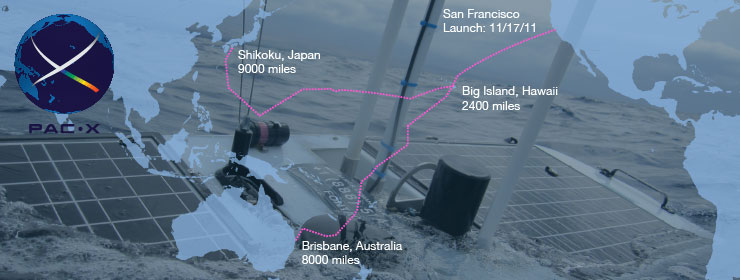
It’s been more than one year and 9,000 nautical miles since Liquid Robotics launched 4 Wave Gliders in San Francisco on November 17, 2011. On November 20, 2012 “Papa Mau” reached the east coast of Australia, near Brisbane. Its sibling “Benjamin” is still enroute, while two other Wave Glider’s ran into delays enroute to Japan. Bill Vass, CEO of Liquid Robotics, announced today that the PacX crossing was a success, both as a research project and the world record for longest autonomous aquatic voyage. In celebration, the top five finalists for the PacX scientific challenge were announced.
“To say we are excited and proud of Papa Mau reaching his final destination is an understatement,” said Bill Vass, CEO of Liquid Robotics. “We set off on the PacX journey to demonstrate that Wave Glider technology could not only survive the high seas and a journey of this length, but more importantly, collect and transmit ocean data in real-time from the most remote portions of the Pacific Ocean. We’ve demonstrated delivery of ocean data services through the most challenging ocean conditions. Mission accomplished.”
An important aspect of the PacX program is the PacX Challenge, a competition designed to encourage scientists and students to make use of the PacX data in interesting, productive, or innovative ways. Research abstracts were submitted from around the world to compete for the grand prize award of a $50,000 research grant from BP and six months of Wave Glider data services.
“Liquid Robotics is proud to announce the PacX Science Board has selected five outstanding finalists to compete for the PacX grand prize,” said Luke Beatman, Oceanographer at Liquid Robotics and chairman of the PacX Science Board. “These scientists will conduct research into some of the world’s most challenging ocean issues ranging from measuring the ocean’s health and respiration to studying the ocean’s biomass – the most fundamental organisms critical to ocean life.” The five PacX finalists are:
J. Michael Beman, University of California Merced, Merced, CA
Nicole Goebel, University of California Santa Cruz, Santa Cruz, CA
Andrew Lucas, Scripps Institution of Oceanography, La Jolla, CA
Elise Ralph, Wise Eddy, Boston, MA
Tracy Villareal, University of Texas, Port Aransas, TX
[press release from Liquid Robotics]
AUAI is supported by:









