Robohub.org
 

Move-in day for the DRC Finals


by
02 June 2015


share this:
post_card_0

Traveling from dozens of locations around the world, the teams competing in the DARPA Robotics Challenge have begun unloading their precious cargo into their respective working bays inside the cavernous Building 9 on the Fairplex site in Pomona, CA. Each team has pulled off its own logistics miracle to pack up not only their robots but also huge chunks of their home laboratories into a truck’s-worth of boxes and crates. Today they are reassembling these small mountains of tech gear into 24 sophisticated pop-up robotics laboratories. One member with Team Hector, coming all the way from the Technische Universitat in Darmstadt, Germany, said there was almost nothing left in the lab back home.
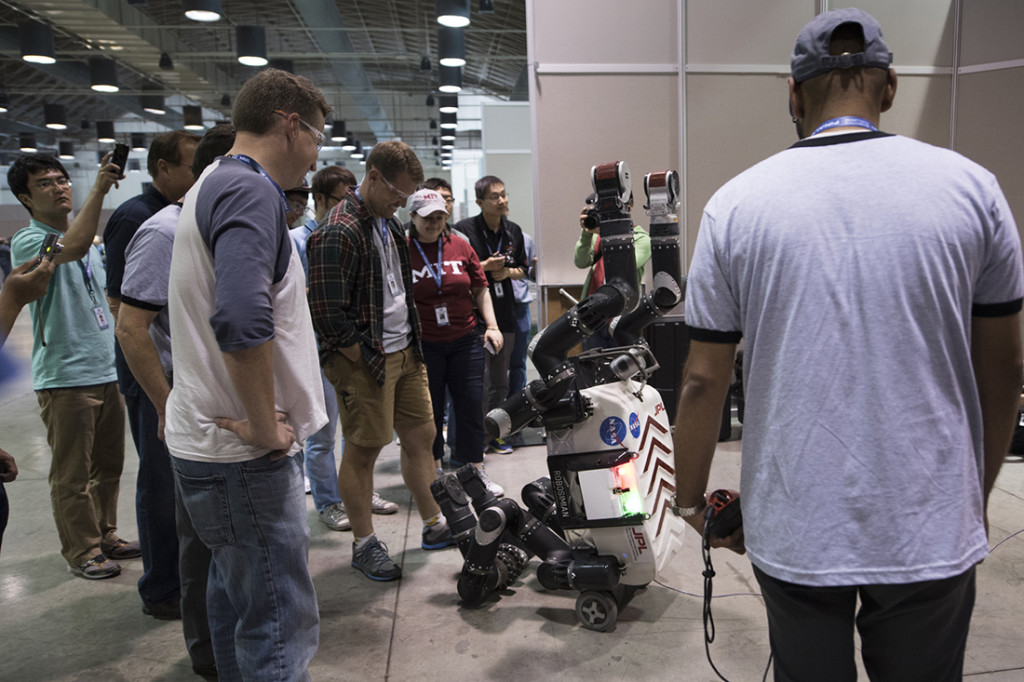
Teams start arriving to set-up their garages in preparation for the Robotics Competition. Twenty-five of the top robotics organizations in the world will gather to compete for $3.5 million in prizes as they attempt a simulated disaster-response course. The event is free to attend and open to the public. It takes place at Fairplex (home of the LA County Fair) in Pomona, California, just east of downtown Los Angeles.

Teams start arriving to set-up their garages in preparation for the Robotics Competition. Twenty-five of the top robotics organizations in the world will gather to compete for $3.5 million in prizes as they attempt a simulated disaster-response course. The event is free to attend and open to the public. It takes place at Fairplex (home of the LA County Fair) in Pomona, California, just east of downtown Los Angeles.

Already at breakfast time, Building 9 was filled with the sounds of construction: a fleet of student-pulled dollies bearing robot parts and tools, fork lifts with sturdy crates, and massive, beeping materials-handling vehicles delivering cinder blocks and wooden frameworks that some teams will use to build replicas of the emergency-response tasks their robots will face later in the week. Now and again, team members rolled in a robot hanging on an aluminum framework—for now, looking like inanimate futuristic manikins—as other robots sat frozen, their arms and hands up in front of their faces like boxers in a defensive position.

drc_link

Already apparent in Building 9 are signs of collaboration among teams and an eager comparing of notes. But apparent also was a rising competitive energy as teams were able to peer into each other’s pop-up laboratories and get first glimpses of their robot rivals. And already on everyone’s mind is which robots and which teams will come out on top.

Who wouldn’t love a win, place or show, and the respective take-home prizes of $2 million, $1 million and $500,000? But the far more valuable result of the entire DRC, noted DARPA program manager Gill Pratt during a welcome session on Sunday evening, transcends the specific outcome of the competition. The priceless payoff, really already in hand, is the community of researchers the DRC has catalyzed into existence with the collective goal of pushing robotic technology forward.

To come later from the DRC, Pratt and other participants expect, are robots that can open a pressure-relief valve to prevent a disastrous explosion in a nuclear power plant or disarm improvised explosive devices on battlefields. But as spectators will witness on Friday and Saturday, getting there will be a one-step-at-a-time journey.
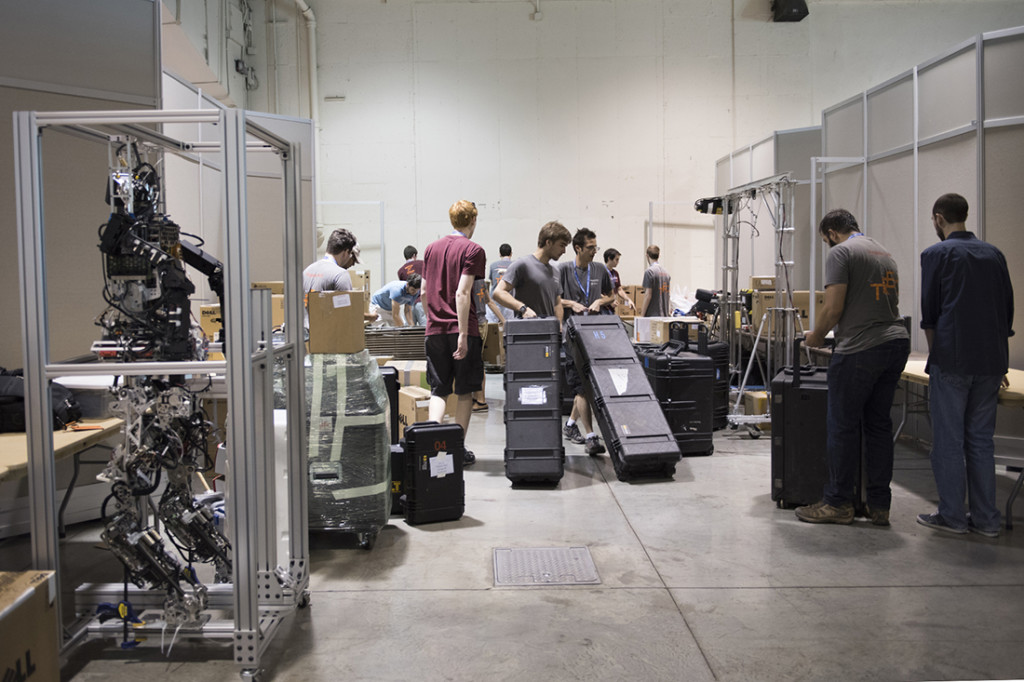
Teams start arriving to set-up their garages in preparation for the Robotics Competition. Twenty-five of the top robotics organizations in the world will gather to compete for $3.5 million in prizes as they attempt a simulated disaster-response course. The event is free to attend and open to the public. It takes place at Fairplex (home of the LA County Fair) in Pomona, California, just east of downtown Los Angeles.
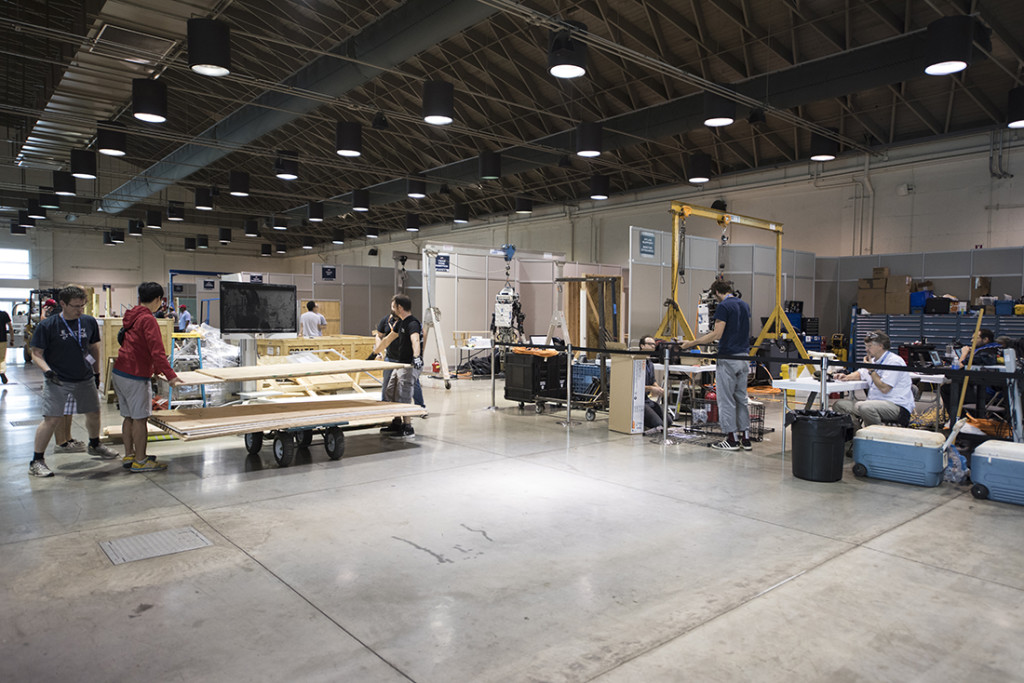
Teams start arriving to set-up their garages in preparation for the Robotics Competition. Twenty-five of the top robotics organizations in the world will gather to compete for $3.5 million in prizes as they attempt a simulated disaster-response course. The event is free to attend and open to the public. It takes place at Fairplex (home of the LA County Fair) in Pomona, California, just east of downtown Los Angeles.


Teams start arriving to set-up their garages in preparation for the Robotics Competition. Twenty-five of the top robotics organizations in the world will gather to compete for $3.5 million in prizes as they attempt a simulated disaster-response course. The event is free to attend and open to the public. It takes place at Fairplex (home of the LA County Fair) in Pomona, California, just east of downtown Los Angeles.

Teams start arriving to set-up their garages in preparation for the Robotics Competition. Twenty-five of the top robotics organizations in the world will gather to compete for $3.5 million in prizes as they attempt a simulated disaster-response course. The event is free to attend and open to the public. It takes place at Fairplex (home of the LA County Fair) in Pomona, California, just east of downtown Los Angeles.


tags: , , , ,


DARPA Robotics Challenge The DRC is a competition of robot systems and software teams vying to develop robots capable of assisting humans in responding to natural and man-made disasters.

            AUAI is supported by:


Subscribe to Robohub newsletter on substack


Related posts :

Robot Talk Episode 153 – Origami-inspired robots, with Chenying Liu

  24 Apr 2026
In the latest episode of the Robot Talk podcast, Claire chatted to Chenying Liu from University of Oxford about how a robot's physical form can actively contribute to sensing, processing, decision-making, and movement.

Sony AI table tennis robot outplays elite human players

  22 Apr 2026
New robot and AI system has beaten professional and elite table tennis players.

AI system learns to keep warehouse robot traffic running smoothly

  20 Apr 2026
This new approach adapts to decide which robots should get the right of way at every moment, avoiding congestion and increasing throughput.

Robot Talk Episode 152 – Dexterous robot hands, with Rich Walker

  17 Apr 2026
In the latest episode of the Robot Talk podcast, Claire chatted to Rich Walker from Shadow Robot Company about their advanced robotic hands for research and industry.

What I’ve learned from 25 years of automated science, and what the future holds: an interview with Ross King

and   14 Apr 2026
Ross King created the first robot scientist back in 2009. He spoke to us about the nature of scientific discovery, the role AI has to play, and his recent work in DNA computing.

Robot Talk Episode 151 – Robots to study the ocean, with Simona Aracri

  10 Apr 2026
In the latest episode of the Robot Talk podcast, Claire chatted to Simona Aracri from National Research Council of Italy about innovative robot designs for oceanography and environmental monitoring.

Generative AI improves a wireless vision system that sees through obstructions

  08 Apr 2026
With this new technique, a robot could more accurately detect hidden objects or understand an indoor scene using reflected Wi-Fi signals.

Resource-constrained image generation and visual understanding: an interview with Aniket Roy

  07 Apr 2026
Aniket tells us about his research exploring how modern generative models can be adapted to operate efficiently while maintaining strong performance.


AUAI is supported by:


Subscribe to Robohub newsletter on substack


©2026.02 - Association for the Understanding of Artificial Intelligence