Robohub.org
 

Google to release monthly driving reports

by
09 June 2015


share this:
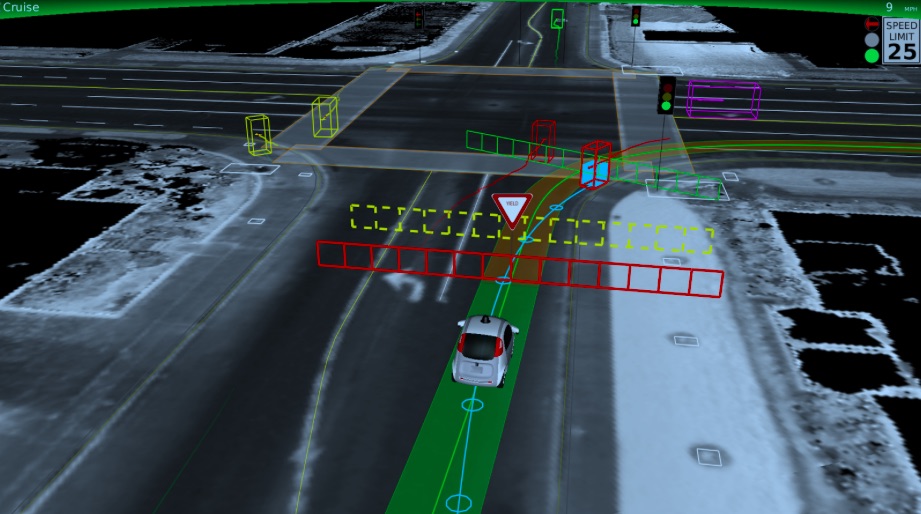
S​elf-driving car keeping track of multiple moving objects at once, in this instance two cyclists, depicted as red rectangles. Source: Google.

S​elf-driving car keeping track of multiple moving objects at once, in this instance two cyclists, depicted as red rectangles. Source: Google.

Google has started publicly disclosing details of accidents involving its self-driving cars.

In the past weeks reports of incidents involving the company’s autonomous vehicles looked to be multiplying. Under Californian law, details of car accidents remain confidential. But, in its May Monthly Report, Google claims that its vehicles were not responsible for any of the 12 accidents they’ve been involved in since testing began in 2009.

Google released the first of what it says will be monthly reports last week. It summarises accident data and highlights from testing, and includes a synopsis of all 12 accidents. Most involved the autonomous vehicles being either rear-ended, sideswiped, or hit after another vehicle failed to follow basic traffic safety laws, such as stopping at a stop sign, according to Google.

The report also gives illustrations and examples of how the driverless cars, which average 10,000 autonomous miles per week on public streets, are able to adapt to traffic situations.

The reports are available to download on a dedicated website: www.google.com/selfdrivingcar/reports


tags: , ,


Adriana Hamacher Associate Editor at Robohub and the UK's Knowledge Transfer Network and a contributor to Economist Insights

            AUAI is supported by:


Subscribe to Robohub newsletter on substack


Related posts :

How to teach the same skill to different robots

  11 May 2026
A new framework to teach a skill to robots with different mechanical designs, allowing them to carry out the same task without rewriting code for each.

Robot Talk Episode 155 – Making aerial robots smarter, with Melissa Greeff

  08 May 2026
In the latest episode of the Robot Talk podcast, Claire chatted to Melissa Greeff from Queen's University about autonomous navigation and learning for drones.

New understanding of insect flight points way to stable flapping-wing robots

  07 May 2026
The way bugs and birds flap their wings may look effortless, but the dynamics that keep them aloft are dizzyingly complex and difficult to quantify.

Robotically assembled building blocks could make construction more efficient and sustainable

  05 May 2026
Research suggests constructing a simple building from interlocking subunits should be mechanically feasible and have a much smaller carbon footprint.

Robot Talk Episode 154 – Visual navigation in insects and robots, with Andrew Philippides

  01 May 2026
In the latest episode of the Robot Talk podcast, Claire chatted to Andrew Philippides from the University of Sussex about what we can learn from ants and bees to improve robot navigation.

Ultralightweight sonar plus AI lets tiny drones navigate like bats

  29 Apr 2026
Researchers develop ultrasound-based perception system inspired by bat echolocation.

Gradient-based planning for world models at longer horizons

  28 Apr 2026
What were the problems that motivated this project and what was the approach to address them?

Robot Talk Episode 153 – Origami-inspired robots, with Chenying Liu

  24 Apr 2026
In the latest episode of the Robot Talk podcast, Claire chatted to Chenying Liu from University of Oxford about how a robot's physical form can actively contribute to sensing, processing, decision-making, and movement.


AUAI is supported by:


Subscribe to Robohub newsletter on substack


©2026.02 - Association for the Understanding of Artificial Intelligence