Robohub.org
 

Online events to look out for on Ada Lovelace Day 2020


by
12 October 2020


share this:

Tomorrow the world celebrates Ada Lovelace Day to honor the achievements of women in science, technology, engineering and maths. We’ve specially chosen a couple of online events featuring amazing women in robotics and technology. You can enjoy their talks in the comfort of your own home.

Ada Lovelace Day: The Near Future (panel discussion)

Ada Lovelace Day 2020: The Near Future (panel discussion)

Organized by Ada Lovelace Day, this panel session will be joined by Dr Beth Singler (Junior Research Fellow in Artificial Intelligence at the University of Cambridge), Prof Praminda Caleb-Solly (Professor of Assistive Robotics and Intelligent Health Technologies at the University of the West of England), Dr Anat Caspi (director of the Taskar Center for Accessible Technology, University of Washington) and Dr Chanuki Seresinhe (visiting data science researcher at The Alan Turing Institute). The event will take place at 4pm (UTC). You can register here.


Ada Lovelace Day 2020 Celebration of Women in Robotics
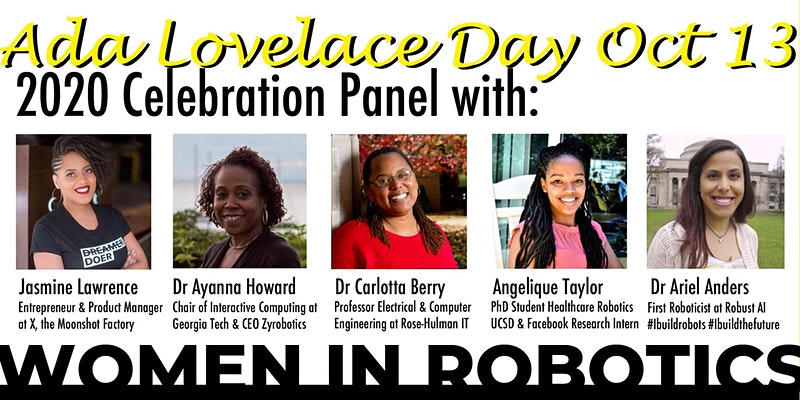
Ada Lovelace Day 2020 Celebration of Women in Robotics

Hosted by UC CITRIS CPAR and Silicon Valley Robotics, this event will be joined by Dr Ayanna Howard (Chair of Interactive Computing Georgia Tech), Dr Carlotta Berry (Professor of Electrical and Computer Engineering Rose-Hulman Institute of Technology), Angelique Taylor (PhD Candidate at the Healthcare Robotics Lab in UCSD and Facebook Research Intern), Dr Ariel Anders (First Technical Hire at Robust.ai) and Jasmine Lawrence, (Product Manager at X, the Moonshot Factory). This event will take place at 1am (UTC). You can register here.


Tomorrow we will also publish our 2020 list of women in robotics you need to know about. Stay tuned!


tags:


Daniel Carrillo-Zapata was awared his PhD in swarm robotics at the Bristol Robotics Lab in 2020. He now fosters the culture of "scientific agitation" to engage in two-way conversations between researchers and society.

            AUAI is supported by:


Subscribe to Robohub newsletter on substack


Related posts :

Robotics Café brings together autonomous robot practitioners

  20 May 2026
Recently launched series for researchers, students and industry practitioners aims to provide a platform for students to present their work.

Table tennis robot defeats some of world’s best players – why this has major implications for robotics

  18 May 2026
Ace, from Sony AI, is the first robot to beat elite human players in competitive physical sport.

Robot Talk Episode 156 – Rugged robots for dangerous missions, with Gavin Kenneally

  15 May 2026
In the latest episode of the Robot Talk podcast, Claire chatted to Gavin Kenneally from Ghost Robotics about robot dogs for defence, security, and public safety.

Developing active and flexible microrobots

  13 May 2026
This class of robots opens up possibilities for biomedical applications.

How to teach the same skill to different robots

  11 May 2026
A new framework to teach a skill to robots with different mechanical designs, allowing them to carry out the same task without rewriting code for each.

Robot Talk Episode 155 – Making aerial robots smarter, with Melissa Greeff

  08 May 2026
In the latest episode of the Robot Talk podcast, Claire chatted to Melissa Greeff from Queen's University about autonomous navigation and learning for drones.

New understanding of insect flight points way to stable flapping-wing robots

  07 May 2026
The way bugs and birds flap their wings may look effortless, but the dynamics that keep them aloft are dizzyingly complex and difficult to quantify.

Robotically assembled building blocks could make construction more efficient and sustainable

  05 May 2026
Research suggests constructing a simple building from interlocking subunits should be mechanically feasible and have a much smaller carbon footprint.


AUAI is supported by:


Subscribe to Robohub newsletter on substack


©2026.02 - Association for the Understanding of Artificial Intelligence