
Robohub.org
Online hands-on science communication training – sign up here!
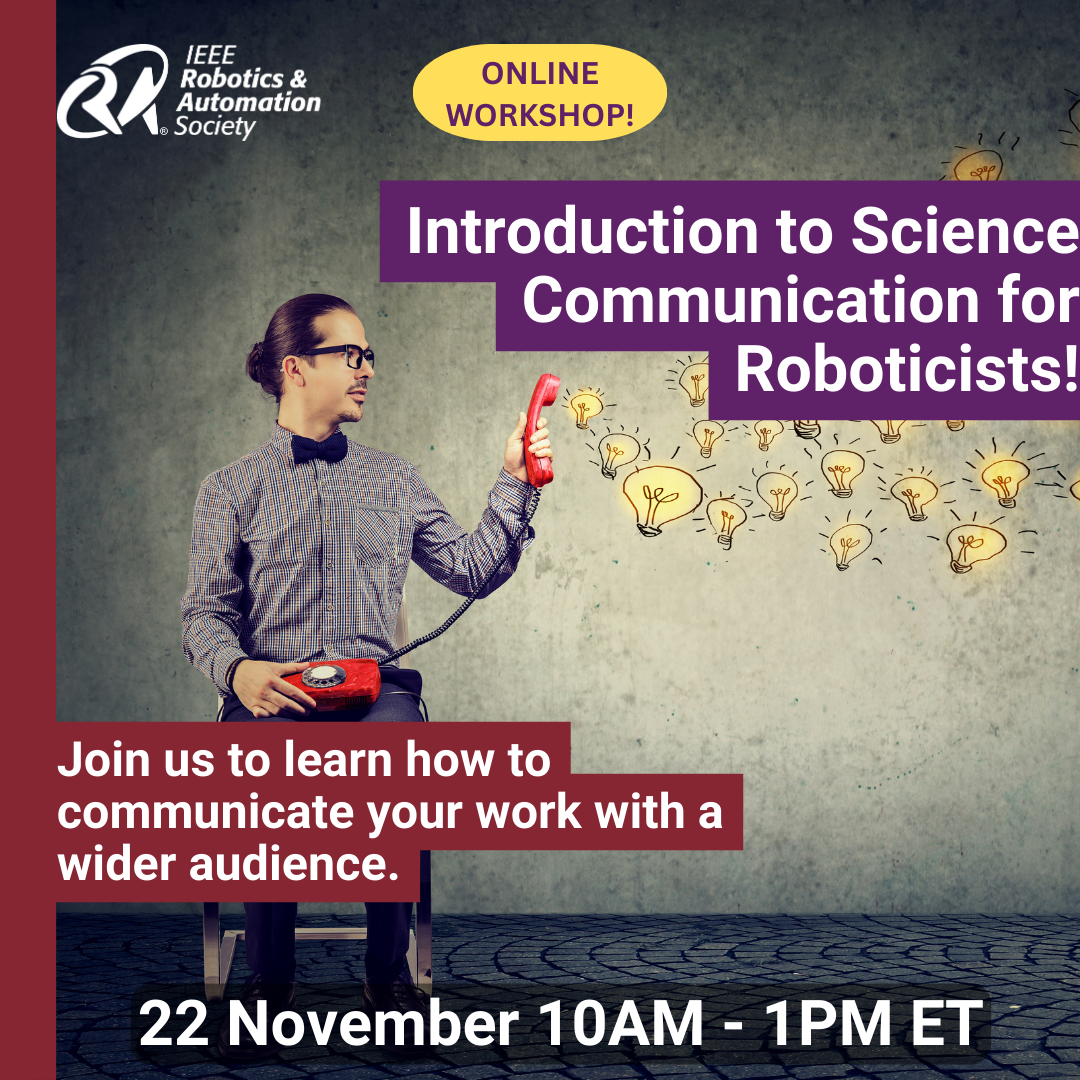
On Friday 22 November, IEEE Robotics and Automation Society will be hosting an online science communication training session for robotics and AI researchers. The tutorial will introduce you to science communication and help you create your own story through hands-on activities.
Date: 22 November 2024
Time: 10:00 – 13:00 EST (07:00 – 10:00 PST, 15:00 – 18:00 GMT, 16:00 – 19:00 CET)
Location: Online – worldwide
Registration
Website
Science communication is essential. It helps demystify robotics and AI for a broad range of people including policy makers, business leaders, and the public. As a researcher, mastering this skill can not only enhance your communication abilities but also expand your network and increase the visibility and impact of your work.
In this three-hour session, leading science communicators in robotics and AI will teach you how to clearly and concisely explain your research to non-specialists. You’ll learn how to avoid hype, how to find suitable images and videos to illustrate your work, and where to start with social media. We’ll hear from a leading robotics journalist on how to deal with media and how to get your story out to a wider audience.
This is a hands-on session with exercises for you to take part in throughout the course. Therefore, please come prepared with an idea about a piece of research you’d like to communicate about.
Agenda
Part 1: How to communicate your work to a broader audience
- The importance of science communication
- How to produce a short summary of your research for communication via social media channels
- How to expand your outline to write a complete blog post
- How to find and use suitable images
- How to avoid hype when communicating your research
- Unconventional ways of doing science communication
Part 2: How to make videos about your robots
- The value of video
- Tips on making a video
Part 3: Working with media
- Why bother talking to media anyway?
- How media works and what it’s good and bad at
- How to pitch media a story
- How to work with your press office
Speakers:
Sabine Hauert, Professor of Swarm Engineering, Executive Trustee AIhub / Robohub
Lucy Smith, Senior Managing Editor AIhub / Robohub
Laura Bridgeman, Audience Development Manager IEEE Spectrum
Evan Ackerman, Senior Editor IEEE Spectrum
Sign up here.

AUAI is supported by:









