Robohub.org
 

Photo essay: VEX’s Paul McKnight hosts robotics competition @ Campus Party EU


by
10 September 2013


share this:

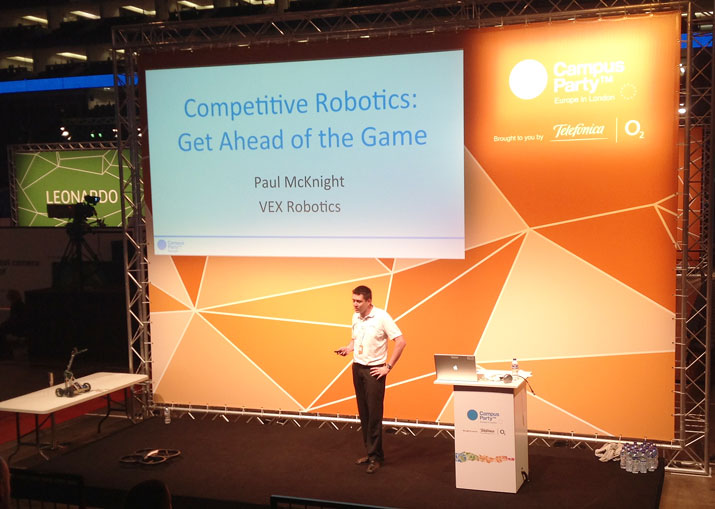
At a robotics workshop Friday September 6th at Campus Party EU in London, VEX Robotic’s Paul McKnight elaborated how robotics platforms and toolkits could be used in schools and universities to enhance education and engage young people with STEM subjects. He explained that “it’s a combination of human interaction and robots that makes VEX stand out as a platform.” The human component, according to McKnight, is essential to create functional and useful robots from robotics kit and to test and improve designs, something that he actively supports and encourages.
Paul-McKnight-Campus-Party-JW

Paul McKnight at Campus Party EU. Photo credit: Jana Witt.

McKnight spoke about how robotics competitions could help pupils learn a set of new skills that are neglected in schools, but are in high demand on the job market, including creative thinking, task-oriented design and problem solving. Furthermore, he emphasised the need for good team work and mutual respect during robotics competitions: “The ethos of our competitions is not about winning, it’s about winning in the right way, it’s a collaborative approach.”
Vex-Workshop-Campus-Party-AB

At Campus Party’s VEX Workshop. Photo credit: Aaron Boardley.

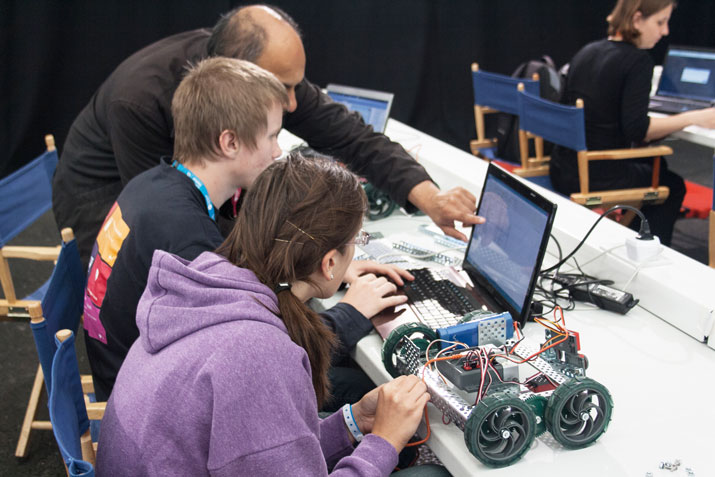
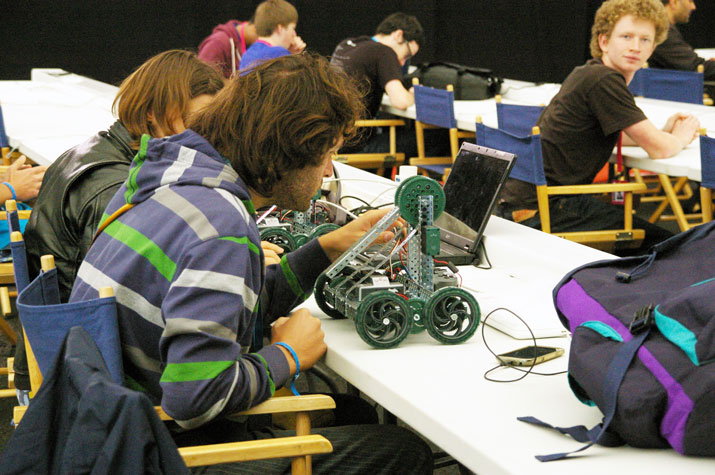
Attending “campuseros” were then offered a chance to get involved in one of two robotics challenges. Participants could either have a go at programming a robot using their personal computers, or they could get their hands dirty in a mechanical challenge, which involved building a robot designed to compete in a game challenge.
Vex-Workshop-Campus_Party-JW-3

Campuseros building robots for the competition. Photo credit: Jana Witt.

Vex-Workshop-Campus-Party-4-AB

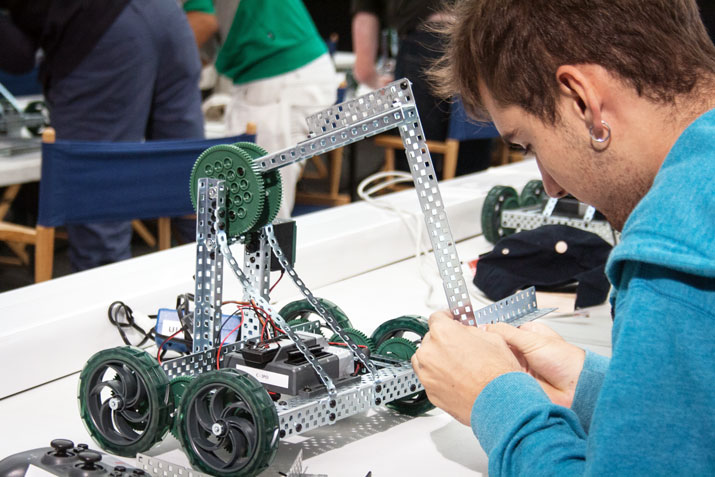
Campuserso perfects his design at the competition. Photo credit: Aaron Boardley.

Vex-Workshop-Campus-Party-AB

Checking code before the competition. Photo credit: Aaron Boardley.

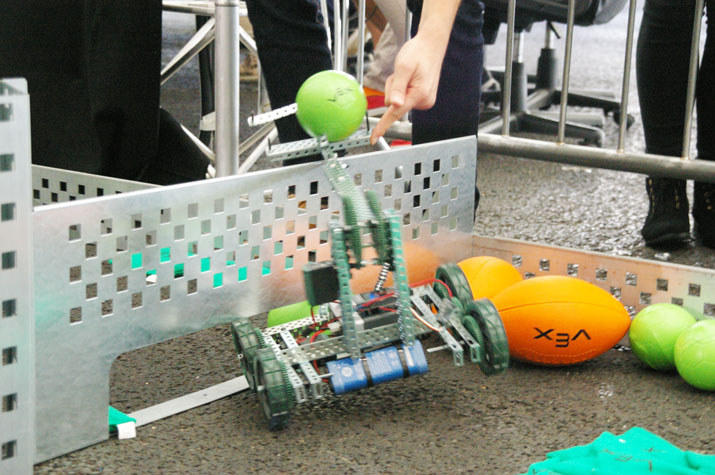
Ten groups of campuseros opted for the mechanical challenge. Using a prebuilt platform, the participants had to come up with a design that would enable the robot to lift, push or throw balls of various sizes and sacks filled with granules into an opposing team’s court. Really getting into the competitive spirit, campuseros battled for the best parts, tested their ideas and attempted to perfect their designs before the competitive matches began.

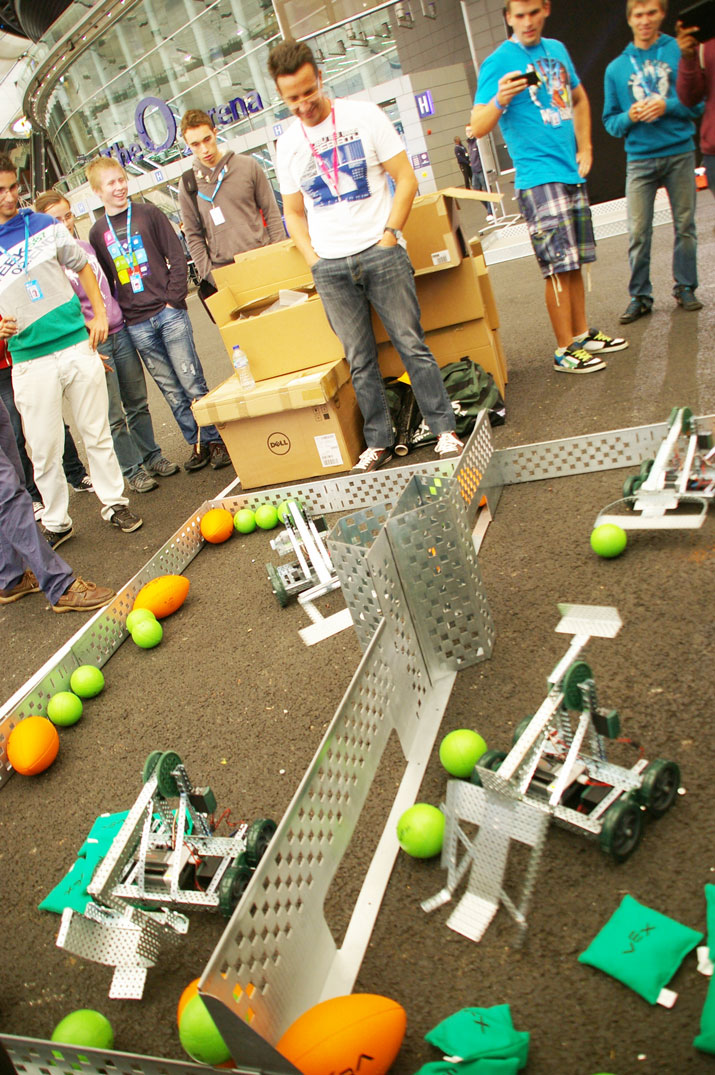
After one hour of design time, the groups were called to compete in matches that saw a total of four robots at a time face each other in teams of two. The aim of the challenge was to fill the opposing team’s court with as many items as possible, while preventing the opposing team from filling one’s own court with the same items.

Vex-Workshop-JW-campus-party-(13)

Vex-Workshop-JW-capmus-party-(19)

Vex-Workshop-Campus-Party-JW-(6)

Challengers try to fill the opposing team’s court with as many items as possible, while preventing the opposing team from filling their own court with the same items. Photo credit: Jana Witt.

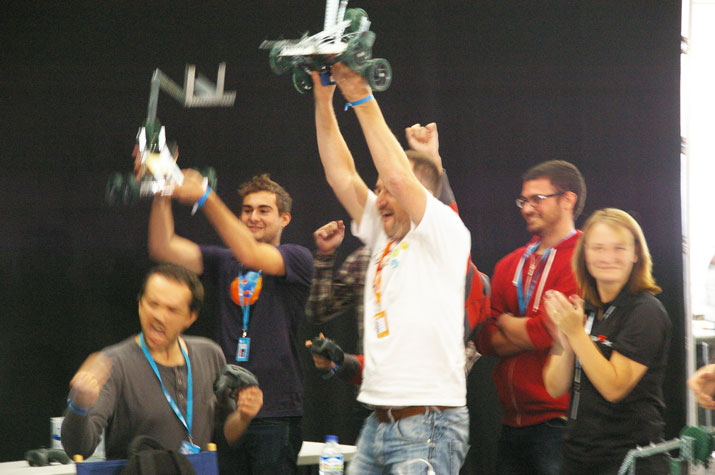
The matches were certainly one of the loudest events in the exhibition zone and attracted quite a crowd of interested passer-bys who stopped to watch. When the winners of the challenge were finally announced – after winning every single one of their matches – their joy clearly showed that robotics competitions do not only have the potential to delight school pupils, but many others too.
Vex-Workshop-JW-campus-party-(31)

Winning team. Photo credit: Jana Witt.


tags: ,


Jana Witt is the Presenter for the ROBOTS Podcast, and is one of Robohub's UK correspondents.


Subscribe to Robohub newsletter on substack


Related posts :

AI system learns to keep warehouse robot traffic running smoothly

  20 Apr 2026
This new approach adapts to decide which robots should get the right of way at every moment, avoiding congestion and increasing throughput.

Robot Talk Episode 152 – Dexterous robot hands, with Rich Walker

  17 Apr 2026
In the latest episode of the Robot Talk podcast, Claire chatted to Rich Walker from Shadow Robot Company about their advanced robotic hands for research and industry.

What I’ve learned from 25 years of automated science, and what the future holds: an interview with Ross King

and   14 Apr 2026
Ross King created the first robot scientist back in 2009. He spoke to us about the nature of scientific discovery, the role AI has to play, and his recent work in DNA computing.

Robot Talk Episode 151 – Robots to study the ocean, with Simona Aracri

  10 Apr 2026
In the latest episode of the Robot Talk podcast, Claire chatted to Simona Aracri from National Research Council of Italy about innovative robot designs for oceanography and environmental monitoring.

Generative AI improves a wireless vision system that sees through obstructions

  08 Apr 2026
With this new technique, a robot could more accurately detect hidden objects or understand an indoor scene using reflected Wi-Fi signals.

Resource-constrained image generation and visual understanding: an interview with Aniket Roy

  07 Apr 2026
Aniket tells us about his research exploring how modern generative models can be adapted to operate efficiently while maintaining strong performance.

Back to school: robots learn from factory workers

  02 Apr 2026
A Czech startup is making factory automation easier by letting workers teach robots new tasks through simple demonstrations instead of complex coding.

Resource-sharing boosts robotic resilience

  31 Mar 2026
When a modular robot shares power, sensing, and communication resources among its individual units, it is significantly more resistant to failure than traditional robotic systems.


Robohub is supported by:


Subscribe to Robohub newsletter on substack


©2026.02 - Association for the Understanding of Artificial Intelligence