Robohub.org
Robot Talk Episode 162 – The robot doctor will see you now
Since the first robot-assisted surgery was performed, over 40 years ago, major advances in robotics, computer vision and artificial intelligence have fundamentally changed medicine and healthcare. Innovative new technologies are already aiding skilled medical professionals in diagnosis, surgery, rehabilitation and beyond. But many questions remain: What ethical issues arise as medical tools become increasingly autonomous? How do we regulate technologies that can learn and change over time? And how can we ensure that cutting-edge medical devices are accessible to all?
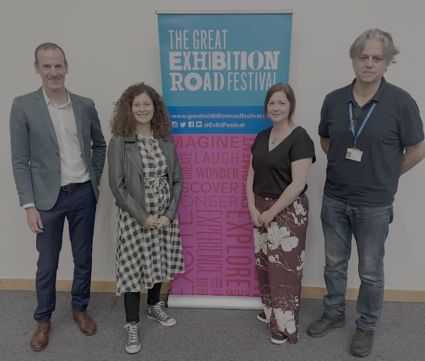
In this special live recording at the Great Exhibition Road Festival in London, Claire chatted to George Mylonas (Imperial College London), Antonia Tzemanaki (University of Bristol) and Tom Vercauteren (King’s College London) about robotics and AI in medicine and healthcare.
George Mylonas is an Associate Professor in Robotics and Technology in Cancer at Imperial College London, and the director of the Human-centred Automation, Robotics and Monitoring in Surgery lab at The Hamlyn Centre, Institute of Global Health Innovation and the Department of Surgery & Cancer, Faculty of Medicine. He is leading research in the areas of surgical robotics, soft robotics, minimal access surgical technology, perceptual human-robot and human-computer interfaces, and smart data-driven operating theatres. He is a member of the European Association of Endoscopic Surgery Technology Committee.
Antonia Tzemanaki is a Senior Lecturer in Robotics at the University of Bristol and a core member of the Bristol Robotics Laboratory. She leads the Dexterous Manipulation and Wearable Robotics group which develops robotic simulators and interventions, including robotic needle steering, abdominal, urology, skull and hand models, for surgical and physical therapy treatments of disease including cancers, neurological, prostate and urinary disorders. The group provides wide expertise in precision manipulation, robot hands, hand exoskeletons, kinematics, haptics and wearable robotics, especially with applications in surgery, preventative medicine, rehabilitation, physiotherapy and dexterous tele-operation.
Tom Vercauteren is a Professor of Interventional Image Computing at King’s College London, where he leads the Contextual Artificial Intelligence for Computer Assisted Interventions research group. His research focuses on medical image computing, machine learning and imaging for surgery and interventional sciences. He is also co-founder and Chief Scientific Officer of Hypervision Surgical, a spin-out company developing safe, non-invasive optical imaging for use during surgery. His work is now used in hundreds of hospitals worldwide. Tom is also a supporter of open-source software and patient involvement.

AUAI is supported by: