
Robohub.org
ROS Awards 2022 results
The ROS Awards are the Oscars of the ROS world! The intention of these awards is to express recognition for contributions to the ROS community and the development of the ROS-based robot industry, and to help those contributions gain awareness.
Conditions
- Selection of the winners is made by anonymous online voting over a period of 2 weeks
- Anybody in the ROS community can vote through the voting enabled website
- Organizers of the awards provide an initial list of 10 possible projects for each category but the list can be increased at any time by anybody during the voting period
- Since the Awards are organized by The Construct none of its products or developers can be voted
- Winners are announced at the ROS Developers Day yearly conference
- New on 2022 edition: Winners of previous editions cannot win again, in order to not concentrate the focus on the same projects all the time. Remember, with these awards, we want to help spread all ROS projects!
Voting
- Every person can only vote once in each category
- You cannot change your answers once you have submitted your vote
- Voting is closed 3 days before the conference, and a list of the finalists per each category is announced in the same week
- Voters cannot use flaws in the system to influence voting. Any detection of trying to trick the system will disqualify the votes. You can, though, promote your favorite among your networks so others vote for it.
Measures have been taken to prevent as much as possible batch voting from a single person.
Categories
Best ROS Software
The Best ROS Software category comprises any software that runs with ROS. It can be a package published on the ROS.org repo of just a software that uses ROS libraries to produce an input. Open Source and closed source are both valid.
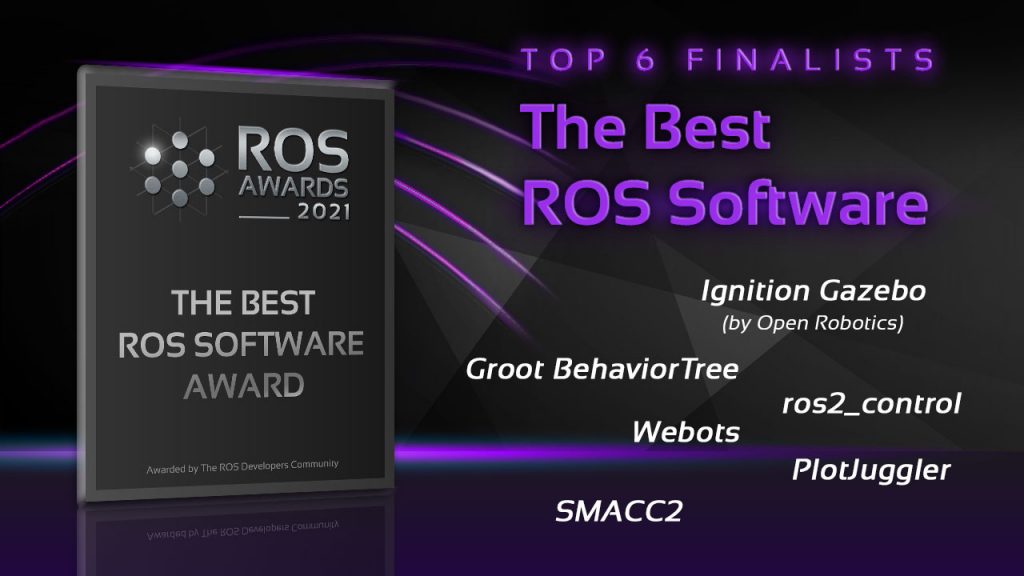
Finalists
- Ignition Gazebo, by Open Robotics
- Groot Behavior Tree, by Davide Faconti
- Webots, by Cyberbotics
- SMACC2, by Brett Aldrich
- ros2_control, by several ROS developers
- PlotJuggler, by Davide Faconti
Winner: Webots, by Cyberbotics
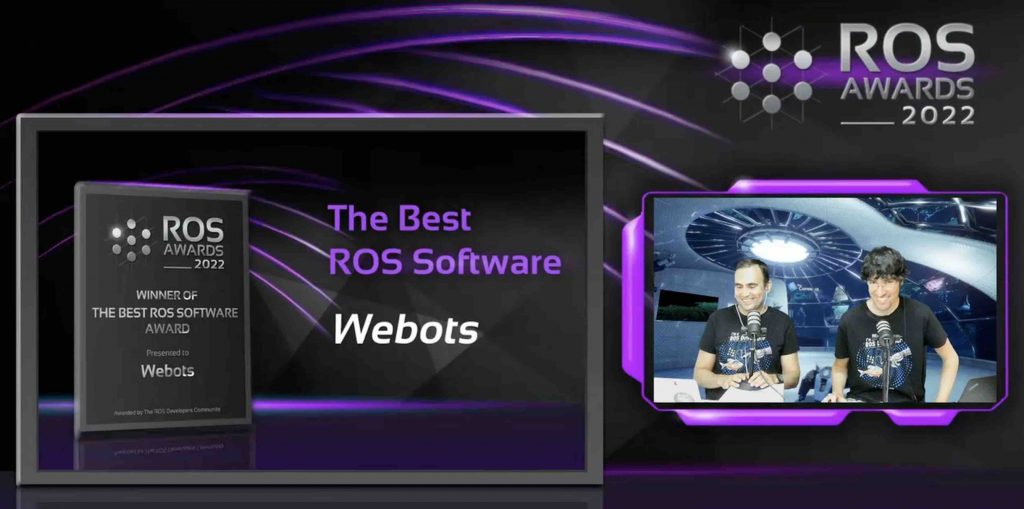
Learn more about the winner in this video:
Best ROS-Based Robot
The Best ROS-Based Robot category includes any robot that runs ROS inside it. They can be robotics products, robots for research, or robots for education. In all cases, they must be running ROS inside.
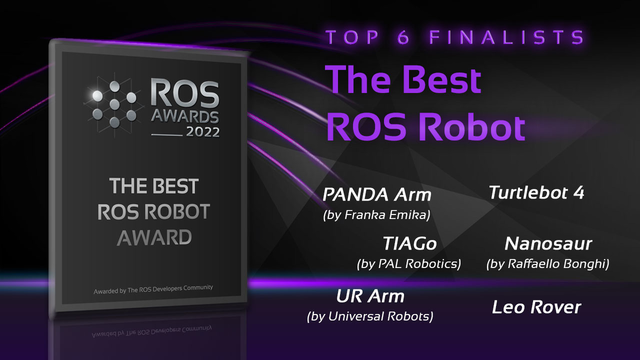
Finalists
- Panda robot arm, by Franka Emika
- TIAGo, by Pal Robotics
- UR robot arm, by Universal Robots
- Turtlebot 4, by Clearpath
- Nanosaur, by Raffaello Bonghi
- Leo Rover, by Leo Rover
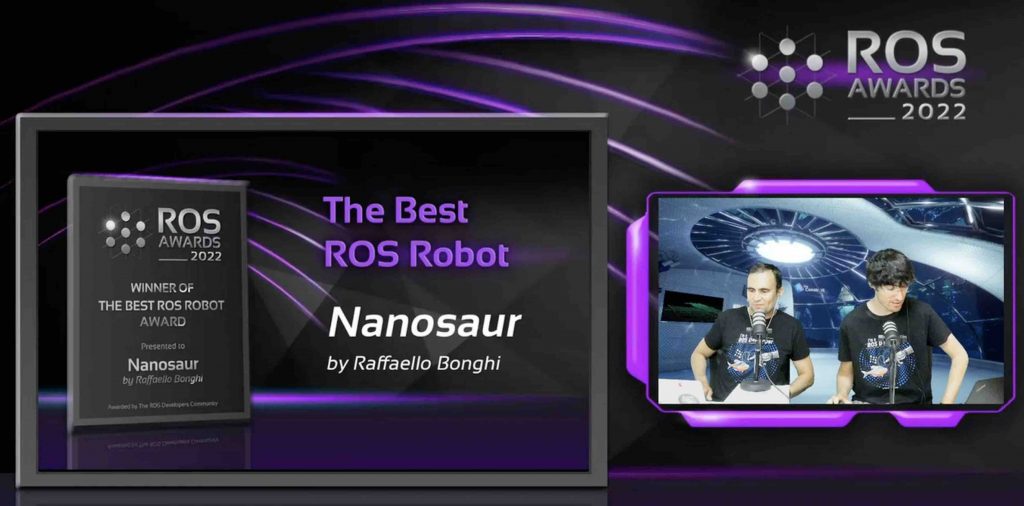
Winner: Nanosaur, by Raffaello Bonghi
Learn more about the winner in this video:
Best ROS Developer
Developers are the ones that create all the ROS software that we love. The Best ROS Developer category allows you to vote for any developer who has contributed to ROS development in one sense or another.
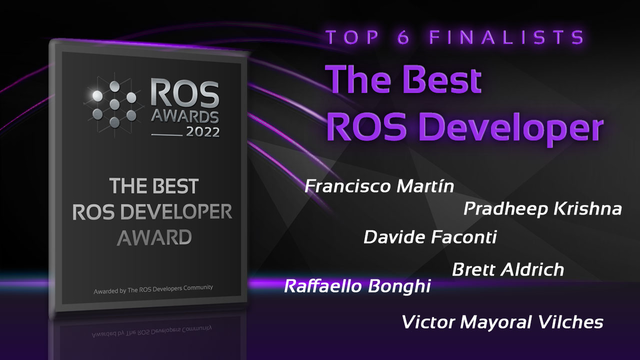
Finalists
- Francisco Martín
- Davide Faconti
- Raffaello Bonghi
- Brett Aldrich
- Victor Mayoral Vilches
- Pradheep Krishna
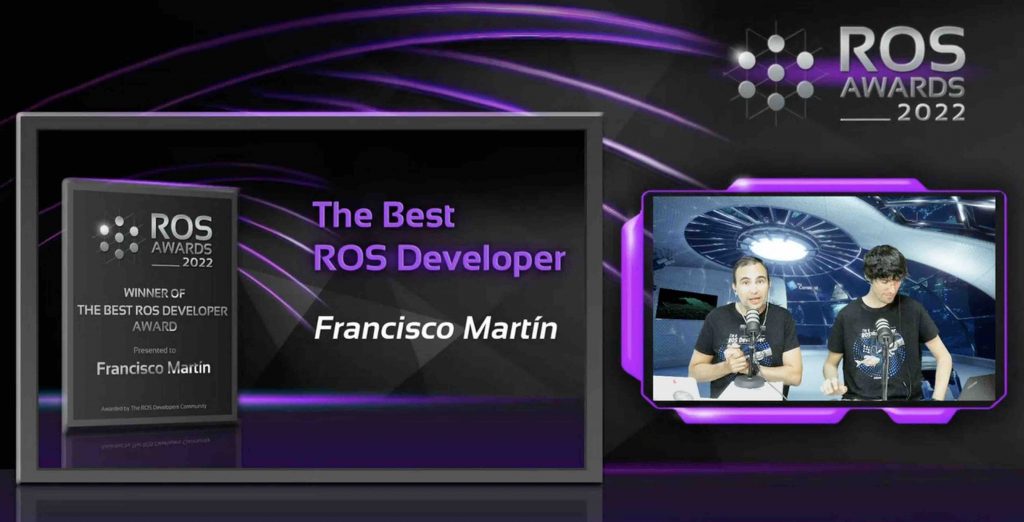
Winner: Francisco Martín
Learn more about the winner in this video:
Insights from the 2022 Edition
- This year, the third time we organise the awards, we have increased the total number of votes by 500% So we can say that the winners are a good representation of the feelings of the community.
- Still this year, the winners of previous editions received many votes. Fortunately, we applied the new rule of not allowing to win previous winners, to provide space for other ROS projects have the focus on the community, and hence help to create a rich ROS ecosystem.
Conclusions
The ROS Awards started in 2020 with a first edition where the winners were some of the best and well-known projects in the ROS world. In this third edition, we have massively increased the number of votes from the previous edition. We expect this award will continue to contribute to the spreading of good ROS projects.
See you again at ROS Awards 2023!
tags: open source

AUAI is supported by:









