Robohub.org
Undergrads’ weed-killing robot wins top prize
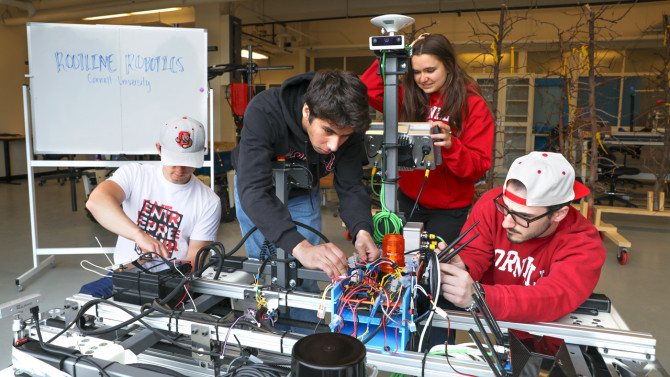 Andrew James (from left), Neil Morrison, Natalia Kurz and Michael Neiss work on a prototype of their weed-killing robot ahead of The Farm Robotics Challenge, which they won on May 21.
By Holly Hartigan
A team of Cornell undergraduates beat 95 other teams to take the grand prize at The Farm Robotics Challenge with their invention: an autonomous robot that kills weeds with electricity.
Their robot can travel through a vineyard or orchard without a human operator, zapping weeds with a small amount of electricity, saving labor and energy and preventing crop loss, without the use of herbicides.
Led by Andrew James, an agricultural sciences major in the College of Agriculture and Life Sciences (CALS), the team of agricultural specialists and engineers studied the existing electrical weeding technology, developed their own low-energy system and built a working prototype over the course of four intense months.
Natalia Kurz, a biological engineering major in CALS, said the project required a lot of late nights. “There were fears for us, like, was it just going to be for nothing?”
Now, James and his co-founders are using the $50,000 grand prize to form a company – Rootline Robotics – to continue working on the robot. Agricultural technology firm Reservoir sponsored the award and will host the startup at its incubator in Sonoma, California.
“I’ve always been interested in building a startup within the ag-robotics space,” James said. “So after winning this competition and seeing all the amazing support from so many different industry stakeholders in this really exciting collaboration, it makes a lot of sense to keep going.”
The problem of weeds
Weeds are a huge challenge in orchards and vineyards because they steal water and nutrients, especially in the spring, according to Steve Selin, owner of South Hill Cider in Ithaca.
“The weed pressure is very strong, and the grasses grow right up to the trees because we can’t afford to weed whack or mulch them as much as we would like to in order to control them,” he said. “If the trees get really stressed out, they’ll just drop the fruit.”
To control weeds, organic growers typically employ string trimming, mowing and mulching, which are all very labor intensive. Existing electric weeders require an operator, consume a lot of energy and cost $150,000, on average, which is out of reach for most growers, James said.
Selin provided feedback to the students as they developed their robot and said he is excited to try out Rootline’s new technology.
“In May and June, if you could do something to knock the weeds back enough that they’re not going to compete with the trees, then the rest of the year you wouldn’t have to worry about it,” he said. “You can let them come back and have positive impacts, like shading the soil, which would help the soil microbes to have a healthier ecosystem.”
The interdisciplinary nature of robots
“Robotics is many different systems in one,” Kurz said. “It is interdisciplinary by definition.”
Next, the Rootline team will work on improving its technology and validating it with growers before bringing it to market, all while Kurz and Neiss finish their degrees.
Neiss said the way the team came together felt a bit like destiny.
“If you have many different minds in one room that gives you the ability to reach solutions that are going to be the most feasible and effective,” he said.

AUAI is supported by: