Robohub.org
 

Autonomous exploration planning using aerial robots

by and
23 May 2016


share this:
aerial-robot-robotics

Autonomous exploration of unknown environments corresponds to a critical ability and a major challenge for aerial robots. In many cases, we would like to rely on the ability of an intelligent flying system to completely and efficiently explore the previously unknown world and derive a consistent map of it. On top of this basic skill, one can then work on several tasks such as infrastructure inspection, hazard detection, and more.
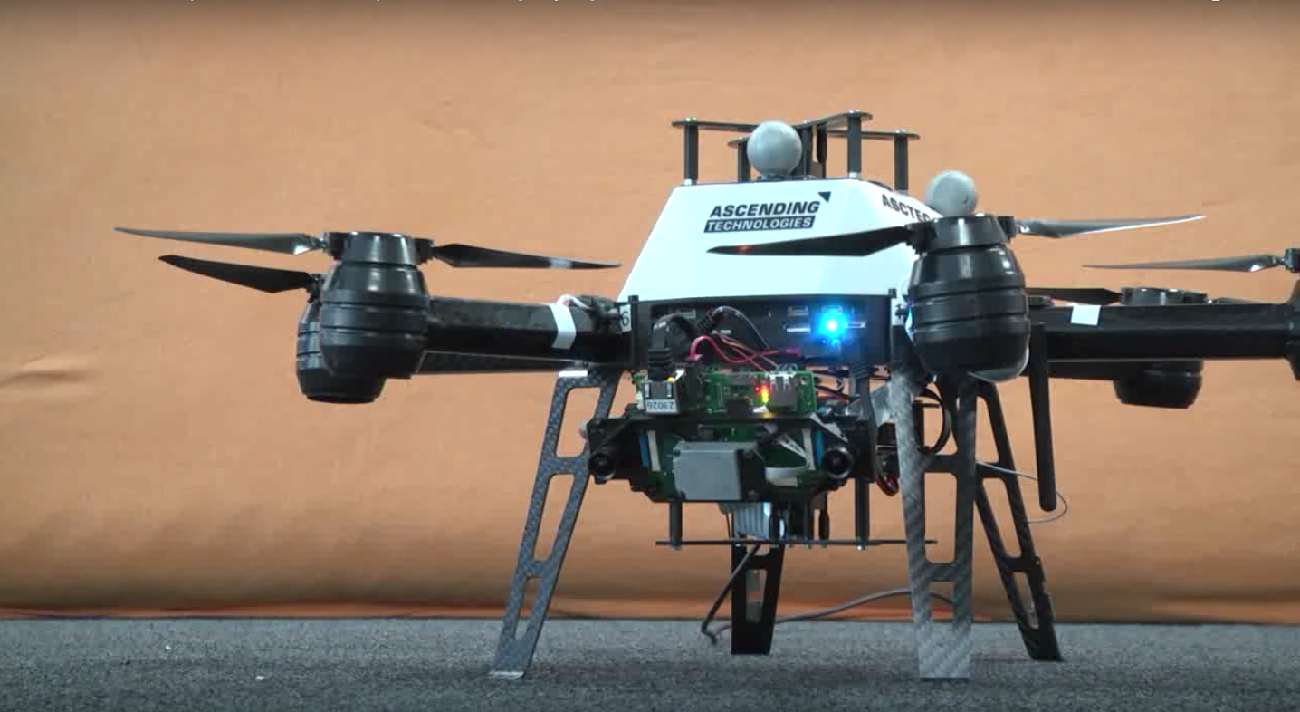
Source: Kostas Alexis, UNR

Source: Dr Kostas Alexis, UNR

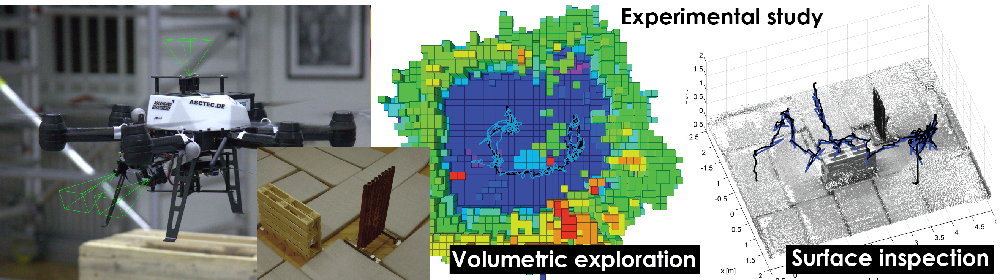
Our algorithm “Receding Horizon Next-Best-View Path Planning” is a recent contribution towards enabling the key goal of autonomous exploration. It achieves this by sampling finite-depth candidate paths within the environment, selecting the one that maximizes the amount of new space to be explored, and executes only the first step while then repeating the whole process in a receding horizon fashion. By performing multiple iterative steps of this process the space is fully and efficiently explored, and a volumetric representation is derived. Finally, one can afterwards launch a second mission for higher-fidelity surface inspection and more accurate 3D reconstruction of the environment.

The algorithm has been experimentally verified with aerial robotic platforms equipped with a stereo visual-inertial system, as shown in our video:

Finally, to enable further developments, research collaboration and consistent comparison, we have released an open source version of our exploration planner, experimental datasets and interfaces to established simulation tools, including demo scenarios. To get the code, please visit: https://github.com/ethz-asl/nbvplanner/

This research was conducted at the Autonomous Systems Lab, ETH Zurich and the University of Nevada, Reno.


Reference:

  1. Bircher, M. Kamel, K. Alexis, H. Oleynikova, R. Siegwart, “Receding Horizon “Next-Best-View” Planner for 3D Exploration”, IEEE International Conference on Robotics and Automation 2016 (ICRA 2016), Stockholm, Sweden. Open-Source Git Repo: https://github.com/ethz-asl/nbvplanner


tags: , ,


Kostas Alexis is an assistant professor at Computer Science & Engineering of the University of Nevada, Reno

Andreas Bircher is a research engineer at WingTra.

            AUAI is supported by:


Subscribe to Robohub newsletter on substack


Related posts :

Global robotics technology roadmap

  03 Jun 2026
A multi-regional, cross-domain strategic perspective for Europe, Asia, and the United States.

RoboChem Flex: democratisation of the autonomous synthesis robot

  02 Jun 2026
A versatile, modular design and the option for "human-in-the-loop" analytics.

Robot Talk Episode 158 – Autonomous robot deliveries, with Ahti Heinla

  29 May 2026
In the latest episode of the Robot Talk podcast, Claire chatted to Ahti Heinla from Starship Technologies about their AI-powered delivery robots that operate independently on streets and pavements.

Light-activated gel could impact wearables, soft robotics, and more

  28 May 2026
In the field of ionotronics, data are transferred through ions, potentially providing a bridge between electronics and biological tissue.

Handle with care: Soft robot gripper picks ripe fruit without bruising

  27 May 2026
Stretchable fiber-optic sensors used to create a soft robot gripper.

Robot Talk Episode 157 – Generating new robot designs, with Josie Hughes

  22 May 2026
In the latest episode of the Robot Talk podcast, Claire chatted to Josie Hughes from École Polytechnique Fédérale de Lausanne about using AI to develop new designs for robotic manipulators.

Robotics Café brings together autonomous robot practitioners

  20 May 2026
Recently launched series for researchers, students and industry practitioners aims to provide a platform for students to present their work.

Table tennis robot defeats some of world’s best players – why this has major implications for robotics

  18 May 2026
Ace, from Sony AI, is the first robot to beat elite human players in competitive physical sport.


AUAI is supported by:


Subscribe to Robohub newsletter on substack


©2026.05 - Association for the Understanding of Artificial Intelligence