
Robohub.org
Hardhat bots take over construction sites
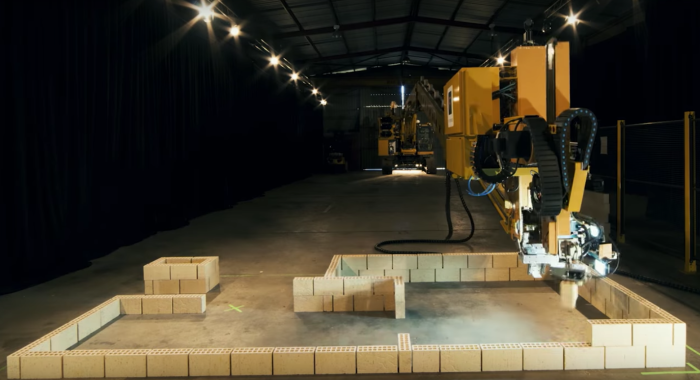
Fastbrick’s Hadrian X prototype.
RobotLabNYC’s third installment will be on June 13, in New York City with Howard Morgan (FirstRound Capital) and Tom Ryden (MassRobotics); together, we will be “Exploring The Autonomous Future” (RSVP today). Coincidentally, Jimmy Fallon featured a new bit this week called “Showbotics,” providing viewers with a sneak peek into the robotic future:
While Fallon pokes fun, the reality is that robots today are showing up for work in record numbers. As America pulls out of NAFTA and starts a trade war with Canada over lumber imports, it is predicted that home building costs could increase by more than 20% over the next year. In order to keep America building without sacrificing margin, labor is shifting from humans with tool belts to job-ready robots.

An example of machines being added to the field is MIT’s Digital Construction Platform (DCP) – a 3D-printing fabrication robot. The DCP consists of a robotic arm that can print structures made of insulating foam at architectural scale — in other words, big enough to live in. In a test last July, MIT researchers printed an open dome structure in two days that was as large as a ranch house. The average single-family home takes about 7 months to build (US Census Bureau).
According to the white paper published this week in Science Robotics, the researchers claim, “this printed test structure is currently both the largest monolithic structure ever 3D-printed by an on-site mobile platform and the fastest autonomously printed architectural-scale structure.”
Shanghai-based WinSun 3D-printed walls last year for a six-story apartment building out of concrete that was assembled on site for immediate occupancy. According to WinSun, they were able “to save 60% of the materials typically needed to construct a home and can be printed in a time span which equates to just 30% of that of traditional construction. In total, 80% less labor is needed, meaning more affordable construction, and less risk of injury to contractors.”

In the USA, Blueprint Robotics is manufacturing wood-framed houses today with industrial robots. Builders upload their architectural plans to Blueprint’s cloud-based platform which outputs within weeks pre-made walls, floors, and roofs. While the concept of pre-fabricated houses is not novel -Sears Roebuck & Co first introduced kits to homesteaders in the 1900s – Blueprint is the first to create an automated production line that pre-places everything from sheetrock to nails to lighting placement. This means modular structures can now be used for bigger and more luxurious developments from multi-million dollar mansions to large apartment buildings. Bloomberg News reported this week that even Marriott, the world’s largest hotel operator, is “turning to modular construction for some of its properties,” shipping the walls inside the same containers as the television sets and beds.
According to leading home consultant, John Burns, “this has to be the wave of the future — I don’t know how we solve the labor shortage otherwise. What drives modular construction is the ability to build the house more cost-effectively.” The Bureau of Labor states that almost 200,000 construction jobs are unfilled across the country at a boom time for homebuilders. The U.S. construction industry’s unemployment is at its lowest level in a decade as fewer young people enter the construction workforce. The door remains wide open for robotic disruption.
Jerry Smalley, CEO of Blueprint, claims his mechanized platform is filling this labor gap. While manual labor is greatly reduced, skilled tradesmen are still high demand, according to Smalley, “robots cut the hole, but somebody still has to put the electrical box and pipes in the right places.” Blueprint utilizes Germany-based Weinmann’s Stiles machines that have been shipping pre-fabricated homes in Europe for decades.
Construction globally generates over $8 trillion annually. It is also one of the most labor-intensive professions with concrete casting, wood framing and bricklaying. As a result, the construction industry accounts for almost 20% of US workplace fatalities. Masons are particularly prone to musculoskeletal injuries, due to repetitive motion strain from carrying and laying over 500 bricks a day by hand.
New York-based Construction Robotics is revolutionizing the masonry trade with its SAM100 (Semi-Automated Mason) robot, capable of working six times faster than the average human. SAM uses a combination of a conveyor belt, robotic arm, and concrete pump. Construction Robotics recently upgraded its product to enable the laying of popular “solider course” bricks. SAM costs the equivalent of the average salary of 10 masons or $500,000 and is already being deployed on sites throughout America.
Construction Robotics’s head of business development, Zachary Podkaminer said, “we don’t see construction sites being fully automated for decades, if not centuries. This is about collaboration between human workers and machines. What SAM does is to pick up the bricks, put mortar on them, and puts it on the wall. It still requires a mason to work alongside it. SAM’s just there to do the heavy lifting.”
Already Construction Robotics has competition from Australian-based Fastbrick Robotics. Fastbrick’s Hadrian X prototype claims to place bricks at an impressive rate of 1,000 per hour. The robot (shown above) can handle different brick sizes as well as cut, grind, mill, and route the bricks to fit any structure before putting them in place. Unlike SAM, which uses traditional bricks and mortar, the Hadrian machine is optimized for interlocking precision bricks (that are 15 times larger) and construction adhesive to hold the concrete structure.
Fastbrick Operation Manager, Gary Paull, says his system “will produce structurally sound wall to renderable quality at speeds never seen before.” The company plans to market the Hadrian bricklayer first in Western Australia and then to the rest of the country before offering it worldwide.

Deployment of task-orientated robots will be advanced further by the coming inevitability of autonomous vehicles ferrying heavy construction equipment and materials on the site. According to Jenny Elfsberg of emerging technologies at Volvo CE, “Autonomous machines will increase safety in hazardous working environments and eliminate the possibility of accidents caused by human error. They will also perform repetitive tasks more efficiently and precisely than a human operator. And because machines will be operated in the most efficient way, customers will benefit from improved performance, productivity, fuel efficiency and durability.”
In a one-hour comparison, it was found that the autonomous wheel loader could reach the equivalent of 70% of that of a skilled operator’s productivity levels when loading and unloading. The machine has also done ‘real work’ for a Volvo CE customer at an asphalt plant in Sweden.
“In the future, you could also potentially have one operator for three or four machines, increasing productivity and further decreasing costs,” Elfsberg states. “Looking ahead, I imagine that autonomous machines will be smaller and more robust. There will be no need for a cab or suspension – much like the HX1 concept [shown above],” which Volvo CE unveiled last year.
Mining company Rio Tinto is deploying a fleet of close to 100 driverless dump trucks (manufactured by Komatsu) to move high-grade ore autonomously. It is also developing and testing an autonomous heavy-haul long-distance railway system, and has deployed an automated blast-hole drill system that allows a single operator to remotely control multiple drill rigs.
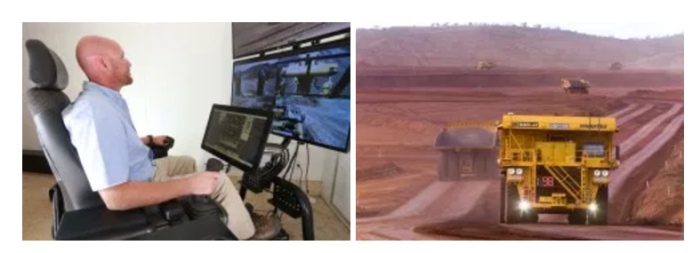
According to a Rio Tinto press release, “these driverless vehicles deliver their loads more efficiently, minimizing delays and fuel use, and are controlled remotely by operators who exert more control over their environment and ensure greater operational safety.”
Industry leaders, like Caterpillar and GE, are taking note by funding innovation at early financing rounds that are typical for corporate venture. Last year GE and Caterpillar invested in Clearpath Robotics’ $30 million Series B round to expand its fleet of autonomous mobile robots into industrial settings, like construction and mining. Previously, Clearpath’s mobile robots were primarily utilized in warehouses moving boxes and pallets around distribution centers.

This past March, Caterpillar co-hosted an industrial startup competition at SxSw’s Interactive Conference with their local dealer Holt. Leading autonomous navigation company 5D Robotics walked away with the $20,000 grand prize. 5D is currently working with United Rentals to convert their fleet of manual industrial machines into autonomous mobile robots. While Caterpillar has been working on self-driving trucks internally since the 1990s, reaching outside for innovation could be the difference in dominating the new autonomous landscape.
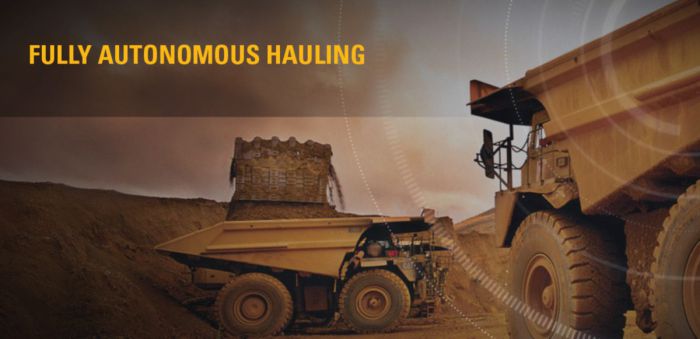
This new sentiment was reflected in its “Year In Review” investor statement: “For 90 years, Caterpillar has delivered breakthrough innovation inside our machines and engines. Today, that innovation is increasingly happening outside the machine. We’re going ‘beyond the yellow iron,’ harnessing the power of big data to offer our customers insights that decrease operating costs, increase uptime and maximize profitability.”
tags: c-Industrial-Automation, Clearpath, NSF, robots and jobs

AUAI is supported by:









