
Robohub.org
Robotics: A rich context for teaching abstract concepts
I am a retired public school teacher with a passion for robotics and I teach robotics programs for after school, home-school and public library groups to provide learning opportunities for kids outside of public education. I have joined the Robohub team to learn from some the greatest minds in robotics about the state of the art of the content that I teach, and I will be contributing posts to Robohub’s ‘Learn’ section every other week — including lessons from classes I am currently teaching, like my ‘Insect Replicants’ which include dark-activated crickets and lightning bugs. I will also be posting chapters, labs, circuits and ideas from my up-coming book, “Electronics as Magic: An Empirical Approach to Learning to Build Useful Circuits,” for your amusement and comments, including the ‘Beer Analogy’, which has always been a favorite of past students.
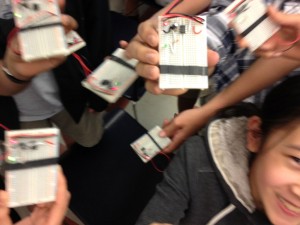
My approach to teaching basic circuit building and robotics creation improves understanding, teaches trouble-shooting and gives opportunity for controlled failure — something that is missing in traditional classes. Learning electronics at a fundamental level gives an important context to neatly packaged technologies like Arduino and Raspberry Pi. There are many add-on devices, called ‘Shields’ available, but they are ‘black boxes’ — their means of operation unknown — and to solve a specific problem, users must choose from a menu of existing devices rather than creating their own solution. Having a basic understanding of underlying principles will help them to make more informed decisions about which device to use if they do use existing technologies.
I have seen great success and retention of methods of inquiry in the students who have ‘learned by doing’ through hands-on electronics, coding and robotics. Teaching younger learners before they enter secondary school, when they are still filled with wonder, not only gets them excited about learning technology but gives them the intellectual tools to succeed at it. Finding interesting problems for kids to solve – and giving them the skills to solve those problems – makes robotics a rich ‘hook’ on which to hang complex ideas. Robotics is a context that immerses kids in real-world simulations, and learning becomes a requirement for successful completion of a game — it brings source code to life and gives a purpose to learning to code.
Besides teaching and writing, I am the founder and president of Robodyssey Systems, a company that develops programs and products for teaching STEM through robotics. I am also helping to establish Makerspaces throughout the state of New Jersey starting with a space at the Artworks, Trenton in New Jersey, USA where we will be offering classes for adults and children in physical computing and embedded controllers to enhance their means of expression. I would also like to offer classes and opportunities (both in person and via the web) to engage kids who do not have the opportunity through their public schools or the resources to afford private tutoring.
Partnering engineers with teachers makes good sense because, together, we can cooperatively develop programs that are fundamentally sound, and that are effective at teaching the kinds of skills that are needed in the field of robotics, both today and in the future. I hope that you can use some of my methods, and that you will help me to improve my programs by commenting on my posts. Thank you for inviting me to participate in this fantastic group, I hope that I can make a meaningful contribution to your efforts.
tags: c-Education-DIY

AUAI is supported by:









