
Robohub.org
RoCKIn Robot Challenge looks at task scenarios to help shape future competitions
 RoCKIn is a three-year EU project that aims to use robot competitions in order to innovate smarter, more dependable robots, and to increase public awareness of robotics. Part of its focus is to look at the ways in which competitions can benefit from being based on convincing and easy-to-communicate task scenarios. Following its kick-off RoCKIn Camp 2013 at this year’s RoboCup in Eindhoven, RoCKIn released its first challenge report, which includes several ‘user stories’: theoretical scenarios and tasks from which to stimulate discussions about the design of future RoCKIn competitions.
The ultimate goal is to make these competitions more applicable to current issues, and ensure that they result in meaningful improvements that can improve lives across the EU.
Building on RoboCup@Work and RoboCup@Home, RoCKIn is split into two challenges: RoCKIn@Work focuses on how robots could help European industry in the future, while RoCKIn@Home looks at developing domestic service robots.
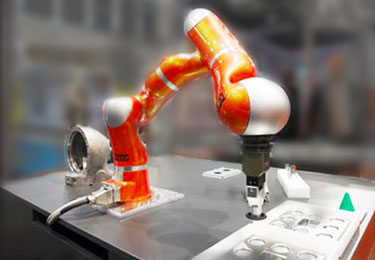
User stories that have inspired the @Work challenge predominantly focus on logistics and assembly, such as the handling of return shipments for online retailers. For this, robots might be required to open returned parcels and sort them into broad categories for human inspection to then decide if resale is possible. Another user story for the @Work challenge is set within the construction industry: creating robots that are able to spray paint areas or walls while avoiding obstacles such as windows or doors.
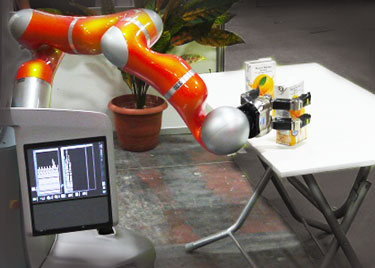
For the @Home challenge, the inspiration has come from maintaining life standards for the elderly or impaired. Robots that are able to set the table, assist with bathing, or clean the kitchen or bathroom could all offer measureable improvements to life. For example, a scenario for cleaning the bathroom might involve robots using appropriate cleaners and tools to first clean flat surfaces, then as the robots become more capable, the scenario would evolve to include edges, corners, a sink, a bathtub and eventually the entire bathroom – culminating in a safe and hygienic environment for the user. The point is for these user stories to have real life aims to make the competition as engaging and relatable as possible.
What’s your opinion? Should these be the basis for the RoCKIn competitive events? Will they promote further innovation in robotics towards RoCKIn’s aims? How would you handle the scenarios, tasks and the benchmarking of the task execution on those scenarios? Give us your feedback in the comments section below.
The full report is available here and contains all the user stories, as well as an overview of other robot competitions, definitions of key RoCKIn concepts and terminology and descriptions of general scenario features. The latter section includes an outline of RoCKIn’s ‘Functional Reference Platform’ that looks to assess the performance of robots both horizontally and vertically: that is, both across certain functionalities such as grasping as well as performance in the overall task.
RoCKIn (Robots Competitions Kick Innovation in Cognitive Systems and Robotics) will build up two competition events in 2014 and 2015, allowing teams to showcase their robotic engineering prowess through scenarios, tasks and benchmarking that are highly relevant to real world processes and the user stories aforementioned. Running alongside these will be RoCKIn Camp and RoCKIn Field Exercise events – educational and practical sessions led by the RoCKIn consortium, with the participation of leading experts in Robotics to give teams the expertise to improve and develop their creations.
Tweets about “@RoCKInChallenge”
tags: actuation, competitions, events, research, RoCKIn
AUAI is supported by:









