
Robohub.org
Summer robot reading: Fact, fiction and debatable

Ghost Fleet: A Novel of the Next World War, Rise of the Robots; Technology and the Threat of a Jobless Future and Spare Parts: Four Undocumented Teenagers, One Ugly Robot and the Battle for the Amercan Dream – new books that have recently come to market. You may find some or all of them of interest.
GHOST FLEET: A NOVEL OF THE NEXT WORLD WAR
By P.W. Singer and August Cole
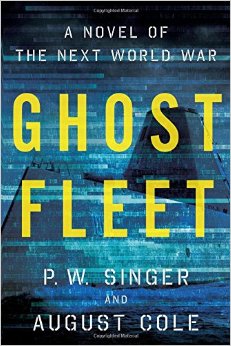
Just as in a Tom Clancy book, the authors take a horrible possibility and turn it into a complex war scenario.
They show how four technologies (and an oil reserve find) can successfully be used for bad ends: tracking the blue rays of nuclear subs, thereby making them destroyable; taking advantage of software backdoors built into chips; exploiting untrustworthy GPS data and using stolen intelligence to know which satellites to disable, which airplane maneuvers to thwart and which subs to sink, thereby crippling and making untrustworthy previously secure channels and procedures.
Then, like a Clancy novel, it becomes a story of honorable warriors (particularly on the American side) who won’t surrender and who rise beyond their previous stature to true heroes, fighting a noble cause.
Innovation and ingenuity triumph: a magnetic ray gun; using older tech with less electronics; crafty software hacks and hackers; finding a back door of our own (the Northern Passage) and adventurous billionaires spending their own money to take back what used to be ours, all coordinated into an exciting read.
Both authors are knowledgeable about war scenarios: Singer, from the technology side, as a 21st century war expert; Cole from his experiences within the State Department and DOD, and as a WSJ reporter covering national security.
Singer has already written two non-fiction tech hits: Wired for War and Cybersecurity and Cyberwar. Cole is director of the Art of War Project and Nonresident Senior Fellow at the Brent Scowcroft Center on International Security, at the Atlantic Council.
Working together, the two offer shocking insights into what we know so little about – including some of the political realities of our present global economy, the privatization of military and intelligence operations and the future of American power in the Pacific. There’s a fascinating description of an argument by shareholders and executives who don’t want to convert some of their factories and plants to government wartime work, because, as global companies, they aren’t bound to be “pawns of the government” – an astute portrayal of future problems particularly as our political system stagnates.
Unlike Clancy however, Ghost Fleet doesn’t flow smoothly or fill in purposefully omitted time gaps of which there are many. But it does do what Clancy was famous for: it uses fiction to clearly describe new military technologies and shows how and in what situations they can be used. For that reason alone this book is noteworthy and worth reading.
RISE OF THE ROBOTS: TECHNOLOGY AND THE THREAT OF A JOBLESS FUTURE
By Martin Ford
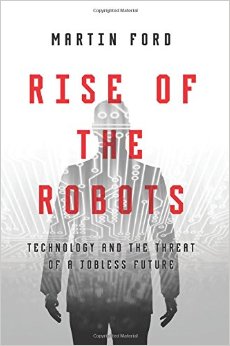
According to the Wall Street Journal: “Mr. Ford lucidly sets out myriad examples of how focused applications of versatile machines (coupled with human helpers where necessary) could displace or de-skill many jobs… His answer to a sharp decline in employment is a guaranteed basic income, a safety net that he suggests would both cushion the effect on the newly unemployable and encourage entrepreneurship among those creative enough to make a new way for themselves. This is a drastic prescription for the ills of modern industrialization—ills whose severity and very existence are hotly contested. Rise of the Robots provides a compelling case that they are real, even if its more dire predictions are harder to accept.”
The problem isn’t the technology but rather market forces. Many writers, including Ford, seem to assume that society can’t improve on the verdict of market forces. According to economist and reporter Robert Kuttner, “market forces aren’t competent to translate the productivity gains into new jobs, much less good jobs, because the demand is in the wrong place. With adequate taxation of wealth and sufficient public investment, society could readily create the new human jobs to replace the ones destroyed by automation. And the faster the rate of technological displacement, the more urgently needed is the social investment.”
The media has been paying a lot of attention to the issue of automation replacing jobs while not creating enough new ones. They warn of an impending crisis. Ford’s book contains sufficient forecast material to cover almost every occupation, industry group and country. It provides fodder for the media’s grist, debatable content to argue about with friends, and, if you can get through the whole book, it will leave you skeptical but more aware of the fact that automation is relentlessly changing the landscape of work and jobs.
SPARE PARTS: FOUR UNDOCUMENTED TEENAGERS, ONE UGLY ROBOT, AND THE BATTLE FOR THE AMERICAN DREAM
By Joshua Davis
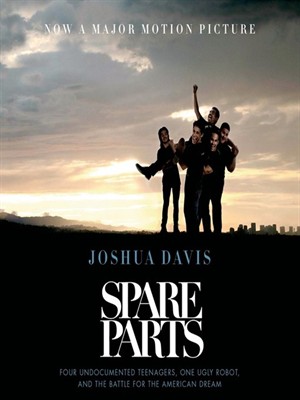
This is an inspiring story of four Mexican-American teenagers struggling to find their place by working together in an unlikely robotics competition. The story covers a lot of ground but is told with compassion and skill. It provides us with a lesson in immigration policy and Arizona politics. A movie was made from the book, but, in typical Hollywood fashion, it ended with their winning the competition. Davis’ book tells the whole story, including the hardships the four teenagers face as undocumented immigrants.
This group of high school students proved their mettle and creativity by besting the nation’s top college engineering students. Davis’ story puts in stark relief the illogical nature of our nation’s immigration laws that would deport incredibly smart and talented youth.
All four students were born in Mexico and were brought across the border illegally as children. Though they grew up in Arizona and viewed themselves as Americans, the law didn’t agree. They lived with the daily threat of deportation.
After the competition, the students struggled to afford tuition for college. Davis details their plight: Lorenzo Santillan considered becoming a mechanical engineer, but instead went for a cheaper associate degree in cooking. Today he works as a line cook. Luis Aranda studied cooking as well, but did not complete a degree and now works as a janitor. Cristian Arcega, the most technically skilled member of the team, made it to Arizona State University on a scholarship. But in 2006, Arizona voters passed Proposition 300, an anti-immigrant measure that prohibits undocumented students from receiving any state financial aid or qualifying for in-state tuition. This had the effect of more than tripling his fees. He dropped out and is now unemployed.
Oscar Vazquez’s story is the most dramatic. He also won a scholarship to A.S.U. He was a sophomore when Proposition 300 passed, and managed to stay in school only by securing more scholarships, all while leading the university’s robotics team to the regional championships. He graduated with a degree in mechanical engineering in 2009 and applied for legal residency. Not only was his application denied, but he was also summarily banned from the United States for 10 years for living here without a visa. He ended up working on an assembly line in Mexico. After a year, his ban was reversed when a US Senator from another state interceded on his behalf. Mr. Vazquez returned, enlisted in the Army, and served a tour of combat duty in Afghanistan. He is finally a citizen, and repairs trains in Montana for the railroad company BNSF.
This is a well-written, fast paced, poignant tale of STEM education at its best, politics at its worst, and good reporting because it’s all true. It is a worthwhile read.
If you liked this article, you may also be interested in:
- 20 great books to hook kids and teens on robotics
- Reading for robot fans: 24 books to inspire, educate and provoke
- Ex Machina: When Turing meets Bechdel test
- 25 gift ideas for RoboGeeks
See all the latest robotics news on Robohub, or sign up for our weekly newsletter.
tags: arts & entertainment, Spare Parts

AUAI is supported by:









