
Robohub.org
Two Horizon 2020 projects researching EU Digital Industrial Platform for Robotics

Horizon 2020 RobMoSys
Market pull for better factory automation and the ever-increasing relevance of software in every domain are triggering a rethink in how we develop software for robotics. Techniques such as Model Driven Engineering (MDE), proven effective in businesses like automotive and aerospace, can be used to this end. Practices such as collaborative development through Open-Source Software (OSS) can also be used. Two projects funded by the European Horizon 2020 research and innovation programme are exploring these opportunities, in a common foundational effort for an EU Digital Industrial Platform for Robotics.
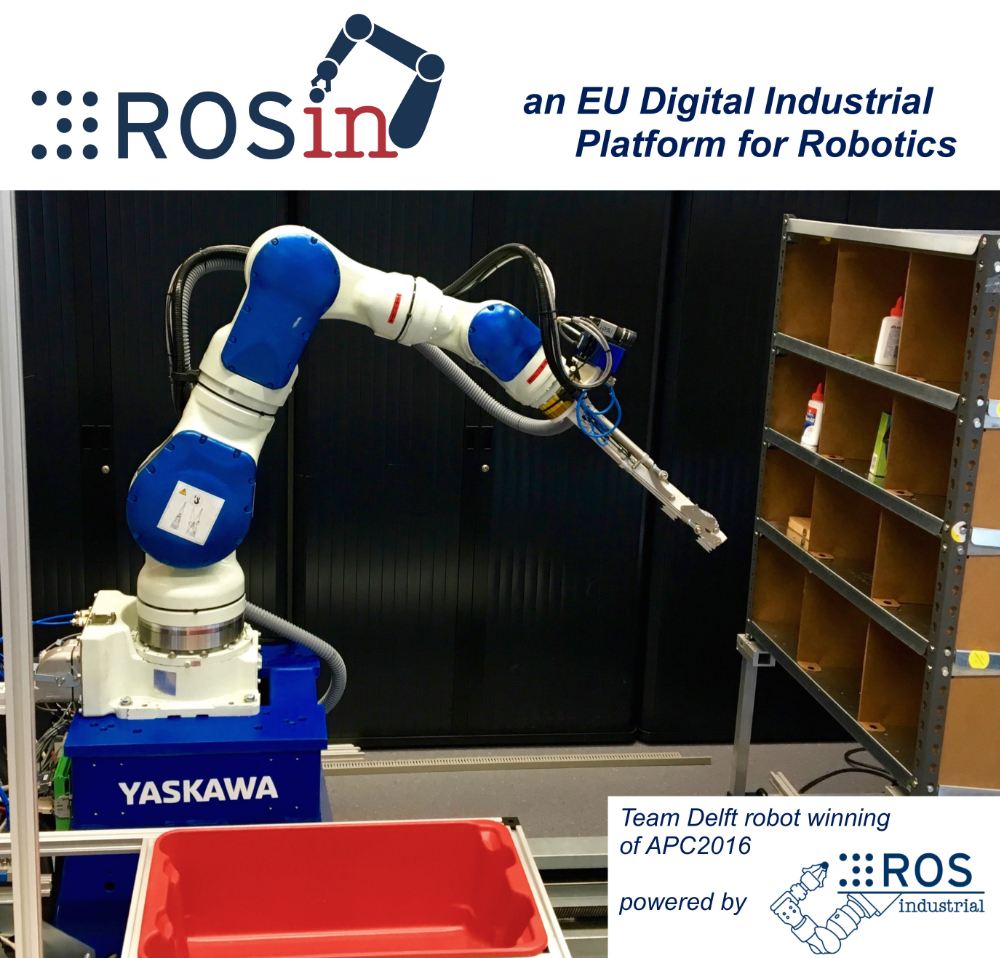
HORIZON 2020 ROSIN project.
RobMoSys, coordinated by the French Alternative Energies and Atomic Energy Commission, envisions a composition-oriented approach to system-of-system integration which is independent of the current code-centric robotic platforms, yet can build on top of them. ROSIN, led by the Delft University of Technology, aims to exploit the current momentum of the open-source Robot Operating System (ROS) and make it better, more accessible, and more relevant to industrial applications. Both projects foresee active involvement of the robotics community, as they make available through Open Calls significant parts of their budgets for third-party technical development.
RobMoSys: Composable Models for Robotics Systems
In the realm of advanced software engineering methods and tools, model-driven engineering demonstrated to be a key driver to manage system complexity in many engineering domains. RobMoSys brings to the robotics software community a model-driven support, specifically targeting the autonomous nature of robotics systems and their validation. To this end, RobMoSys adopts a composition-oriented approach that manages, maintains and assures system-level properties, while preserving modularity and independence of existing robotics frameworks and code bases.
RobMosys will engage the robotics community in this endeavour, thanks to two rounds of Open Calls. Expected results include improved tools, interoperable tool-chains and better software for an open and sustainable European robotics software ecosystem of professional quality and scope.
The RobMoSys project is coordinated by the Commissariat à l’énergie atomique et aux énergies alternatives (France). Further partners include COMAU (Italy), Eclipse Foundation Europe (Germany), EUnited AISBL (Belgium), Hochschule Ulm (Germany), KU Leuven (Belgium), PAL ROBOTICS (Spain), SIEMENS (Germany) and Technical University of Munich (Germany).
ROSIN: ROS-Industrial quality-assured robot software components
Open-Source Software for robots is a de-facto practice in academia, and its advantages can benefit industrial applications as well. The worldwide ROS-Industrial initiative has been using ROS, the Robot Operating System, to this end. In order to consolidate Europe’s dominance in advanced manufacturing, the H2020 project ROSIN will push the role of the EU within ROS-Industrial to a leading position.
It will achieve this goal through three main actions on ROS. The first one is to ensure industrial-grade software quality. Secondly, the project partners will promote new business-relevant applications. More industrial tools and components will be created and existing ones will be improved. This will be performed by making 50% of the ROSIN budget available to collaborating European users and developers for so-called Focused Technical Projects (FTPs). The third action is to support educational activities for students and industry professionals. Interested entities are welcome to apply for participation.
The ROSIN project is coordinated by TU Delft (the Netherlands), and further partners include Fraunhofer IPA (Germany), IT University of Copenhagen (Denmark), FH Aachen University of Applied Sciences (Germany), Fundacion Tecnalia Research & Innovation (Spain) and ABB AB (Sweden).
 Duration: January 1st 2017 to December 31st 2020
Funding: These projects received funding from the European Horizon 2020 research and innovation programme under grant agreements No 732410 (RobMoSys) and 732287 (ROSIN).
RobMoSys
Website: www.robmosys.eu
Project partners: Commissariat à l’énergie atomique et aux énergies alternatives (France, coordinator), COMAU (Italy), Eclipse Foundation Europe (Germany), EUnited AISBL (Belgium), Hochschule Ulm (Germany), KU Leuven (Belgium), PAL ROBOTICS (Spain), SIEMENS (Germany), Technical University of Munich (Germany)
ROSIN
Website: www.rosin-project.eu
Project partners: Delft University of Technology (The Netherlands, coordinator), Fraunhofer Institute for Manufacturing Engineering and Automation IPA (Germany), IT University of Copenhagen (Denmark), Fachhochschule Aachen University of Applied Sciences (Germany), Fundacion Tecnalia Research and Innovation (Spain), ABB AB (Sweden)
tags: Horizon 2020, research


AUAI is supported by:









