
Robohub.org
14 teams qualify for euRathlon land competition
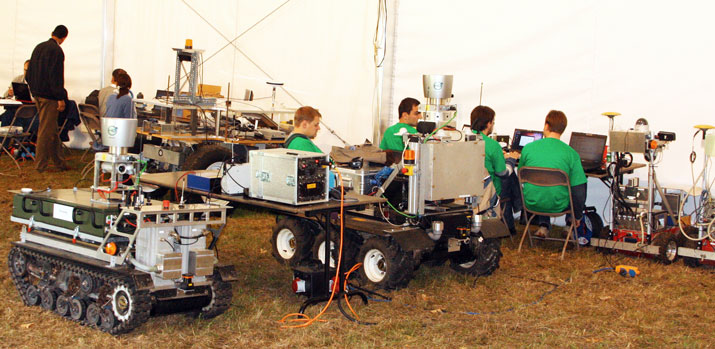
Buildings that are collapsed or on fire, tunnels flooded with smoke or water, unstructured areas subject to radiation, chemical spills or gas leaks … these are the kinds of scenarios that place emergency services personnel at great risk, and where using robots could help contain damage and minimize injury or death. euRathlon is a civilian outdoor robotics competition supported by the European Commission with a focus on realistic cooperative search and rescue response scenarios. Inspired by the 2011 Fukushima accident, the competition scenarios have been carefully designed to provide teams with realistic challenges that test their robot’s ability to face real-world situations. Fourteen teams qualified for the event. We will be providing daily coverage of the competition, which will take place in Berchtesgaden, Germany from September 23-27, 2013.
The scenarios
When designing the event, organizers asked themselves how robots could best be leveraged by emergency services personnel in a disaster scenario: How can robots be monitored from a safe distance, so that human emergency workers can focus on other important tasks? What kinds of tasks could the robots perform? Are robots ready to succeed in real-world environments? And how can we test them?
To help address these questions, the euRathlon 2013 land competition was designed around five scenarios:
- Reconnaissance and surveillance in urban structures (USAR)
- Mobile manipulation for handling hazardous material
- Search and rescue in a smoke-filled underground structure
- Autonomous navigation using GPS, GLONASS and GALILEO
- Reconnaissance and disposal of explosive devices
Descriptions of the five scenarios were published in advance of the competition to allow teams to prepare their robots. Detailed descriptions of the scenarios and potential hazards the robots would face were deliberately kept from the teams so as to keep an element of uncertainty, just like in a real world disaster.
Qualifying teams
Successfully tackling the competition scenarios is not an easy task, and prospective teams were required to take part in a qualifying process to prove that their robot(s) would be able to cope with the scenarios. Each team was required to write a Scenario Application Paper (SAP) explaining how their robot(s) would address the technical challenges of the scenarios they were planning to enter. The SAPs were reviewed to see if each team’s proposed solutions were realistic, and feedback from this process was fed back to the teams to help them prepare for the actual land competition. Here are the 14 teams that have qualified for participation in the euRathlon 2013 land competition:
- ARTOR — ARTOR is a team of researchers and technical staff from the Autonomous Systems Lab (ASL) of ETH Zürich and RUAG Defence. They will participate with their robot, also called “ARTOR” (Autonomous Rough Terrain Outdoor Robot), in the autonomous navigation scenario.
- E15 — E15 is formed by a group of 16 students from the University of Applied Sciences Esslingen, Germany. Their robot “Monique” will participate in the mobile manipulation, smoke-filled underground and autonomous navigation scenarios.
- ELP — The ELP team represents German company ELP GmbH and will participate with their robot “PAckBot EOD 510” in the USAR, mobile manipulation, smoke-filled underground and EOD scenarios.
- ENSTA Bretagne — ENSTA Bretagne is a small team of students and researchers from the Institute of ENSTA Bretagne, France. They will participate with their robot “Tracker” in the smoke-filled underground scenario.
- Fraunhofer FKIE — The team of the Fraunhofer Institute for Communication, Information Processing and Ergonomics FKIE, Fraunhofer FKIE, will participate in the USAR, mobile manipulation, and autonomous navigation scenarios with their robots: “Telemax”, “TeodorPrime” and “Garm”.
- IMM-IAIR — IMM-IAIR is a team of researchers of the Institute of Mathematical Machines in collaboration with the Institute of Automatic Control and Robotics, Warsaw, Poland. They will participate with their robot “MSAS II” in the USAR and smoke-filled underground scenarios.
- MAJIDADA – Allen Vanguard — MAJIDADA is the team of the UK- based company Allen-Vanguard. They will participate in the USAR, mobile manipulation, smoke-filled underground and EOD scenarios with the robots “Defender D2.1”, “Digital Vanguard”, “Scorpion SUGV”, “Armadillo UGV” and “Beetle NUGV”.
- MuCAR — MuCAR is the team of the University of the Bundeswehr Munich, Germany. The team develops and operates the robot vehicle “MuCAR-3” that will participate in the autonomous navigation scenario.
- NAMT — The NAMT team is formed by students and staff of two institutions, the Nizhny Novgorod Automotive Technical School (NAMT) and the Moscow State Technical University. They will participate with the robot “CyberMobile” in the autonomous navigation scenario.
- RIS — RIS is the team of the Laboratory of Analysis and Architecture of Systems (LAAS), a CNRS research unit, based in Toulouse, France. They will participate with the robots “Mana” and “Minnie” in the USAR, smoke-filled underground and autonomous navigation scenarios.
- RI Spirit – Robotics Inventions — RI Spirit is the team of Polish company Robotics Inventions. They will participate with the robot “A-Bot Light” in the USAR, mobile manipulation, smoke-filled underground and autonomous navigation scenarios.
- SCentRo — SCentRo is a team of 6 PhD students of the Sheffield Centre for Robotics (SCentRo) that was jointly established by the Sheffield Hallam University and the University of Sheffield, UK. SCentRo will participate with the robot “PIONEER P3 AT” in the “Search and rescue in smoke filled underground structure” scenario.
- SPACEAPPS — The SPACEAPPS team is formed by staff of the Belgium company Space Applications Services N.V. They will participate with the robot “MILOU” (Clearpath Husky A200) in USAR, mobile manipulation, smoke-filled underground and EOD scenarios.
- Telerob — Telerob is the team of the German-based company telerob Gesellschaft für Fernhantierungstechnik mbH trading as Cobham Mission Equipment. They will participate with the robot “Telemax” in the USAR, mobile manipulation, smoke-filled underground and EOD scenarios.
Which robots will successfully address the scenarios? Don’t miss the daily updates next week.
For pictures and more information about the teams visit: http://www.eurathlon2013.eu/information/competition/participants.html
See all the euRathlon 2013 coverage.
tags: c-Events, competition, cx-Exploration-Mining, cx-Military-Defense, cx-Research-Innovation, euRathlon, euRathlon 2013
AUAI is supported by:









