Robohub.org
5G fast and ultra-low latency robot control demonstrated
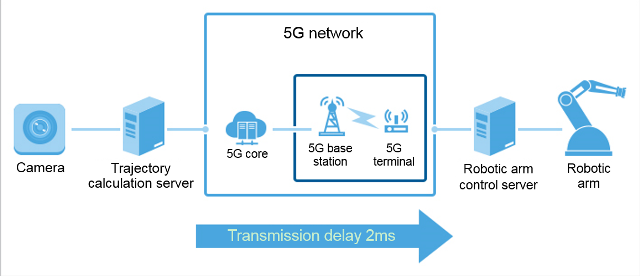
SoftBank and Huawei jointly demonstrated various use cases for their forthcoming 5G network. 5G commercial services, which will provide ultra-high throughput of over 800 Mbps with ultra-low latency transmission of less than 2ms, will begin being rolled out in 2020 in Japan and Korea and 2021-2023 in China, Europe and the U.S.
5G will (we hope) be able to handle the massive growth of IoT devices and their streaming data. With 5G technology, getting and staying connected will get easier. You’ll still need a robust network provider but your devices will learn to do things like sync or pair automatically.
When 5G comes online, around 50 billion “things” will be connected and that number will be growing exponentially. Think of self-driving cars that have capabilities to communicate with traffic lights, smart city sensor systems, savvy home appliances, industrial automation systems, connected health innovations, personal drones, robots and more.
“5G will make the internet of things more effective, more efficient from a spectral efficiency standpoint,” said an Intel spokesperson. “Each IOT device and network will use exactly and only what it needs and when it needs it, as opposed to just what’s available.”
In the SoftBank and Huawei robot demonstration, a robotic arm played an air hockey game against a human. A camera installed on top of the air hockey table detected the puck’s position to calculate its trajectory. That data was streamed to the cloud and the calculated result was then forwarded to the robotic arm control server to control the robotic arm. In the demonstration, the robotic arm was able to strike back the puck shot by the human player on various trajectories at competition speed, i.e., with no noticeable latency from camera to cloud to controller to robot arm.
Other demonstrations by SoftBank and Huawei included real-time ultra-high definition camera data compressed, streamed and the then displayed on a UHD monitor; an immersive video scenery capture from 180-degree 4-lense cameras uploaded and the downloaded to smartphones and tablets; remote rendering by a cloud GPU server; and the robot demo. Each demo was oriented to various industries, eg: tele-health, tele-education, VR, AR, CAD overlays at a remote (construction) site and the robot example which can apply to factory automation and vehicle-to-vehicle communication.
Other vendors have also demonstrated 5G use cases. Ericsson and BMW tracked a connected car at 105 mph and Verizon used 5G wireless to livestream the Indianapolis Motor Speedway in VR and hi-res 4k 360° video.
5G is coming!

AUAI is supported by: