
Robohub.org
 

AR app from docomo translates menus and signs in real time

by
10 October 2012


share this:
12-0178-r

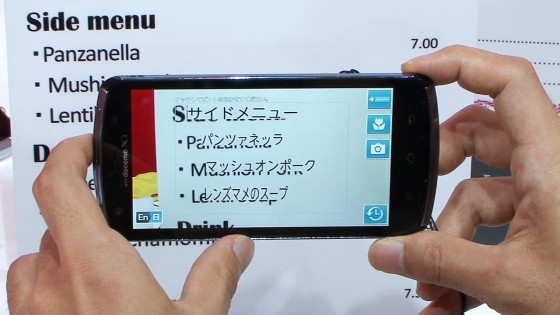
On October 11, NTT Docomo will start the Utsushite Honyaku service, which instantly translates foreign-language restaurant menus when you point a smartphone’s camera at them.

Utsushite Honyaku is a commercial version of a service that’s been available as a trial version. As well as menus, the new service can now handle signs. It works between Japanese and four languages: English, Korean and both simplified and traditional Chinese.

“For example, suppose you visit Korea, and you can’t read signs in Korean at all. You can start up this app, select the Korean dictionary, and use it just by pointing your smartphone’s camera at the writing you can’t read. The translation is shown over the Korean text, so when you use this app, it feels as if you’re looking at a sign in Japanese.”

“This service doesn’t use cloud translation, so instead, the app itself and the dictionary are downloaded to the phone. This means it can be used for free, without having to access the mobile network.”

The user can choose two translation modes. In one mode, the whole translation is superposed on the actual picture, and in the other, it’s shown line by line in a separate window.

This service can also translate from Japanese into the four languages. So, it’s helpful not only for Japanese Docomo users, but also for foreign Android smartphone users visiting Japan.



DigInfo TV is a Tokyo-based online video news platform dedicated to producing original coverage of cutting edge technology, research and products from Japan.

            AUAI is supported by:



Subscribe to Robohub newsletter on substack


Related posts :

Exploring the Moon will require rovers that can think for themselves – an upcoming NASA mission will test whether they can

  04 Sep 2026
NASA is planning to send three small rovers to the Moon to autonomously compute how to best explore a patch of ground.

Surviving the paper deluge: Notes from an ICRA panel on publishing, LLMs, and the future of peer review

Experts discuss peer-review challenges and possibilities for reshaping the process.

When expressive humanoid robots are awkward, people become wary – new brain study

  31 Aug 2026
People become more suspicious of a humanoid robot that makes errors, especially when the robot is an expressive conversation partner.

First 11 vs 11 humanoid soccer game played at RoboCup 2026

  28 Aug 2026
Watch highlights from this historic match.

How green is your robot? And other awkward questions

Robots clean rivers and sort waste, monitor ecosystems, and inspect renewable-energy infrastructure. But even the greenest robot has an environmental footprint.

These tiny drones are powered by sound

  24 Aug 2026
EPFL engineers have designed acoustic cavities that convert sound waves into thrust, propelling small robots and ultralight aerial vehicles without on-board actuators or electronics.

#AAMAS2026 blue sky award winner: Foundation world models for agents in changing environments

and   21 Aug 2026
Hear from the AAMAS 2026 Best Blue Sky Paper Award winner.

Robotics roadmaps from around the world spotlight of the month: Japan

Robots have been a prolific theme in Japanese pop culture and media since the 1950s


AUAI is supported by:


Subscribe to Robohub newsletter on substack


©2026.05 - Association for the Understanding of Artificial Intelligence








