
Robohub.org
AUVSI conference brings robots to drone debate epicenter
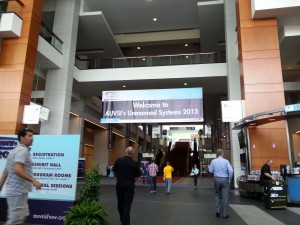
Amidst a climate of fiscal austerity and vibrant debates over the growing importance of unmanned vehicles in foreign policy and homeland security, the 2013 AUVSI Unmanned Systems Conference returned to Washington, D.C., last week after hosting the 2012 event in Las Vegas. The event was not without controversy, however, as activist group Code Pink held a demonstration outside the venue and disrupted a keynote address. The show itself was a tale of two storylines as the exhibit hall demonstrated that applications for defense and law enforcement are still the lifeblood of the unmanned systems industry, while the technical program and panel discussions pointed to a growing interest to move into commercial industries. Here’s what you missed:
UAVs as economic drivers
As expected, the Federal government’s booth presence was minimal among the nearly 600 exhibitors compared to previous years due to limited budgets. Interestingly, several states including Ohio, Minnesota, Nevada, North Dakota, Utah, Oklahoma, New Mexico, and Arizona were present to promote their economic programs and bids as one of six test sites under the FAA’s UAS integration program. Approved sites will attract unmanned aerial vehicle manufacturers as the FAA begins to open U.S. airspace in 2015. North Dakota Lieutenant Governor Drew Wrigley and U.S. Congressman Mike Turner (R-Ohio) made special visits to the conference to further promote their respective states. States will become increasingly important for manufacturers as Defense procurements slow and commercial markets are opened.
Big and small vendors showcase new platforms
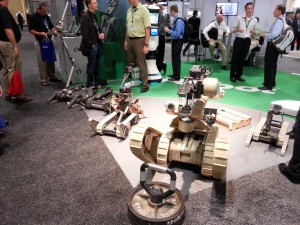
Among exhibitors, the vast majority of platforms continue to be fixed-wing aerial vehicles of various sizes. The big players of General Dynamics, Lockheed Martin, and Northrop Grumman showed the latest in drone technology, including a model of Northrop’s X-47B, which just this past July achieved a historic result by autonomously landing on the flight deck of the USS George H.W. Bush. Several quadrotor vendors were also present to market easy-to-use and agile systems for law enforcement. I was particularly impressed by systems from Aeryon Labs and navigation systems from Airware. While last year we were introduced to the unique ground platforms from Boston Dynamics such as the LS3 and RHex, no particular system stole the show this year. It was nice to see iRobot’s RP-VITA out and about with live telepresence demonstrations, however. Among maritime systems, California-based Liquid Robotics brought along “Benjamin Franklin,” recently returned from a Guinness World Record-setting 14,703 km data collection journey across the Pacific Ocean.
Self-driving cars, the future?
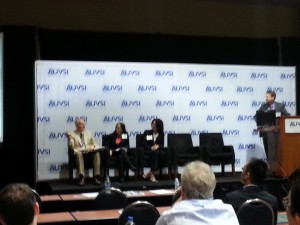
But it was the push toward applications in agriculture and self-driving cars that attracted the most attention and excitement among technical program attendees. The automated driving panel featured a lively discussion from panelists Chuck Thorpe, Clarkson University Provost and former Carnegie-Mellon University Robotics Institute head; Virginia Tech researcher Myra Blanco, and consultant Annie Lien. Chief among the discussion topics was the role of states in regulating self-driving cars. While California, Nevada, and others are helping get these vehicles onto roads, this approach will hinder progress and development, according to Ms. Lien. “Safety requirements are normally defined at the federal level,” she noted. Different regulations for each state will eventually create a logistical and legal headache for manufacturers and consumers alike.
Though Google and car manufacturers are making significant progress in developing and testing the necessary technologies for fully autonomous systems, the panelists noted that they are taking very different approaches toward market introductions. Among the four defined levels of autonomous cars, with level 0 being manual and level 4 being full autonomy in unstructured road conditions, panelists suggested Google is aiming directly for level 4 within five years while BMW, Mercedes and others are gradually introducing new features in time-tested industry fashion. For example, some 2014 year models will feature traffic jam assistance that will facilitate self-driving with minimal intervention in stop-and-go situations.
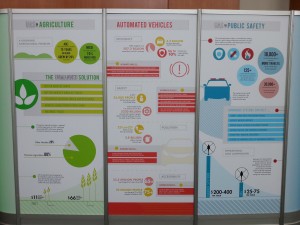
So where will we be by 2020? The panelists seemed to converge on the certainty of level 3 market availability, but with complex socio-technical systems such as transportation, that is still anyone’s guess. Thorpe summed it up fairly well by suggesting it is always more difficult to transform an existing industry than creating a new one. Aside from the technology and safety regulations, we are only now considering the larger societal questions such as urban sprawl: if you could work or sleep while the car autonomously drove during your commute, would you live farther away?

tags: analysis, c-Events, cx-Military-Defense, cx-Politics-Law-Society, policy

AUAI is supported by:









