Robohub.org
 

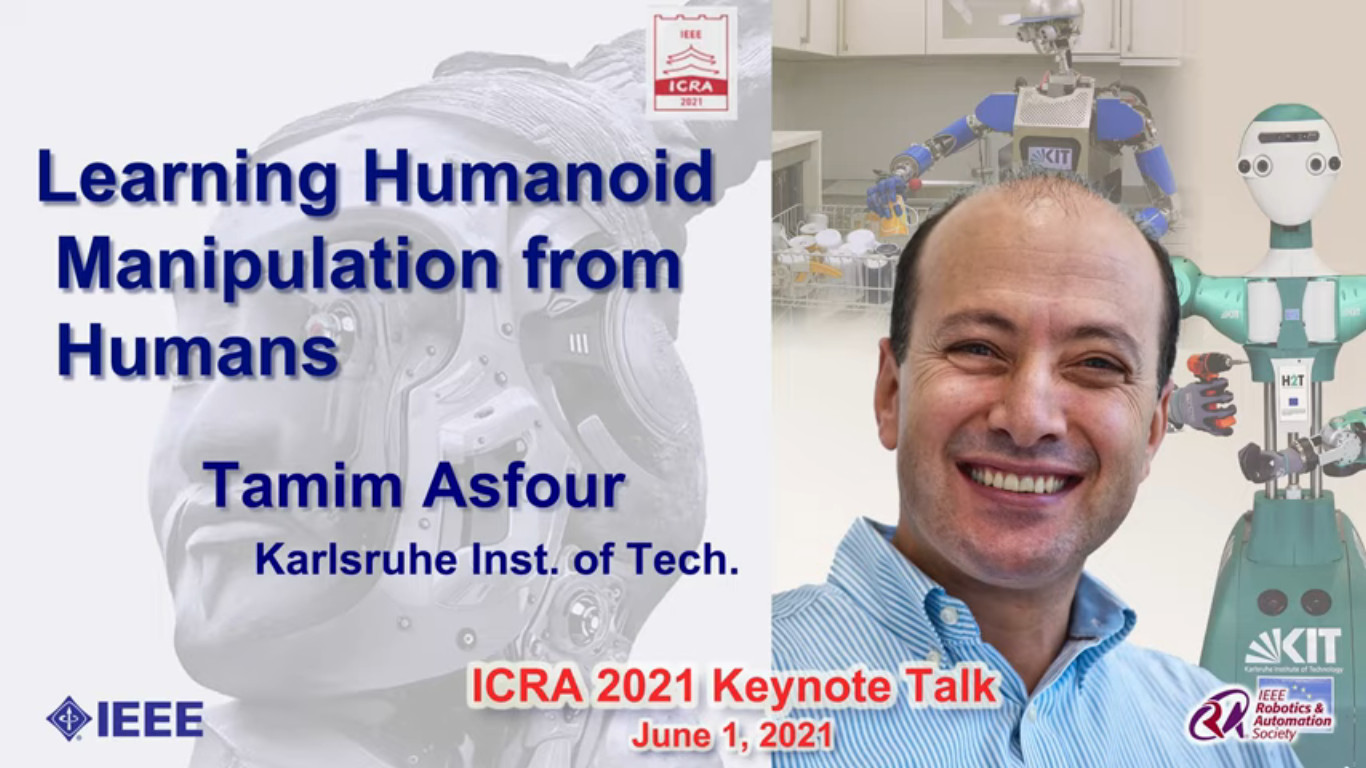
Tamim Asfour’s Keynote talk – Learning humanoid manipulation from humans

Through manipulation, a robotic system can physically change the state of the world. This is intertwined with intelligence, which is the ability whereby such system can detect and adapt to change. In his talk, Tamim Asfour gives an overview of the developments in manipulation for robotic systems his lab has done by learning manipulation task models from human observations, and the challenges and open questions associated with this.

Bio: Tamim Asfour is full Professor at the Institute for Anthropomatics and Robotics, where he holds the chair of Humanoid Robotics Systems and is head of the High Performance Humanoid Technologies Lab (H2T). His current research interest is high performance 24/7 humanoid robotics. Specifically, his research focuses on engineering humanoid robot systems integrating the mechano-informatics of such systems with the capabilities of predicting, acting and learning from human demonstration and sensorimotor experience. He is developer and the leader of the development team of the ARMAR humanoid robot family.


tags:


Daniel Carrillo-Zapata was awared his PhD in swarm robotics at the Bristol Robotics Lab in 2020. He now fosters the culture of "scientific agitation" to engage in two-way conversations between researchers and society.

IEEE Robotics and Automation Society (RAS) strives to advance innovation, education, and fundamental and applied research in robotics and automation

            AUAI is supported by:


Subscribe to Robohub newsletter on substack


Related posts :

Mars rovers give scientists a ground-level view of the red planet – peek inside their NASA control room

  21 Sep 2026
NASA created Curiosity to search for evidence of ancient habitable environments.

Reimagining robotics for sustainability

  18 Sep 2026
"Our ambition is not to simply make robots more sustainable; they must actively contribute to solving sustainability challenges."

Watch the ICRA keynote and plenary talks

  16 Sep 2026
If you missed the conference you can catch up on IEEE TV.

Building and programming autonomous robots at the York Micromaze Hackathon

and   11 Sep 2026
From 25–27 August, UK RAS STEPS members came together for a three-day Micromaze Robot Hackathon.

Robotics roadmaps from around the world spotlight of the month: United States of America

US robotics researchers and industry are looking for a cohesive national robotics strategy.

Could robots help tackle loneliness? BBC’s Ann Droid raises questions about the future of care

  07 Sep 2026
While the series exaggerates what robots can currently do, some of the technology it depicts is already being tested.

Exploring the Moon will require rovers that can think for themselves – an upcoming NASA mission will test whether they can

  04 Sep 2026
NASA is planning to send three small rovers to the Moon to autonomously compute how to best explore a patch of ground.


AUAI is supported by:


Subscribe to Robohub newsletter on substack


©2026.05 - Association for the Understanding of Artificial Intelligence